



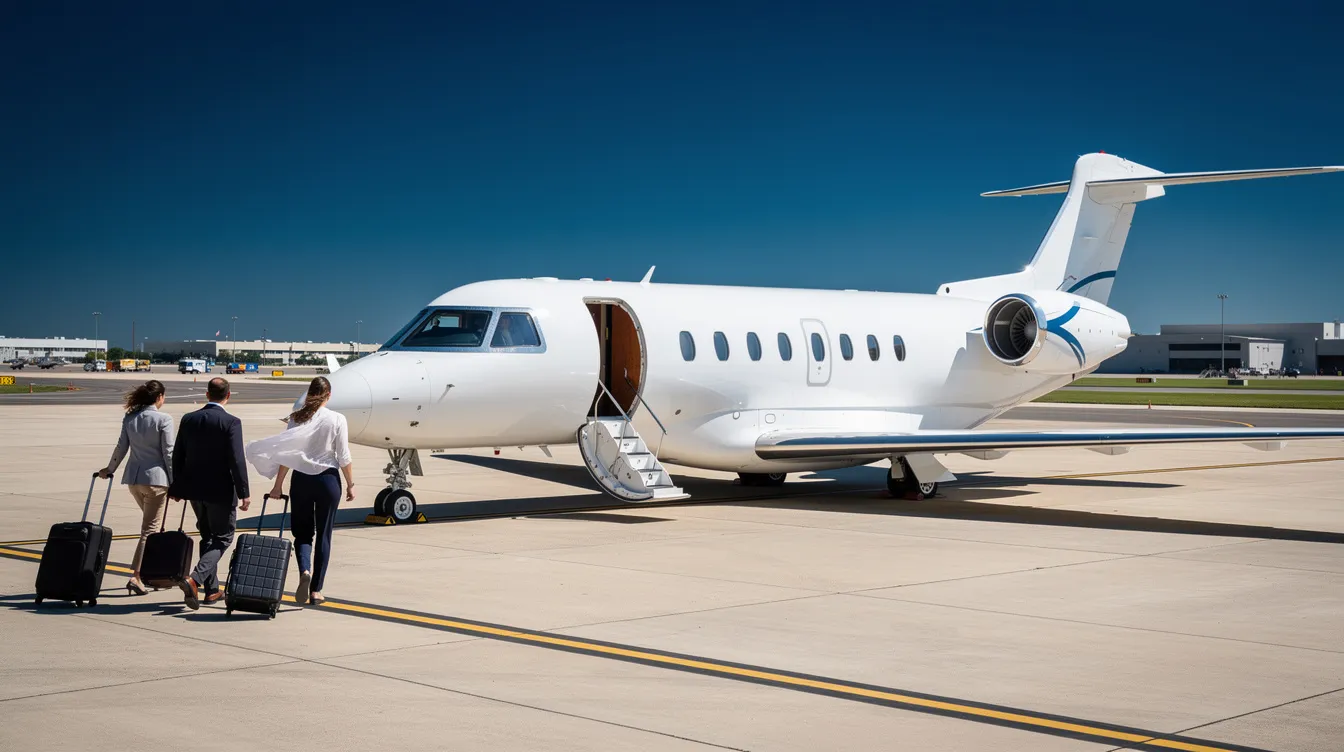
Quick Guide: How to Compare Private Jets for Your Next Charter Flight
If you're exploring private aviation for the first time, the sheer number of jet types, price points, and cabin configurations can feel overwhelming. Take a breath. This guide breaks private jet comparisons into clear, concrete steps so you can make informed decisions without stress.
Comparing private aircraft goes beyond price. Range, cabin space, airport access, cruise speed, and how the flight will physically feel (noise, turbulence perception, takeoff and landing sensations) all matter. Private jets are categorized into seven basic types, grouped by size, range, and capability, and each type creates a different passenger experience.
Digital platforms now function as an aircraft comparison tool, letting you compare aircraft side by side before contacting a broker. They display cabin dimensions, seating, range, and hourly rates in one view, which saves hours of research.
Before you open any comparison tool, settle these four things first as part of the comparison process:
-
Passenger count: How many people, including children and crew needs?
-
Distance and route: How far, and which airports work for departure and arrival?
-
Baggage: Standard luggage, or oversized items like skis, golf clubs, or medical equipment?
-
Budget: Total budget for the flight, including potential repositioning and handling fees?
Key factors for selecting a private jet include trip length, group size, and airport accessibility. Private flights come with a simpler check-in process and fewer lines, and private jets allow travelers to choose their own departure time, which already reduces travel stress.
Every certified private aircraft, from a very light jet to a heavy jet, meets FAA, EASA, or equivalent safety standards. The differences across categories are comfort, range, and cost, not safety.
Once you've chosen your jet, SkyGuru can help you understand what you'll feel and hear on board: turbulence forecasts, noise explanations, and real-time flight stage updates, all designed to reduce flight anxiety.
How to Compare Private Aircraft at a Glance
A good aircraft comparison starts with your mission: where you're flying, when, with how many people, and what level of comfort you need. Private jets are used to provide rapid and convenient travel for various passenger needs, so defining yours narrows the field fast.
Here are the key specifications to compare for any private charter:
-
Seating and passenger capacity
-
Cabin height, width, and length
-
Range in nautical miles
-
Cruise speed
-
Runway requirements (access to short runways or only major airports)
-
Luggage space
-
Hourly charter rate
-
Onboard features: Wi-Fi, full galley, enclosed lavatory, lie-flat beds, flight attendant
Published range assumes ideal conditions: light load, no headwind, optimal altitude. Weather, winds, and payload can reduce real-world range by 10% to 30%. This is why brokers sometimes recommend a slightly larger jet than what the minimum published range suggests.
Concrete example: Light jet vs mid size jet, New York to Miami (2026)
|
Spec |
Light Jet (Phenom 300) |
Mid-size Jet (Citation Latitude) |
|---|---|---|
|
Seats |
~6 |
~8 |
|
Cabin height |
~1.50 m (no stand-up) |
~1.80 m (stand-up) |
|
Flight time |
~2.5 hours |
~2.5 hours |
|
Approx. charter cost |
$12,000–$16,500 total |
$16,000–$22,500 total |
|
Turbulence feel |
More noticeable |
Smoother, heavier airframe |
Many platforms marketed as a comparison tool let you filter by passenger count and range, but a human advisor or pilot adds context about comfort and likely turbulence that spreadsheets cannot.
Private Jet Categories and Typical Use Cases
Private jets range from compact very light jets to converted executive airliners. Each category differs in range, passenger capacity, cabin volume, and hourly rate, which means each is suited to a different mission profile.
Typical use cases in plain language:
-
Weekend city break (1–2 hours): Very light jets or light jets
-
Coast-to-coast business trip (4–5 hours): Mid-size or super mid-size jets
-
Overnight transatlantic (7–10 hours): Large jets or ultra long range jets
-
VIP group or touring company (15–40 passengers): Executive airliners
Turboprop aircraft sit alongside VLJs as a cost-effective option for short, slower flights under about 500 miles, but the core of this private jets comparison focuses on pure jet aircraft.
Nervous flyers often find that larger cabins, higher cruise altitudes, and smoother rides on midsize jets, super mid jets, and large jets are worth the added cost. Even if a light jet covers the distance, the physical experience in a heavier airframe can be noticeably calmer, which is particularly important for travelers dealing with fear of flying.
The sections below walk through each main category with concrete models and 2026 pricing. For a deeper look at how to choose the right aircraft model, we have a separate guide.
Very Light Jets: When the Smallest Private Jets Make Sense
Very light jets are the smallest private aircraft with jet engines, bridging the gap between turboprop aircraft and light jets for short regional trips.
Typical VLJ numbers: A VLJ typically seats 2 to 4 passengers (some configurations up to four passengers comfortably), flies 800 to 1,200 miles, and cruises at roughly 340 to 390 mph. Very Light Jets typically accommodate 4 to 5 passengers and have a range of 1,000 to 1,200 nautical miles. Luggage space is limited. Most VLJs have no dedicated flight attendant and sometimes only a basic or semi-enclosed lavatory.
2026 model examples:
-
Embraer Phenom 100EV: seats ~4, range ~1,200 nm, cruise ~405 knots
-
Cessna Citation Mustang: seats ~4, range ~1,143 nm, classic VLJ for short hops
-
HondaJet HA-420: seats ~4, range ~1,547 nm, innovative noise and drag reduction
Ideal use: short city pairs like Los Angeles to Las Vegas, London to Zurich, or Dallas to Houston, where a small team wants speed and privacy more than cabin space. Very light jets can access airports with short runways, getting you closer to your final destination.
For a nervous flyer, VLJs feel more "sporty." Cabin noise is more noticeable. Because VLJs have less mass and smaller wings, turbulence produces sharper accelerations than in a heavier aircraft. Charter rates average $2,000 to $3,000 per flight hour for very light jets. They may look cheapest in an aircraft comparison tool, but they are not ideal for long flights or flyers who are sensitive to turbulence.
Light Jets and Super-Light Jets: The Workhorses of Private Charter
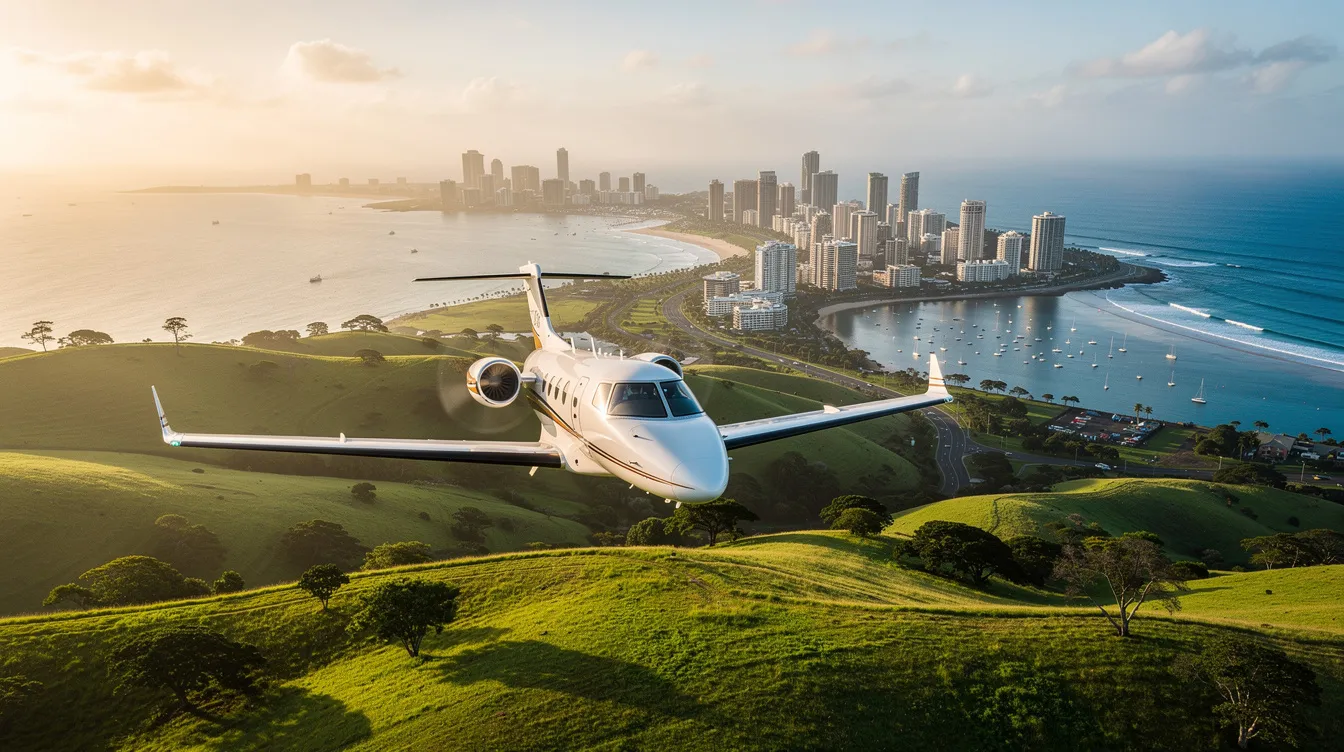
Light jets are among the most commonly chartered private jets worldwide for trips under about three hours. They offer a strong balance of cost, access, and comfort.
Light jets typically seat 6 to 8 passengers (often up to eight passengers in club-seating layouts) with a range of 1,400 to 2,500 miles. Cruise speed runs 430 to 500 mph. Most have an enclosed lavatory and good access to smaller airports, though usually no dedicated flight attendant.
Super light jets are an upgraded subset with more cabin space and extended range up to around 3,000 miles, still more economical than midsize jets.
Popular models:
-
Cessna Citation CJ3+: strong runway performance, seats 7
-
Embraer Phenom 300E: one of the best-selling light jets globally, range ~1,800 nm
-
Bombardier Learjet 45XR: wider cabin for its class, good for longer legs
Passenger experience: moderate cabin height (often no true stand-up room), comfortable seating for four to six people, and takeoff and climb sensations similar to commercial jets but in a quieter, more private environment.
Charter rates average $2,600 to $4,250 per flight hour for light jets at the base level. At the higher end of the light jet market, hourly charter rates for light jets range from $7,722 to $8,502. Light jets often show the best value in an aircraft comparison for small groups on flights like New York to Chicago or Paris to Barcelona. If you're a first-time private flyer, a light jet is often the entry point.
Midsize and Super Midsize Jets: Comfort and Range for Longer Missions
Mid-size jets and super midsize jets are the sweet spot when travelers want stand-up cabins, longer range, and quieter, more stable flights without jumping to heavy jet pricing.
Mid-size jets can carry 7 to 9 passengers over 3,000 miles. They offer stand-up cabins and enclosed lavatories, larger baggage capacity, and better sound insulation than light jets. Cruise speed approaches 530 mph. Mid-size jets cost approximately $5,500 to $7,500 per hour to charter.
Super-Midsize jets typically accommodate 8 to 10 passengers and have a range of 3,200 to 3,600 nautical miles. Some super midsize jets achieve near-Mach cruise speeds (0.82 to 0.90), and several can fly transatlantic routes. Super mid-size jets have hourly rates between $7,500 and $9,500.
Model examples:
|
Aircraft |
Category |
Seats |
Range |
Standout Feature |
|---|---|---|---|---|
|
Citation Latitude |
Mid size |
9 |
~2,700 nm |
Stand-up cabin, flat floor |
|
Learjet 60XR |
Mid size |
8 |
~2,590 nm |
1.73 m cabin height |
|
Challenger 350 |
Super mid |
10 |
~3,200 nm |
Transcontinental range |
|
Gulfstream G280 |
Super mid |
10 |
~3,600 nm |
High cruise altitude |
|
Citation Longitude |
Super mid |
9 |
~3,500 nm |
Low cabin noise |
For anxious passengers, these jets offer more headroom, smoother turbulence response due to higher weight, quieter cabins, and better temperature and lighting control. You can fly coast to coast (Los Angeles to New York) or across Europe (Lisbon to Moscow) without a fuel stop.
When comparing super mid vs mid size in an aircraft comparison, the deciding factors are usually range, cabin dimensions, and whether the mission requires nonstop capability over 3,000 miles.
Large Jets, Heavy Jets, and Ultra-Long-Range Private Jets
Large jets and heavy jets are built for intercontinental travel and high-end comfort, with multiple cabin zones and usually a dedicated flight attendant on board.
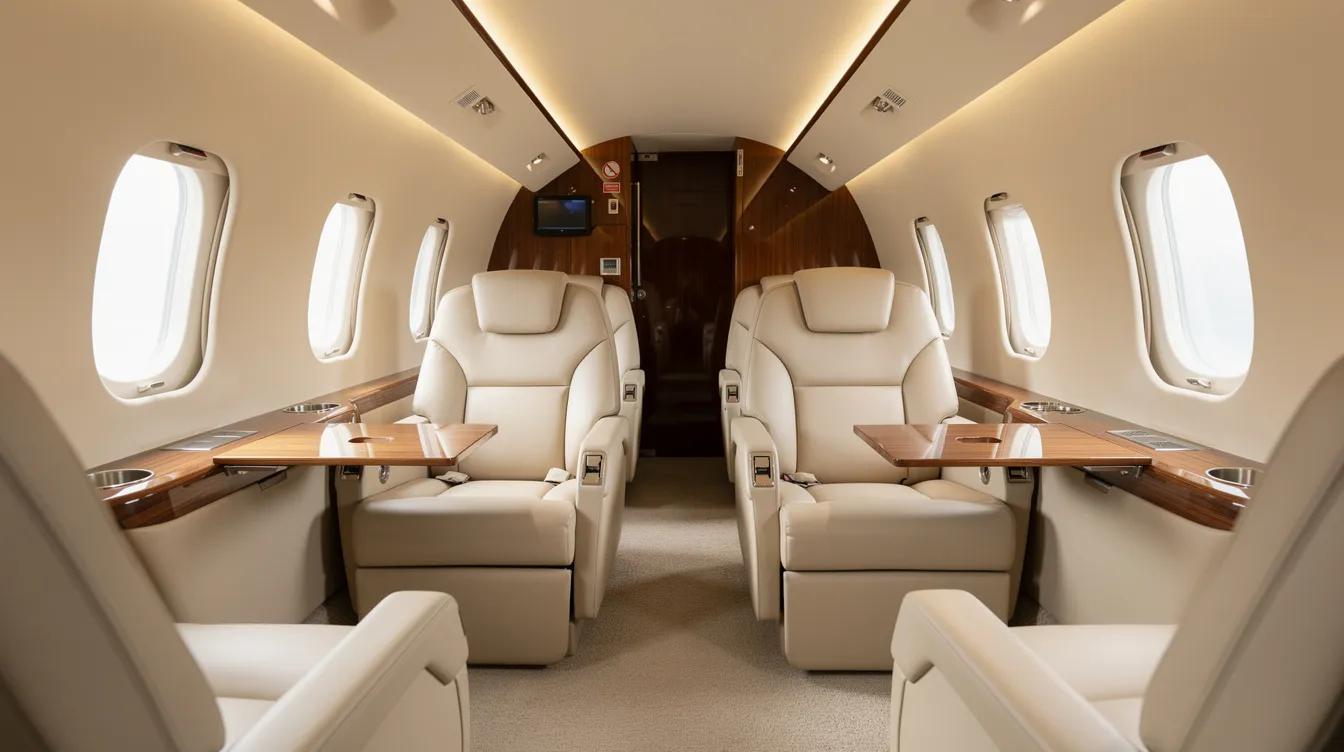
Heavy jets typically accommodate 10 to 16 passengers and have a range of 4,000 to 5,000 nautical miles. Large jets can accommodate up to 13 passengers and travel 5,500 miles. Cabins feature stand-up height (1.8 to 2.0 m), lie-flat beds, a full galley, multiple lavatories, and advanced entertainment with Wi-Fi. Charter rates start around $6,000 to $14,000+ per flight hour for heavy jets.
Ultra-long-range jets push further. Ultra-Long-Range jets typically accommodate 12 to 19 passengers and have a range of 6,000 to 8,000 nautical miles. Ultra-long-range jets can fly up to 8,000 nautical miles nonstop, enabling routes like New York to Hong Kong or London to Singapore without a fuel stop. Ultra-long-range jets can cost $13,000 to $20,000+ per hour.
Key examples:
-
Gulfstream G650ER: seats ~13, range ~7,500 nm, one of the fastest large-cabin jets
-
Bombardier Global 7500: accommodates approximately 19 passengers, with a range of around 7,700 nautical miles, featuring four distinct living areas
-
Dassault Falcon 7X: seats ~12, three-engine design for added redundancy and steep-approach capability
From an anxiety perspective, these jets are the most reassuring. More room to move, quieter and more stable at high cruise altitudes (FL 430 to FL 510), better sleep arrangements, and constant access to a flight attendant who can explain what's happening. Private jets can provide considerable comfort for long-distance travel, and heavy and ultra-long-range aircraft represent the highest expression of that comfort.
In an aircraft comparison tool, these jets appear expensive, but they are the only practical choice for long nonstop sectors or larger groups needing maximum cabin space.
Executive Airliners and Bizliners: When You Need a Flying Hotel
Executive airliners (bizliners) are converted commercial aircraft like the Boeing 737 BBJ and Airbus A319CJ, used by heads of state, touring artists, and large corporate or VIP groups.
Typical capacity runs from around 19 to 48 passengers in luxury configurations. Cabins can include multiple bedrooms, lounges, conference rooms, full-size showers, and dining areas. A Boeing BBJ retains the wide-body feel of a 737 but replaces rows of economy seats with open living spaces. An Airbus A320 corporate jet offers similar flexibility with a wider fuselage cross-section.
Hourly charter rates often run $20,000 to $30,000+ per hour in 2026, placing them at the top end of any private jet comparison table. These are niche options for missions where aircraft size, luxury, and show matter.
For an anxious flyer within a group, executive airliners often feel most like a traditional commercial flight, but with fewer unknowns and more control over timing and environment. Multiple flight attendants, wide aisles, and a very stable sensation in the air reduce stress. Private jets provide a more comfortable flying experience than commercial flights, and bizliners take that to the extreme.
Comparing Costs and Access Models in Private Aviation
When people compare aircraft, they're often also comparing how to access them. Private jets vary in operating costs based on size, range, and passenger capacity, but the access model you choose shapes total cost just as much.
-
Outright ownership: Highest capital cost. Ongoing expenses include crew, hangar, maintenance, and insurance. Only cost-efficient for operators logging well over 300 to 400 hours per year.
-
Fractional ownership: You buy a share of a new aircraft as one of several aircraft owners, with monthly management fees and hourly usage costs. Fractional ownership requires flying 200+ hours per year to justify costs.
-
On-demand private charter: Pay per trip, no long-term commitment. Ideal for 10 to 150 hours per year. Digital platforms now act like an aircraft comparison tool across fleets and operators. Platforms like Jettly help users make informed charter decisions by consolidating fleet data.
-
Jet cards and memberships: Prepaid hours at fixed rates with priority access. For a detailed breakdown, see our best private jet membership programs guide or use our jet card comparison tool.
-
Empty leg flights: Repositioning flights sold at a discount; great savings but limited flexibility.
Sometimes spending a bit more on a midsize or super mid jet brings disproportionately more comfort and peace of mind than the cheapest possible option, especially for nervous travelers.
Comfort, Cabin Experience, and Flight Anxiety Across Jet Types
This section is for anyone comparing jets not just by price, but by how the flight will feel physically and emotionally.
Cabin height, seat layout, and noise levels improve as you move from very light jets up through large jets and executive airliners. For claustrophobic or anxious passengers, the difference between a 1.3 m VLJ cabin and a 1.8 m heavy jet cabin changes the entire experience.
Turbulence perception differs by aircraft size. Larger, heavier jets have greater inertia: the same gust of air that jolts a light jet barely registers in a Gulfstream G650ER. Higher cruise altitudes (FL 400 to FL 450 in heavy jets) also mean thinner, smoother air. The aircraft remains structurally safe in either case, but the physical sensation is different.
Amenities that reduce anxiety on flights longer than two to three hours:
-
A dedicated flight attendant who can explain noises and sensations
-
A proper galley for meals and hot drinks
-
Larger lavatories with more privacy
-
Lie-flat beds for rest on overnight sectors
Practical tips for nervous flyers on any private jet:
-
Choose seats near the wings for less motion
-
Keep your seatbelt loosely fastened during cruise
-
Use noise-reducing headphones
-
Tell the crew you're a nervous flyer so they can offer extra reassurance
After you choose your aircraft and route, entering your flight in the SkyGuru app gives you real-time explanations of noises, sensations, and turbulence forecasts on your phone. Knowing what's coming next reduces the startle response and turns uncertainty into calm.
Using an Aircraft Comparison Tool Without Getting Overwhelmed
Modern comparison tools display dozens of data points at once. Without a clear priority, that volume of information increases anxiety instead of reducing it.
When using any aircraft comparison tool, follow this priority order:
-
Safety and operating standards: Confirm the operator is certified (FAA Part 135, EASA AOC, or equivalent).
-
Range vs route distance: Does the jet cover your route nonstop, with reserve?
-
Passenger and baggage capacity: Will everyone fit with their luggage?
-
Cabin comfort: Stand-up height, lavatory, seating layout, noise level.
-
Price: Hourly rate plus estimated fees.
Some tools compare over 300 aircraft types side by side and include performance specs and cabin dimensions for each. Users can view key specifications of three jets simultaneously, which is a good limit. Comparing more than three at once often leads to decision fatigue.
Talk with a broker, operator, or pilot to translate technical numbers into real-world sensations. Ask about turbulence patterns on your route, typical cruise altitudes for the aircraft you're considering, and climb rate during departure.
Most tools focus on performance and price. SkyGuru complements them by focusing on the passenger's emotional experience once the flight is booked, making the entire private aviation journey, from comparison to touchdown, more predictable and reassuring.
FAQs: Private Jets Comparison and Choosing the Right Aircraft
Q1: What is the difference between a very light jet and a light jet?
Very light jets (VLJs) are smaller, seating 2 to 4 passengers with shorter range (800-1,200 miles) and limited amenities. Light jets are larger, seating 6 to 8 passengers, with longer range (1,400-2,500 miles) and usually include enclosed lavatories.
Q2: How do I know which jet category is best for my trip?
Consider your trip length, passenger count, baggage needs, and budget. Short trips with few passengers suit VLJs or light jets, while longer trips with more passengers may require mid-size, super mid-size, or heavy jets.
Q3: Are private jets safer than commercial flights?
All private jets operate under strict FAA, EASA, or equivalent safety standards. Safety differences between jet categories are minimal; differences lie mainly in comfort, range, and cost.
Q4: Why do larger jets feel smoother during turbulence?
Heavier jets have greater inertia, so they respond less noticeably to air gusts. They also cruise at higher altitudes where the air is thinner and less turbulent, providing a calmer ride.
Q5: Can I charter a private jet on short notice?
Yes, many operators and platforms like Jettly can source jets within 24-48 hours, though availability and aircraft choice may be limited.
Q6: What amenities reduce anxiety on longer private flights?
Amenities like a dedicated flight attendant, enclosed lavatories, lie-flat beds, Wi-Fi, and a full galley can improve comfort and reduce anxiety on flights longer than two to three hours.
Q7: How do hourly charter rates vary by jet type?
Very light jets typically cost $2,000 to $3,000 per flight hour, light jets $2,600 to $8,500, mid-size jets $5,500 to $7,500, super mid jets $7,500 to $9,500, heavy jets $6,000 to $14,000+, and ultra-long-range jets $13,000 to $20,000+ per hour.
Q8: What should I prepare before using a private jet comparison tool?
Have your departure and arrival cities, travel dates, passenger count, baggage details, and any special needs ready to get accurate and relevant aircraft options.
Q9: Are all private jets equipped with Wi-Fi and lie-flat seats?
No, amenities vary by jet category and model. Mid-size and larger jets are more likely to have Wi-Fi and lie-flat seating, while smaller jets may have limited connectivity and simpler interiors.
Q10: How does fractional ownership compare to on-demand charter?
Fractional ownership involves buying a share of an aircraft with fixed and hourly costs, beneficial if you fly 200+ hours per year. On-demand charter requires no ownership and is cost-effective for less frequent flyers.
Choosing the Right Jet for Your Next Trip: Practical Scenarios and Final Checklist
Three common scenarios:
-
2-hour regional business hop (e.g., Chicago to Nashville): A light jet or even a VLJ covers the distance. Cost-effective, quick, access to smaller airports.
-
5-hour coast-to-coast trip (e.g., New York to Los Angeles): Midsize or super-mid jets offer nonstop range, stand-up cabins, and a smoother ride for the longer distance.
-
10-hour overnight intercontinental flight (e.g., London to Dubai): Heavy jets or ultra-long-range jets with lie-flat beds, a full galley, and a flight attendant.
Simple decision path:
-
Under 2 hours, fewer than 5 passengers → very light or light jets
-
3 to 5 hours, 6 to 8 passengers → midsize or super mid jets
-
7 to 12 hours, 9+ passengers → large, heavy, or ultra-long-range jets
-
15 to 30+ passengers → executive airliners
Pre-booking checklist:
-
Route and dates (flexibility on departure time?)
-
Number of passengers
-
Luggage type (standard bags, skis, golf clubs, medical equipment?)
-
Cabin preferences (stand-up height, Wi-Fi, lie-flat beds?)
-
Comfort needs for nervous flyers (noise sensitivity, turbulence concern?)
There is no single "best" private jet, only the best jet for your mission and comfort level. All modern private aircraft in commercial service operate under strict regulatory oversight.
Understanding aircraft categories and what they mean for your in-flight sensations turns private jet comparison from something overwhelming into a clear, step-by-step choice. Flying becomes less stressful when you know both your aircraft and what to expect in the air.
Once you've chosen an aircraft and booked your private charter, download SkyGuru, enter your flight details, and use the app as an in-flight guide to turbulence, noises, and flight stages. Your next trip can feel informed, predictable, and much less stressful.
Learn more about managing flight anxiety.
Explore detailed turbulence-explained insights to ease your mind.
Discover our best seats for nervous flyers guide for a calmer flight.
Check out our flight preparation tips to get ready with confidence.
FLEET SELECTION
JET CARDS
COST ANALYSIS


How to Auditing Your Operator's Maintenance Logs
Oct 05, 2025

How to Auditing Your Operator's Maintenance Logs
Oct 05, 2025

How to Auditing Your Operator's Maintenance Logs
Oct 05, 2025
Sky Guru Weekly
The smartest private aviation intelligence in your inbox.
.svg)

