


Membership model with app-first booking and competitive pricing.

Membership model with app-first booking and competitive pricing.
The total cost of fractional ownership includes much more than the initial purchase or the occupied hourly rate. Buyers should consider acquisition costs, recurring management fees, variable operating expenses, financing, depreciation, taxes, and eventual resale value to understand the full financial commitment.
.png)
Purchase an ownership percentage instead of the entire aircraft.
.png)
Larger shares generally provide more annual flight hours.
.png)
Recurring operational costs paid regardless of utilization.
.png)
Flight-specific operating charges.

Most programs operate under multi-year ownership agreements.
.png)
Potential value recovered when the ownership share is sold.
.png)
Conditions and timelines for selling your ownership share back.
.svg)
Every provider is evaluated using the same editorial framework designed to measure long-term owner value rather than marketing claims.
The upfront investment required to purchase a fractional ownership share.
Examples
• Aircraft share purchase
• Ownership agreement
• Initial acquisition costs
Full cost analysis & scoring methodology across all
ownership programs
.svg)
Every provider is evaluated using the same editorial framework designed to measure long-term owner value rather than marketing claims.
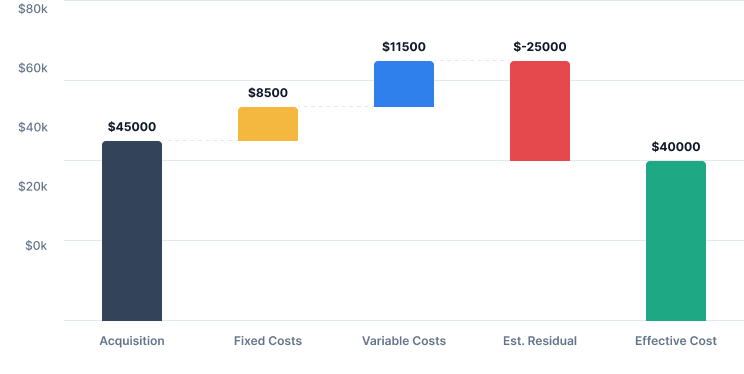
The following examples illustrate how ownership costs may change depending on share size and annual flight hours.
Estimated Acquisition Cost
Annual Fixed Costs
Occupied Hourly Cost
Estimated 5-Year Ownership Cost
Effective Hourly Cost
Estimated Acquisition Cost
Annual Fixed Costs
Occupied Hourly Cost
Estimated 5-Year Ownership Cost
Effective Hourly Cost
Estimated Acquisition Cost
Annual Fixed Costs
Occupied Hourly Cost
Estimated 5-Year Ownership Cost
Effective Hourly Cost

Aircraft values change over time due to age, utilization, maintenance history, and market demand.

Supply, demand, fuel prices, and broader economic conditions can influence resale values and buyer interest.

When an ownership share is sold, owners may recover a portion of their original investment depending on market conditions.

Selling a fractional share may take weeks or months depending on demand and the provider's resale process.

Unlike publicly traded assets, aircraft ownership shares may require time to find a buyer, making them less liquid.
Fractional ownership can involve tax, financing, and accounting considerations that vary based on ownership structure, aircraft usage, jurisdiction, and local regulations. This section provides a general educational overview rather than personalized financial advice.
01
Depending on jurisdiction, purchasing an ownership share may be subject to sales or use taxes.
02
Business travel may have different tax and accounting implications than personal use, depending on applicable laws and regulations.
03
Some owners explore depreciation strategies for tax purposes, subject to local regulations and professional advice.
04
Ownership shares may be purchased through cash or financing arrangements, each with different long-term cost considerations.
05
Organizations may account for ownership differently depending on their reporting standards and business structure.
06
Some buyers purchase through personal ownership, while others use business entities or trusts depending on legal and financial objectives.
Side-by-side pricing across all 4 private aviation models

Periodic cabin or interior refurbishment programs may require additional owner contributions to maintain aircraft standards.

Avionics upgrades, regulatory compliance updates, and onboard technology improvements may result in additional ownership expenses over time.

International operations can involve customs charges, permits, handling fees, navigation charges, and additional regulatory costs.

Certain travel requests may require aircraft repositioning, depending on provider policies and operational requirements.

Optional services such as premium catering, ground transportation, concierge requests, or customized cabin amenities may incur additional charges.

If an ownership share is financed, interest payments and lending fees increase the overall cost of ownership.

Capital invested in an ownership share cannot be allocated elsewhere, making opportunity cost an important financial consideration.

Select an ownership share that aligns with your expected annual flight hours. Purchasing more capacity than you regularly use may increase overall ownership costs.

Evaluate your annual travel requirements to determine whether fractional ownership, jet cards, charter, or whole ownership is the most cost-effective solution.
Review management fees, operational policies, fleet availability, and owner services when comparing providers.

Understand management fees, hourly rates, resale conditions, exit clauses, and contract duration before making a purchase.
Considering resale timing early may help you better understand long-term ownership costs and market conditions.
Evaluate several providers rather than relying on a single proposal. Comparing pricing structures and contract terms can provide a more complete picture of ownership value.
Explore additional guides designed to help you compare ownership models, understand long-term costs, and make informed private aviation decisions.

The total cost includes the acquisition price, monthly management fees, occupied hourly charges, financing (if applicable), taxes, and the eventual resale value of the ownership share. The exact amount varies by provider, aircraft type, and ownership percentage.
A jet card is a prepaid aviation product that gives you access to private aircraft at locked-in hourly rates. You purchase a set number of flight hours (typically25+) which can be used on-demand with a provider's fleet. Unlike charter, jet cards offer fixed pricing and streamlined booking without per-trip negotiation.
A jet card is a prepaid aviation product that gives you access to private aircraft at locked-in hourly rates. You purchase a set number of flight hours (typically25+) which can be used on-demand with a provider's fleet. Unlike charter, jet cards offer fixed pricing and streamlined booking without per-trip negotiation.
A jet card is a prepaid aviation product that gives you access to private aircraft at locked-in hourly rates. You purchase a set number of flight hours (typically25+) which can be used on-demand with a provider's fleet. Unlike charter, jet cards offer fixed pricing and streamlined booking without per-trip negotiation.
A jet card is a prepaid aviation product that gives you access to private aircraft at locked-in hourly rates. You purchase a set number of flight hours (typically25+) which can be used on-demand with a provider's fleet. Unlike charter, jet cards offer fixed pricing and streamlined booking without per-trip negotiation.
Take the next step with independent reviews, side-by-side comparisons, and educational resources
designed to help you make an informed private aviation decision.

.svg)

My Sky Guru® operates independently. We do not accept compensation for rankings, reviews, or placements. Our editorial standards prioritize transparency, accuracy, and buyer protection. Not affiliated with any aircraft operator or broker.
© My Sky Guru 2026