



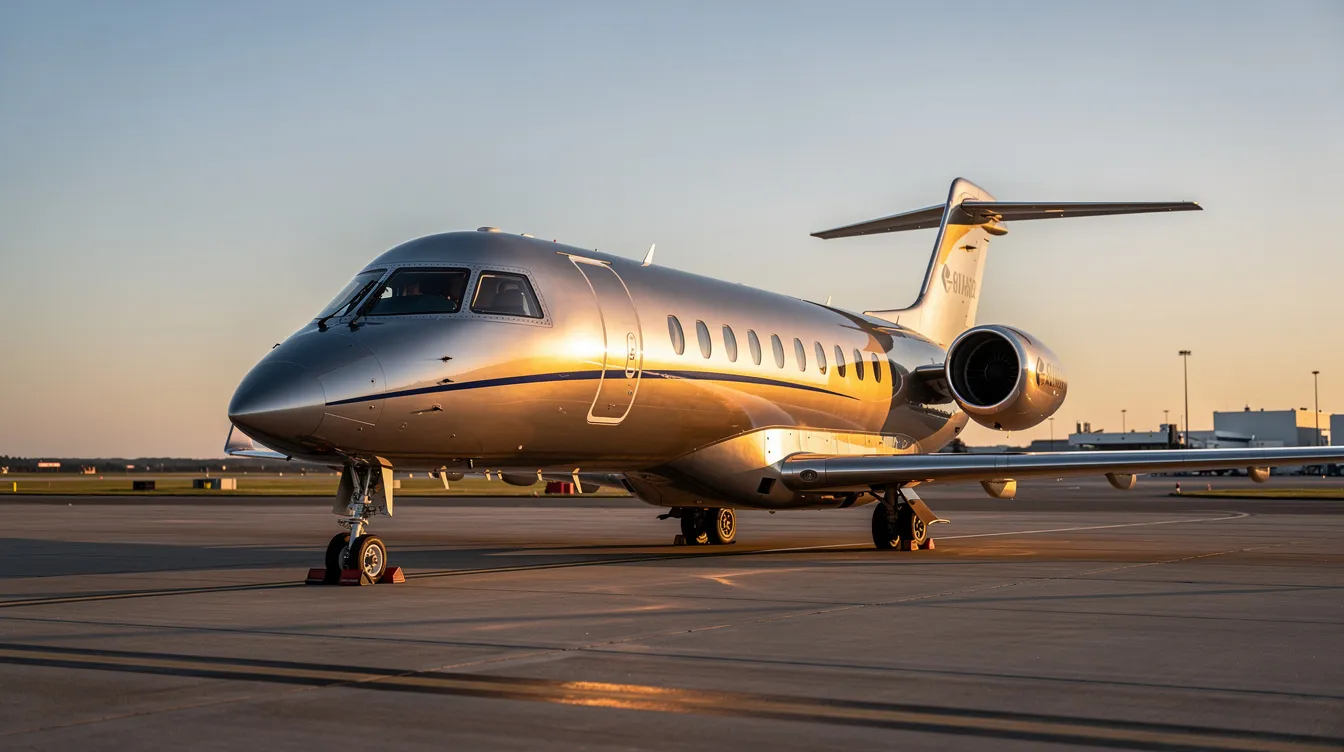
Introduction to the NetJets Challenger 350
If you're about to step aboard a Challenger 350 for the first time, or if the idea of flying on a private jet brings a wave of unease, this guide is for you. The Bombardier Challenger 350 is a super-midsize business jet that entered service in 2014 as an evolution of the earlier Challenger 300 series. By July 2020, Bombardier had delivered 350 of these aircraft to operators worldwide. The jet was designed for regional and transcontinental travel, and it remains one of the most common business aircraft in the sky today.
NetJets, the world's largest private jet company, operates one of the largest fleets of Challenger aircraft. It was originally founded as Executive Jet Airways before becoming NetJets. NetJets was the first customer to order the Challenger 350, and the company currently operates 100 Challenger 350 and Challenger 650 aircraft across its global fleet. That scale of commitment means deep pilot experience, well-stocked spare parts, and mature maintenance routines built over hundreds of thousands of flight hours.
The Challenger 350 follows the same global safety standards that govern large commercial airlines. Transport Canada, the FAA, and EASA all certified this aircraft. NetJets crews undergo rigorous, recurrent training, and the fleet maintains a dispatch reliability rate above 99%. Here is what this article covers:
-
Cabin space, seating, and what the interior feels and sounds like
-
Performance numbers that explain why the ride is smooth and the routes are flexible
-
How SkyGuru can help anxious travelers understand every phase of a Challenger 350 flight
-
Practical tips for choosing and preparing for your trip
Bombardier Challenger 350 in the NetJets Fleet
The Bombardier Challenger 350 sits in the middle of Bombardier's business jet lineup, above the smaller Learjet family and below the wide-cabin Global series. NetJets chose it as a core super midsize jet because it combines coast-to-coast range with access to smaller airports that larger jets cannot reach.
Key Technical Facts
The Bombardier Challenger 350 is a super-midsize business jet. The Challenger 350 first flew on March 2, 2013. It received approval from Transport Canada on June 11, 2014, with FAA certification following two weeks later and EASA certification arriving in September of that year. The aircraft has a range of 3,200 nautical miles (about 5,900 km) with eight passengers and standard fuel reserves, based on zero-wind ISA conditions, with no runway or temperature restrictions reducing performance.
The term "super midsize" means the Challenger 350 is larger and longer-range than standard midsize jets, but more efficient and flexible than heavy, large-cabin aircraft. Concretely, it can complete nonstop flights efficiently between major U.S. cities: New York to Los Angeles (about 2,450 nm), New York to San Francisco, or Dallas to Vancouver. It crosses time zones in style without needing a fuel stop. Typically configured to seat 8 to 10 passengers in a spacious layout.
NetJets' Order History
NetJets launched its Challenger 350 relationship with an order for 75 firm Challenger 350 aircraft, plus options for more. By 2019, NetJets had taken delivery of its 100th Bombardier Challenger, spanning 80 Challenger 350s and 20 Challenger 650s. That fleet flew more than 300,000 flight hours across roughly 178,000 flights before the end of the decade.
Best-Selling Aircraft in Its Class
The Challenger 350 is the best-selling business jet of the last decade. It achieved 300 deliveries faster than any other jet in its category. In 2019, the Challenger 350 secured a 44% market share in the super midsize segment, beating competition from Embraer, Gulfstream, and Cessna. For anxious passengers, that market success means this aircraft has been tested, refined, and trusted by more operators and customers than any comparable jet.
Challenger 300, 350, and 3500: How They Relate
The Challenger 350 and 3500 family shares a common airframe and type certificate (BD-100-1A10). Each generation brought incremental improvements. The Bombardier Challenger 350 3500 variant, announced in 2021 and certified in 2022, added autothrottle, redesigned cabin seating, and extended range to about 3,400 nm. NetJets operates both 350 and 3500 variants today, gradually refreshing the NetJets fleet as new deliveries arrive.
|
Feature |
Challenger 300 |
Challenger 350 |
Challenger 3500 |
|---|---|---|---|
|
Entry into service |
2004 |
2014 |
2022 |
|
Range (typical mission) |
~3,065 nm |
~3,200 nm |
~3,400 nm |
|
Typical seats |
8–9 |
8–10 |
8–10 |
|
Cabin highlights |
Original layout, smaller windows |
Larger windows (20% taller), improved engines, winglets |
Redesigned seats, voice control, autothrottle, further noise insulation |
Aircraft endurance approximations are based on standard conditions. Cabin configurations may vary between operators and individual aircraft.
Cabin Space, Comfort, and Onboard Experience
Cabin Dimensions and Layout
Step inside a Challenger 350 and the first thing you notice is the cabin space. It features a flat-floor, stand-up cabin for spaciousness. The flat-floor, stand-up cabin gives most passengers room to walk upright. The cabin height is approximately 6 feet, allowing most passengers to stand comfortably, and the width stretches to about 7 feet 2 inches. It has a wingspan of 69 feet and a cabin length of 68 feet from bulkhead to bulkhead. For a super midsize jet, this feels spacious.
Seating and Layout
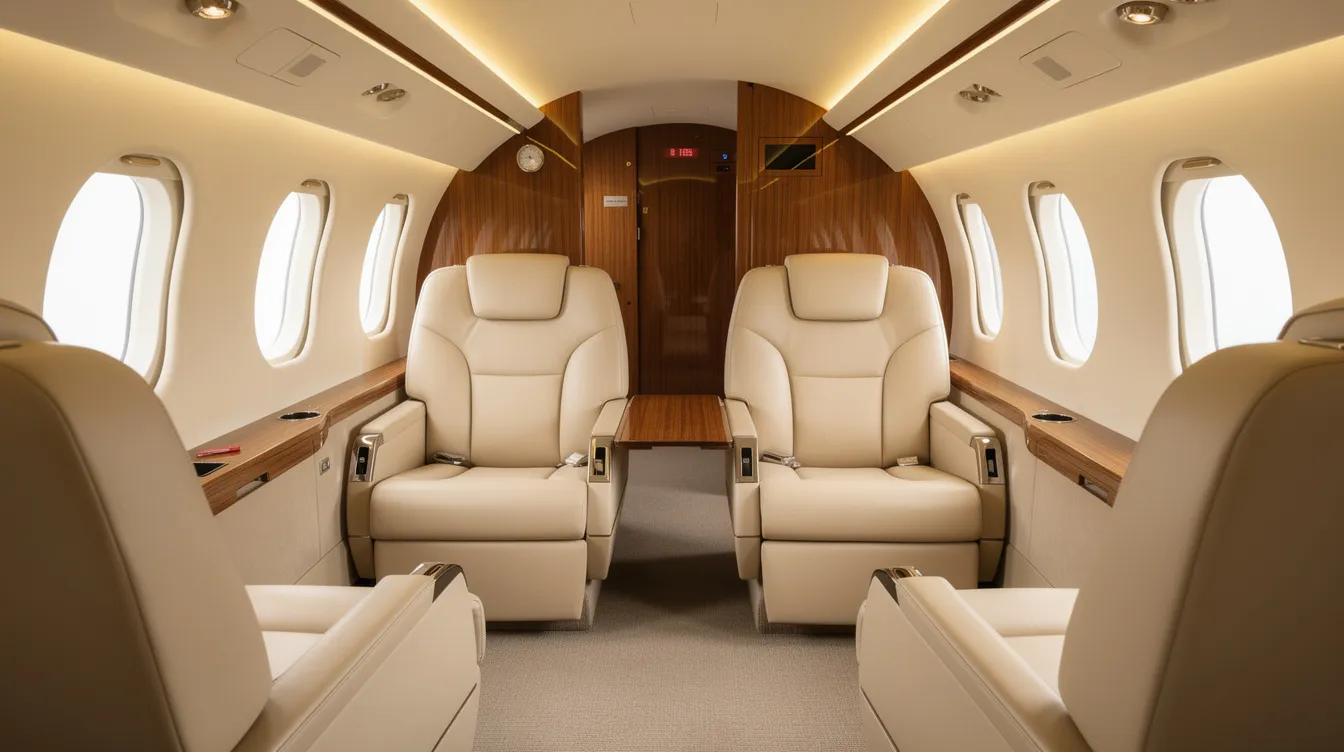
NetJets typically configures the Challenger 350 with double club seating for eight passengers in two facing groups of four. The seating configurations often include double-club arrangements, though some aircraft may vary between double club and a nine-seat layout with a divan at the rear. Whether you choose an eight- or nine-seat layout, seating for eight passengers is guaranteed across the fleet. Typically configured to seat 8 to 10 passengers in a spacious layout.
Cabin Amenities
The cabin includes premium leather seats and fold-out worktables. Some operators outfit them with hand-stitched leather seats. These seats recline into fully flat beds for up to four passengers at a time, which helps on longer flights when you need rest. If you are flying on a private jet for the first time, the ability to recline fully and stretch out can reduce physical tension that feeds anxiety.
The aircraft also offers 106 cubic feet of baggage capacity accessible in-flight, so you can reach personal items, blankets, or comfort essentials without asking crew to access an external compartment.
Design That Reduces Stress
Several design choices aboard the Bombardier Challenger make the cabin feel calmer, and its flat-floor layout adds convenience by making it easier to move around the cabin:
-
Rear-mounted engines. The turbofan engines sit at the tail, pushing noise behind the cabin. Passengers experience reduced noise levels due to advanced acoustic insulation layered throughout the fuselage walls and floor.
-
LED lighting. Adjustable cabin lighting lets you create a dim, relaxed environment or brighten the space for work.
-
Pressurization. The cabin pressure system reduces altitude effects on your body, keeping headaches and fatigue lower than in some older aircraft types.
-
Tailored cabin management systems allow passengers to control climate and entertainment features from a touchscreen panel or seat-side controls.
Most NetJets Challenger 350 aircraft include Wi-Fi, power outlets, and enough connectivity to stream content, work, or use apps that help people who experience fear of flying. Staying occupied helps anxious minds stay calm. For many travelers, knowing they can access email, music, or a flight anxiety app mid-flight removes a layer of isolation that feeds fear.
What You'll Hear and Feel
If you have never flown on this aircraft, here is what to expect at each stage:
-
Takeoff: You feel a firm push into your seat as the engines spool up. Acceleration is brisk. Within seconds, the nose lifts and you hear the landing gear retract with a mechanical thump and click. Flaps adjust with a faint whirring sound.
-
Climb: The aircraft climbs steeply, often reaching 30,000 to 40,000 feet in 20 to 30 minutes. Engine noise fades as speed stabilizes. Some pressure changes in your ears are normal.
-
Cruise: The quietest phase. Minimal vibration, steady hum. At these altitudes, the jet sits above most weather and turbulence.
-
Descent and landing: You hear thrust reduction, then the flaps extending. Landing gear deployment produces a thud and increased wind noise. The runway touchdown brings tire vibration and braking sounds.
Every one of these sounds is a normal part of the aircraft adjusting its configuration. Pilots expect them. The aircraft is built for them.
The Challenger 350's wide wing, stable aerodynamics, and modern autopilot help smooth out turbulence. While bumps at altitude can feel intense in any aircraft, they remain well within the jet's structural limits. The wings flex by design; they are engineered to handle forces far beyond anything weather will produce.
Performance, Safety, and How SkyGuru Supports Nervous Flyers
Performance Overview
The Challenger 350's performance numbers are not just specifications for pilots. They directly affect how comfortable your flight feels. A jet that climbs fast, cruises high, and can reroute around storms gives its crew more options to keep the ride smooth.
The Challenger 350 cruises at a speed of 460 knots true airspeed, which translates to a maximum cruise speed of approximately 540 miles per hour. At that speed, a flight from New York to San Francisco takes about five hours.
The aircraft climbs to a typical cruise altitude of 41,000 to 45,000 feet. It has a maximum operating altitude of 45,000 feet. At those altitudes, the Challenger 350's cruising altitude helps it avoid commercial traffic and weather disturbances. Most thunderstorms top out below 40,000 feet, so flying above them is standard procedure.
Turbofan engines provide high thrust and efficient climbing capabilities, reaching cruise altitude faster than many competitors. The Challenger 350 has excellent short-runway performance: it can depart from runways as short as 4,835 feet at sea level. That access to smaller airports means less ground travel and fewer delays at crowded terminals.
Advanced avionics enhance situational awareness for pilots, giving them real-time weather radar, terrain mapping, and traffic data. These systems allow crews to spot turbulence cells ahead and adjust course before passengers feel anything.

Safety Certifications
The Bombardier Challenger 350 holds certifications from Transport Canada, the FAA, and EASA. These are the same regulatory bodies that oversee commercial airline fleets. The aircraft features redundant engines, avionics, and hydraulic systems. If one system fails, a backup takes over.
A common myth is that smaller private jets are "less safe" than big airliners. The Challenger 350 operates under similarly strict rules, with experienced crews and meticulous inspections. NetJets is known across the industry for a conservative safety culture: if conditions are marginal, they cancel or reroute rather than push through.
Passenger Experience
Because the Challenger 350 is lighter than a commercial airliner, you will notice certain sensations more clearly. The takeoff push feels stronger. Climbs feel steeper. Turbulence bumps may seem sharper, though the forces involved are smaller than what you experience in a car hitting a pothole.
During descent, power reductions and flap movements create more audible changes than in cruise. These are all normal. Pilots control every phase with precision, and the aircraft's flight envelope includes generous margins beyond anything routine weather produces.
How SkyGuru Helps on a Challenger 350 Flight
SkyGuru provides real-time explanations for these sensations on private and commercial flights alike. For travelers aboard the Bombardier Challenger 350 3500 family, the app offers:
-
Advance turbulence forecasts on typical business routes, showing when and where bumps are expected
-
Stage-of-flight alerts that tell you when takeoff, climb, cruise, and descent are happening, and what sounds to expect next
-
Explanations of specific noises like gear retraction, flap movement, and engine power changes
-
Coping tools including guided breathing exercises timed to turbulence events
Understanding what this aircraft can do — its strong structure, powerful engines, and sophisticated avionics — helps transform fear of the unknown into informed, manageable concern. When you know why the jet turns or why the engines change pitch, unpredictability shrinks. And when unpredictability shrinks, so does anxiety.
Choosing a Challenger 350 Flight and Finding More Support
A NetJets Challenger 350 is an ideal choice when you need super midsize range for nonstops across the continental United States or throughout Europe, with generous cabin space, without the cost and footprint of a large-cabin private jet. If you are comparing jet card, charter, or fractional ownership options, the Challenger 350 sits at a price point of roughly $5,000 to $6,500 per hour depending on the program and region.
Planning a Comfortable Trip
A few practical steps can reduce travel anxiety before you board:
-
Choose mid-day departures when possible. Morning and evening hours often bring more thermal turbulence near the ground.
-
Request a seat near the wing. In the Challenger 350's double club layout, the forward club group sits closest to the wing root, where pitch motion is lowest.
-
Avoid tight schedules. Rushing to catch a flight adds stress that compounds flight anxiety. Give yourself a buffer.
-
Discuss preferences with the operator. NetJets crews are accustomed to working with first-time and nervous flyers. If you need the cabin dimmed, a specific temperature, or a heads-up before descent begins, ask.
Claustrophobia Concerns
If enclosed spaces trigger anxiety, the Challenger 350's wide cabin, tall stand-up aisle, and large windows can feel more open than many regional airline cabins. Sitting near a window with the shade up gives a sense of openness and connection to the outside. Moving around the cabin when the seat-belt sign is off, even just standing and stretching, helps break the feeling of confinement.
Understanding Turbulence on Common Routes
Certain routes have predictable turbulence patterns. Flights crossing the Rockies, for instance, frequently encounter mountain-wave turbulence between 25,000 and 35,000 feet. The Challenger 350 cruises above most of that layer. Flights across the North Atlantic may encounter jet-stream turbulence, but crews use wind and turbulence data to choose altitudes and tracks that minimize it.
SkyGuru can show you these patterns before your flight. Enter your route and departure time, and the app maps expected turbulence along the way. Knowing that the bumpy patch over Colorado lasts eight minutes, not the entire flight, changes how you experience it.
More Posts and Further Reading
If you want to enjoy learning more about the flying experience, explore these related posts, or visit the resources below for more details:
-
How to choose the right aircraft model for your travel needs
-
Best private jet programs comparison for first-time buyers
-
NetJets jet card review with pricing and program details
Aircraft like the NetJets Challenger 350 are built around reliability, comfort, and access. The company launched this partnership with Bombardier because the Challenger delivers consistent performance across hundreds of routes and thousands of flights each year. Today, the success of that fleet shows in the numbers: dispatch reliability above 99%, a best-selling aircraft record in its class, and a cabin designed to let passengers create the environment they need.
Combining a well-chosen private jet with informed guidance from tools like SkyGuru can make even nervous flyers feel at ease. Download the app before your next flight, enter your details, and let real-time commentary replace uncertainty with understanding.
FLEET SELECTION
JET CARDS
COST ANALYSIS


How to Auditing Your Operator's Maintenance Logs
Oct 05, 2025

How to Auditing Your Operator's Maintenance Logs
Oct 05, 2025

How to Auditing Your Operator's Maintenance Logs
Oct 05, 2025
Sky Guru Weekly
The smartest private aviation intelligence in your inbox.
.svg)

