




Introduction: What "Flying Private" Really Means in 2026
If you've ever wondered how to fly private, the answer in 2026 is more accessible than you might think. You don't need to own an aircraft or have a nine-figure net worth. Today, private aviation covers a wide spectrum: on-demand charter flights, empty leg flights, jet cards, fractional ownership, memberships, and yes, full aircraft ownership for those who want it.
Post-2020 travel habits pushed more potential travelers toward private flights and show how private aviation fits modern travel through flexibility, speed, and convenience. The reasons vary. Some want to skip long TSA lines. Others want to set their own departure times, enjoy enhanced privacy and productivity during travel, or simply save the hours lost in crowded commercial terminals. Private jets save significant time compared to commercial flights and can offer a more personalized private travel experience. Private jets can be used for business as well as leisure travel needs.
This guide covers everything a first-time flyer or seasoned traveler needs to know:
-
Your main private aviation options and how they compare
-
Realistic costs and how to find the best prices
-
Safety credentials and how to vet charter providers
-
What airport access and private terminals actually look like
-
Onboard amenities, flight sensations, and turbulence
-
Practical tips for flying with anxiety
Private Aviation 101: Your Main Options to Fly Private
Private aviation simply means flying on an aircraft that isn't a scheduled commercial airline. You travel on smaller aircraft, often from private terminals, on your own schedule. The experience differs from commercial flights in almost every way: fewer passengers, more flexibility, and direct access to smaller airports closer to your destination.
Here are the main models for anyone looking to fly privately:
-
On-demand charter flights - book a single flight, pay for that specific trip, no long-term contract
-
Empty leg flights - discounted repositioning flights when a jet needs to return to base
-
Jet cards - prepaid blocks of flight hours at fixed rates with guaranteed availability
-
Fractional ownership - buying a share of an aircraft for a set number of annual hours
-
Full aircraft ownership - purchasing, operating, and maintaining your own aircraft
You don't need to be a billionaire. Most beginners start with a charter service or trial membership. A 2026 on-demand charter from New York to Miami on a light jet might cost $8,000–$14,000 one way, while a jet card hourly rate on the same route could offer more predictable pricing for frequent flyers.
Charter Flights: The Easiest Way to Start Flying Private
On-demand private charter is the simplest entry point. You book a single flight, pay for that trip only, and carry no long-term contract. Many private charter operators can offer on-demand service without long-term commitment.
Here's what the booking process looks like in 2026:
-
Request a quote - provide your route, dates, passenger count, and any special needs
-
Review aircraft options - your broker or operator suggests aircraft types with pricing
-
Evaluate safety and value - check safety ratings (ARGUS, Wyvern), crew experience, aircraft age
-
Confirm and pay - agree on all-in pricing including fees, then finalize payment
-
Pre-flight details - receive FBO location, arrival time, and onboard amenities info
Booking a private flight typically involves providing trip details and personal information. For the best pricing, book private jets 30 to 60 days in advance.
What does it cost? Chartering a private jet costs about $2,000 to $10,000 per hour. Light jets typically cost $3,500 to $7,000 per hour to charter, while very light jets charter for $2,500 to $4,800 per hour. A 1.5-hour flight in a midsize jet costs around $34,500.
For a Los Angeles to Las Vegas hop on a light jet, expect roughly $4,000–$7,000 one way. Split that among six passengers, and you're looking at under $1,200 each — sometimes comparable to a last-minute business-class airline ticket.
When evaluating charter operators beyond headline price, ask about FAA Part 135 certification, which governs safety standards for on-demand charter operations in the U.S. Check pilot experience, maintenance records, and whether onboard amenities are included.
Empty Leg Flights & Repositioning Deals: Flying Private for Less
Empty leg flights happen when a private jet needs to fly back to its base (or to its next charter pickup) without passengers. Rather than fly empty, operators offer these legs at steep discounts — sometimes 25–50% below standard charter rates.
In June 2026, the empty leg market tracked over 15,214 new listings, with roughly 3,000 active legs at any given time and an average asking price of about $10,648. That's a record high, which means more opportunity for flexible travelers.
Private jet charters allow access to over 20,000 aircraft worldwide, and empty legs expand those options further. Private aviation can sometimes provide more economical group travel options compared to commercial tickets when you split empty leg costs among several passengers.
The trade-offs are real:
-
You fly on someone else's schedule, not yours
-
Routes and airports may not match your ideal itinerary
-
Flights can be cancelled if the original charter changes plans
-
Usually one-way only
How to find them: specialized apps, operator newsletters, charter broker websites. In shoulder seasons like late October, you often see New York–South Florida empty legs at steep discounts. Flexibility with date, time, and airport is the key to making empty legs work.
Jet Card and Membership Programs: Predictability vs. Commitment
A jet card is essentially a prepaid block of flight hours. You deposit funds in advance, lock in a fixed hourly rate for your aircraft category, and receive guaranteed availability — often with as little as 24–48 hours' notice.
Jet cards typically cost between $ 100,000 and $375,000 for 25 hours, depending on aircraft size. In 2026, a 25-hour NetJets card costs approximately $215,000. Average hourly rates across North America sit around $11,314 per hour, with light jets averaging about $8,456 per hour and large cabin jets around $15,236 per hour.
Membership programs for private jets start at about $2,000 per month, providing access to a fleet with dynamic pricing rather than fixed rates. These suit travelers who want more flexibility without a large upfront deposit.
Who should consider a jet card? Frequent flyers logging 25 or more flight hours per year who want predictable pricing and guaranteed aircraft. For a deeper comparison, see our guide to jet card pros and cons and the best private jet membership programs.
Who should avoid them? Occasional flyers. If you take only two or three private flights a year, on-demand charter or empty legs will likely serve you better at lower total cost.
Fractional Ownership & Full Aircraft Ownership: When You Really Live on a Jet
Fractional ownership means buying a share of an aircraft— for example, a 1/16th share — and receiving a set number of flight hours each year. You pay an upfront acquisition cost, monthly management fees, and an occupied hourly rate when you fly.
Fractional ownership requires a minimum investment of $500,000, so you're committing a significant amount of money just to buy into the model. For a 1/16 share of a light jet in 2026, expect roughly $500,000–$650,000 upfront. Monthly management fees for light jet shares run about $6,000–$10,000, with occupied hourly rates of $4,000–$7,000 per hour on top.
This model makes sense if you're flying 50–200+ hours per year on similar routes and aircraft types. Below that threshold, jet cards or charter flights typically offer better value.
Full aircraft ownership means you buy, operate, and maintain the plane yourself, and it can require a huge amount of money before any flying even begins. Annual fixed costs for a midsize business jet can reach $1.5 million before you log a single flight hour — covering hangar, crew salaries, insurance, and maintenance. For most readers exploring how to fly private, charter, empty legs, or memberships will be far more practical than ownership. For those seriously considering buying, our guide on the best private jet to buy covers what to look for.
Choosing the Right Aircraft for Your Trip
You don't need to memorize every airplane model. Understanding a few broad categories helps you pick the right aircraft for any specific trip.
|
Category |
Passengers |
Range |
Best For |
|---|---|---|---|
|
Very Light Jet |
4–5 |
~1,000 mi |
Short hops, 1–2 hrs |
|
Light Jet |
6–8 |
Up to 1,500 mi |
Regional trips |
|
Midsize Jet |
7–9 |
~2,500 mi |
Cross-country |
|
Super-Midsize |
8–10 |
~3,500 mi |
Coast-to-coast, stand-up cabin |
|
Heavy Jet |
10–16 |
~7,000 mi |
International trips, full amenities |
Light jets can fly distances up to 1,500 miles before refueling — perfect for Boston to Chicago with four people and light luggage. Charter demand often centers on a few popular private planes because passenger count, range, and cabin comfort drive most booking decisions. Heavy jets average a range of 7,000 miles for international travel, covering New York to London with eight travelers comfortably. Private jets can fly up to 7,000 miles non-stop.
Specialty needs matter. If you're traveling with golf clubs, skis, pets, or medical equipment, confirm baggage limitations before booking a private jet. Select the right aircraft based on trip requirements — ask your charter provider about cabin layout, baggage hold size, and in-flight connectivity before confirming.
Airport Access & Private Terminals: How the Ground Experience Works
One of the biggest advantages of private aviation is airport access. Private flights allow access to over 5,000 airports worldwide — far more airports than commercial airlines serve. This means flying into Teterboro instead of JFK in New York, Van Nuys instead of LAX in Los Angeles, or small regional fields minutes from your destination.
Private flights operate out of Fixed-Base Operators (FBOs), not major commercial terminals. An FBO is essentially your private terminal: a calm, quiet building where you arrive, show ID, and walk directly to your aircraft on the tarmac.
The timeline is refreshingly simple:
-
Arrive 15 to 30 minutes before departure
-
Drive up to the terminal entrance
-
Quick ID check—no long security lines, no removing shoes
-
Walk straight to your plane
Private jet travelers can check in just 15 minutes before departure. Ground transportation can often meet passengers at private terminals immediately upon landing, and private aviation can significantly reduce ground travel time compared to commercial flights. Choose airports wisely to avoid congestion — smaller airports often mean faster departures and arrivals.
For nervous flyers, this calmer atmosphere makes a real difference. Fewer crowds, quieter spaces, and personal service ease the stress before you even board.

Onboard Amenities, Sensations, and What the Flight Actually Feels Like
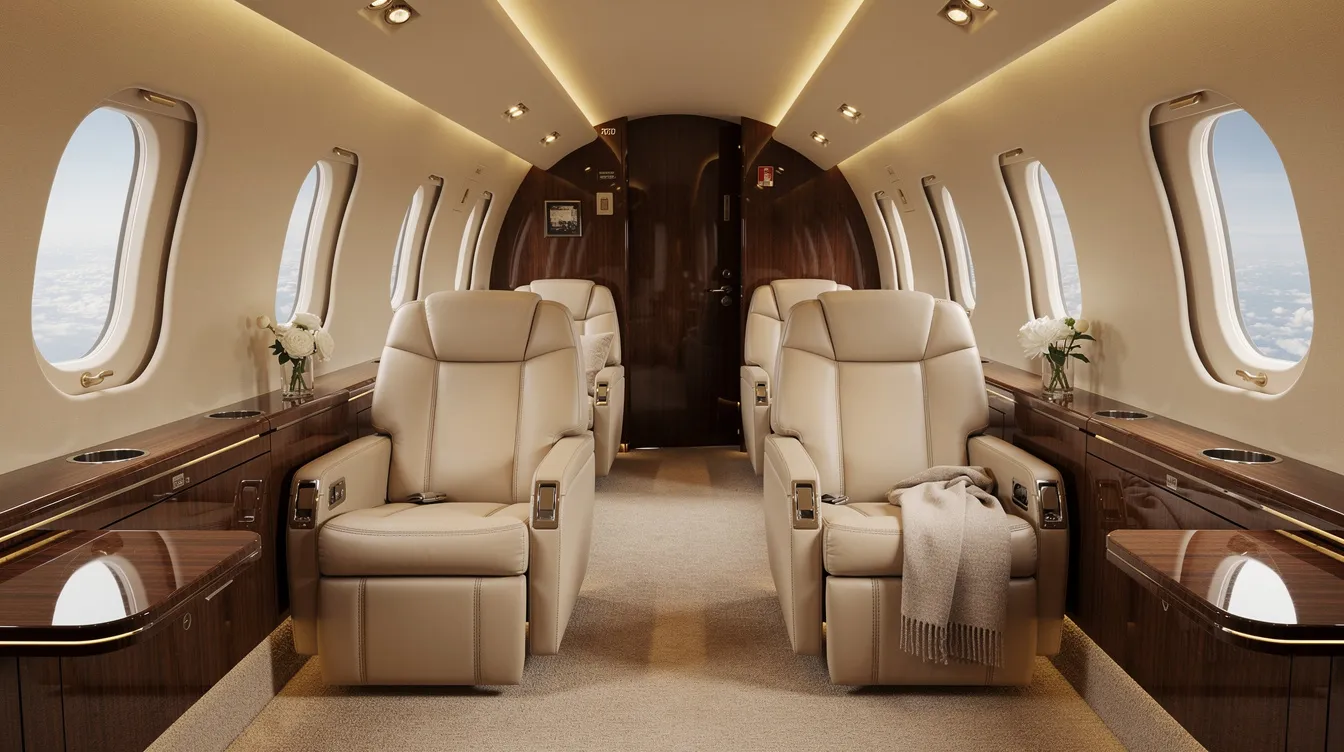
Private jet travel offers a more comfortable and spacious cabin experience than anything in the commercial world. Customized in-flight services can include catering and entertainment options tailored to passenger preferences. Private jets offer more luggage flexibility than commercial airlines, and the cabin is yours alone.
Common onboard amenities in 2026 include:
-
High-speed satellite Wi-Fi and power outlets
-
Lie-flat seats on larger jets
-
Full galley catering (custom meals, dietary preferences)
-
Pet-friendly cabins
-
Entertainment systems with streaming access
What does flying private actually feel like? You'll notice a faster climb after takeoff, quicker turns, and a cabin that's noticeably quieter than a commercial airplane. On light jets and midsize jets, turbulence can feel more noticeable because the airframe is lighter. Small aircraft can be sensitive to extreme weather conditions compared to commercial airliners, but pilots operate under the same strict safety standards.
Understanding these sensations in advance reduces in-flight anxiety. When engine noise changes or the plane bumps through a patch of air, knowing what's happening transforms worry into recognition. Real-time guides like SkyGuru can explain noises, bumps, and flight stages while you're onboard—turning unknown sensations into predictable, understandable events.
Costs, Best Prices, and Smart Ways to Save When Flying Private
The main cost drivers for any private flight are aircraft type, distance, routing, airport fees, peak dates, and demand. Holiday periods like Christmas or major events push prices higher, while midweek flights and shoulder seasons offer savings.
Practical tips to find the best prices:
-
Fly on Tuesdays or Wednesdays when demand drops
-
Choose secondary airports with lower landing fees
-
Consider empty leg flights for one-way trips
-
Split charter costs: dividing a $10,000 light jet charter among six passengers drops the per-person cost well below a premium airline ticket
-
Compare on-demand charter vs. jet card vs. membership based on how many trips you plan in the next 12 months
Private charter flights don't have to be pure luxury. Flying privately allows skipping long TSA security lines common in commercial travel, and when you factor in time saved on the ground plus the ability to access more airports, the value equation shifts — especially for group or leisure travel.
It's also worth noting: private aircraft emit more carbon per passenger mile than commercial airliners. If environmental impact matters to you, consider carbon offset programs offered by many charter providers.
Safety, Certifications, and How to Vet a Charter Provider
Private aviation operates under strict national and international regulations. In the United States, FAA Part 135 governs safety standards for on-demand charter operations, covering pilot training, aircraft maintenance, and operational control.
However, private flying can be subject to variable safety standards among operators. That's why vetting matters.
How to check:
-
Ask for third-party safety audit results (ARGUS Gold or Platinum, Wyvern PASS)
-
Verify pilot experience on the specific aircraft type
-
Review aircraft age and maintenance records
-
Confirm insurance coverage and operational certificates
Working with a reputable charter service or aviation experts eliminates most risk. Avoid "grey market" operators — flights without proper Part 135 certification carry less oversight and more uncertainty. Our guide on how to choose a private jet company walks through the vetting process in detail.
For nervous flyers, understanding how safety is managed — redundant systems, intensive training, weather planning — often lowers flight anxiety more than any other single factor.
Flying Private with Flight Anxiety: Comfort, Turbulence, and Mental Wellness
Even on a spacious private plane, many travelers still feel fear of flying. Turbulence, unfamiliar noises, and the intimacy of a smaller cabin can trigger anxiety.
The private environment can actually help. Fewer strangers means less social pressure. You can talk directly to pilots before departure. You control timing and surroundings. Flying private allows you to set your own departure times, which reduces the rush and stress that often amplifies anxiety.
What turbulence feels like on smaller jets: bumps may feel sharper because of the lighter airframe, but they're usually uncomfortable, not unsafe. Pilots actively avoid the worst areas using onboard weather radar and real-time reports.
Simple strategies that work:
-
Breathing exercises like 4-7-8 paced breathing
-
Grounding techniques (name five things you see, four you hear)
-
Sit near the center of gravity for less motion
-
Limit caffeine and stimulating media before boarding
Preparation for private flights includes confirming passenger details and special requirements in advance — and that preparation extends to your mental readiness too. Apps like SkyGuru help anxious travelers by providing real-time explanations of flight stages, turbulence forecasts, and sensor-based alerts for noises like flap deployment or engine changes. Instead of guessing what that sound was, you know. Explore our list of the best apps for flying for more tools.
Step-by-Step: How to Plan Your First Private Flight
Here's a concrete scenario: a first-time flyer booking a June 2026 weekend trip from New York to Nassau with family.
-
Define your trip - four passengers, light luggage, departing Friday afternoon, returning Sunday evening
-
Request quotes - contact two or three charter providers with your route, dates, and passenger count
-
Evaluate offers - compare aircraft types (a light jet handles this 2.5-hour route well), safety ratings, and all-in pricing
-
Check credentials - verify FAA Part 135 certification, pilot hours on type, and recent safety audits
-
Confirm the booking - finalize payment, provide passenger details, confirm any special requests (catering, child seats)
-
Travel day - drive to the FBO 20 minutes before departure, show ID, walk to your aircraft, board
The flight itself: expect a quick climb, smooth cruise at high altitude, and a descent into Nassau's smaller field. You'll hear engine changes during climb and flap adjustments during approach — all normal.
For your first private flight, consider using SkyGuru, so you receive calm, real-time explanations of every phase: what that noise was, whether turbulence ahead is expected, and what the pilot is doing. It turns the unfamiliar into the understood. For more detailed preparation, read our guide on how to fly a private jet for the first time.

Conclusion: Turning Private Flying into a Calm, Informed Choice
You can fly private through several flexible options— charter flights, empty legs, jet cards, or fractional ownership — without needing to own a jet. The world of private air travel is more accessible in 2026 than ever before.
Knowledge about aircraft types, airport access, pricing, and safety turns flying private from a mysterious luxury into an understandable travel tool. And for nervous flyers, understanding what happens in the air — especially during turbulence or odd noises — is one of the most effective ways to reduce anxiety.
Flying becomes less intimidating when you understand what's happening around you. Before your next private or commercial flight, explore the SkyGuru app to receive calm, expert explanations in real time. Knowing what to expect transforms uncertainty into confidence — and confidence makes every flight a more peaceful journey.
Learn more about jet card pros and cons and how they compare to other private flight options.
Discover tips for flying with anxiety to help you stay calm and comfortable.
Explore our detailed guide on how to choose a private jet company to ensure your safety and peace of mind.
Understand the realities of turbulence and why it’s usually nothing to worry about.
Check out our best apps for flying to enhance your travel experience with helpful tools and insights.
FLEET SELECTION
JET CARDS
COST ANALYSIS


How to Auditing Your Operator's Maintenance Logs
Oct 05, 2025

How to Auditing Your Operator's Maintenance Logs
Oct 05, 2025

How to Auditing Your Operator's Maintenance Logs
Oct 05, 2025
Sky Guru Weekly
The smartest private aviation intelligence in your inbox.
.svg)

