



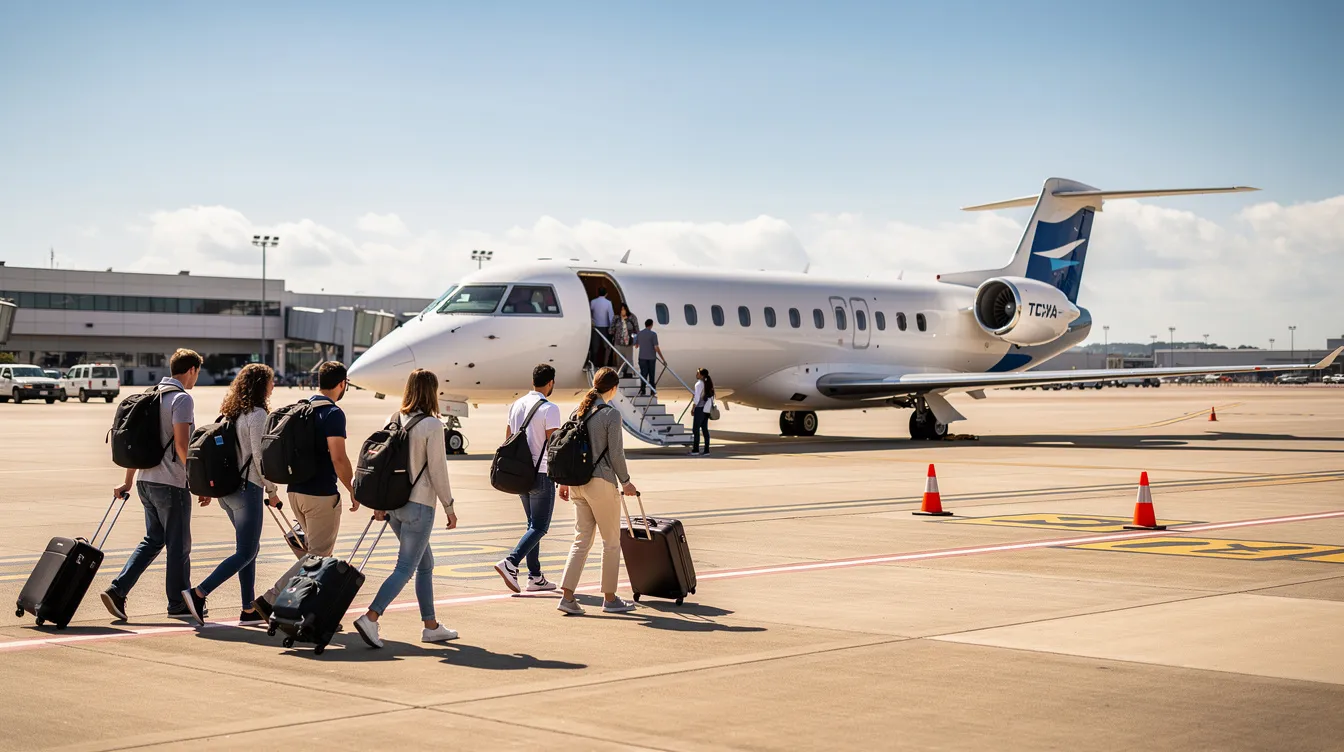
Introduction: What "Flying Semi-Private" Really Means (and Why Anxious Flyers Love It)
If the thought of navigating a packed airport terminal makes your stomach tighten, you're not alone. Many travelers dread the crowds, noise, and unpredictability of commercial air travel far more than the flight itself. Semi-private flights offer a middle ground that most people don't know exists — a way to skip the chaos without chartering an entire aircraft.
Flying semi-private means boarding a smaller plane with fewer passengers, often from a quiet private terminal, and arriving at your destination without the usual stress. Semi-private flights bridge the gap between commercial air travel and chartered private jets, giving you many of the comforts of private aviation at a fraction of the cost.
For nervous flyers, the benefits go beyond leather seats and legroom. Smaller crowds, shorter waits, and calmer boarding can make the entire experience feel more manageable. And when you pair that quieter environment with an in-flight guide like SkyGuru — which explains noises, turbulence, and flight stages in real time — flying starts to feel far less intimidating.
What Is Semi-Private Air Travel? (Clear Definition for First-Time Flyers)
Semi-private air travel refers to scheduled or on-demand flights on aircraft with roughly 4 to 30 passengers. These flights typically depart from private terminals or fixed-base operator (FBO) facilities rather than busy commercial concourses.
Here's the key difference from a full private charter: you book your own seat, just like a commercial flight, rather than paying for the entire aircraft. That makes semi-private travel a more affordable alternative to flying private for the first time while still preserving many of the perks of private aviation.
What to expect from semi-private flights:
-
Aircraft size: Semi-private flights typically accommodate 4 to 15 passengers on light jets and up to 30 on regional jets like the Embraer ERJ-135
-
Terminals: Semi-private flights often use private terminals for check-in, separate from the main airport
-
Routes: Mostly domestic city pairs such as Los Angeles to Las Vegas, New York to Miami, and Los Angeles to Los Cabos
-
Amenities: Semi-private flights provide amenities similar to private jets — think spacious seating, complimentary refreshments, and personalized service
-
Booking: Passengers can book individual seats or entire aircraft, depending on group size and preference
-
Airports: Semi-private flights offer access to smaller airports like Van Nuys, Henderson Executive Airport, and Westchester County Airport
Operators like JSX, Blade, Surf Air, and Aero run scheduled service on these routes. Unlike a full private charter with a custom schedule, semi-private jet flights follow pre-scheduled flights on fixed or semi-flexible timetables.
How Semi-Private Flights Compare to Commercial Flights
For anxious travelers, the difference between a semi-private flight and a commercial flight often comes down to one word: calm. The smaller scale and quieter flow of semi-private travel can feel emotionally safer, even before the plane leaves the ground.
Here's how the two experiences differ:
-
Arrival time: Passengers can arrive just 15 to 30 minutes before departure at private terminals, compared to 60 to 120 minutes at major hubs like LAX or JFK
-
Security: Passengers can bypass long security lines when using semi-private flights. Security is still TSA-compliant or equivalent, but it's handled with far fewer people around
-
Passengers: Fewer passengers result in more legroom and comfort. A typical semi-private cabin has 9 to 30 people versus 150 to 300 on a commercial jet
-
Seat layout: No middle seats. Most semi-private jets use two-by-one or two-by-two configurations with generous pitch
-
Noise: Fewer passengers lead to less noise and distractions. There are fewer overhead announcements and no gate-change chaos
-
Service: Semi-private flights allow for personalized service from crew members, who often greet you by name
-
Cabins: Cabins on semi-private flights often feature spacious seating and quiet environments
The trade-off? Commercial airlines offer more flexible scheduling options with multiple daily departures and a much larger route network. Semi-private airlines have fewer daily flights and cover fewer destinations. That's worth factoring into your travel plans.
Private Charter vs Semi Private vs Commercial: Which Is Right for You?
Choosing between a private charter, semi-private, and commercial depends on your budget, your tolerance for crowds, and how much control you need over your schedule.
A private charter gives you the ultimate private flight experience. You book the entire aircraft, set your own departure time, and choose exclusive airports. A light jet from Los Angeles to Las Vegas typically costs $6,000 to $9,000 for the full charter. Ideal for groups or complex itineraries, but the high cost puts it out of reach for many travelers.
Semi-private is best for individuals or couples who want the private experience — quiet lounge, fast boarding, attentive service — without paying for every seat on the plane. Prices for semi-private flights vary based on demand and routes but are generally higher than economy commercial tickets. You share the cabin with other passengers, but far fewer than on a commercial jet. Passengers enjoy more privacy than on commercial flights.
Commercial flights win on network size and price. Multiple daily connecting flights between New York and almost any major city, often at a lower cost. But the busiest terminals and longest lines come with it.
Choose semi-private if you:
-
Want to fly private but at a more affordable alternative price point
-
Travel a popular route like LA to Las Vegas or New York to Miami
-
Need a calmer airport experience for anxiety or sensory reasons
Choose private charter if you:
-
Need the entire aircraft for a group or want a preferred aircraft type
-
Require more flexible scheduling options and custom routes
Choose commercial if you:
-
Need the widest route network and last-minute flights
-
Are budget-focused and comfortable with busier terminals
Popular Semi Private Routes: From Los Angeles, Las Vegas, New York and Beyond
Semi-private networks tend to connect high-demand city pairs and leisure destinations where business travelers and vacationers overlap. Here are the most popular clusters:
-
Los Angeles to Las Vegas: The single most popular semi-private route in North America. Operators like JSX fly this route multiple times daily from smaller airports in Southern California, offering a far less chaotic departure than LAX. Henderson Executive Airport or North Las Vegas Airport serve as quieter arrival points
-
New York to Miami / West Palm Beach: New York to Miami is a frequently booked semi-private route. JSX and other carriers connect Westchester County Airport to Florida, cutting out the stress of JFK or LaGuardia
-
Los Angeles to Cabo San Lucas: Popular semi-private flights also include Los Angeles to Cabo San Lucas, with Aero operating seasonal flights on this leisure-focused route
-
Dallas to Aspen: Dallas to Aspen is a sought-after semi-private flight route, especially during ski season
-
California commuter routes: San Diego to the Bay Area, LA to Truckee — shorter hops where semi-private carriers utilize private terminals to save significant ground transportation time
-
International: Semi-private flights connect London to Paris regularly, and Caribbean destinations are increasingly served by per-seat charter models
These routes share a common trait: flight time is short (often under two hours), and using smaller airports on both ends — Van Nuys instead of LAX, Burbank instead of Ontario — can cut your door-to-door journey dramatically.

What It's Like to Fly Semi-Private: Step-by-Step Experience
Walking through a typical semi private journey helps remove the unknown — and for anxious flyers, the unknown is often what hurts most.
Booking: You select your route and date online or through a mobile app. The process feels similar to booking a commercial flight. You pick your available flights, choose your seat, and pay.
Arrival: You arrive at a private terminal 15 to 30 minutes before departure. No long concourse walks. No crowded food courts. The lobby is usually quiet, with comfortable seating, complimentary coffee, and a small team of ground staff.
Check-in: A staff member greets you, often by name. Your bags are tagged and taken. There's no conveyor belt drama.
Security: Quick and private. You walk through screening with a handful of other passengers, not hundreds.
Boarding: You walk a short distance across the ramp or take a quick shuttle to the aircraft. No jet bridge. No boarding zones. No overhead-bin competition.
In-flight: Leather seats with generous legroom. Snacks, drinks, and increasingly common wi fi (some U.S. fleets now offer Starlink). The cabin is quiet — fewer people talking, no loud PA announcements every few minutes. The better service and personalized attention from crew members feel noticeably different from commercial airlines.
Arrival: Bags are usually waiting for you as you step off. Ground transportation is a short walk away. The whole process feels compact and controlled.
Semi-Private Aircraft Types, Cabins, and Safety Standards
The specific aircraft used in semi-private aviation varies by operator and route. Here are the most common types:
-
Regional jets: JSX operates 30-passenger Embraer E135 aircraft — the same family used by regional airlines worldwide. Two-by-one seating, large windows, and a small galley
-
Light jets: Models like the Citation CJ series or Phenom 100/300. Light jets seat 4 to 7 passengers for short hops. Ideal for per-seat bookings on routes like LA to Las Vegas
-
Midsize jets: Midsize jets offer roomier cabins and extended range, suitable for longer routes or Caribbean destinations
-
Turboprops: Aircraft like the Pilatus PC-12 or King Air. Turboprops are used for regional routes with smaller airport access, landing at airfields that jets can't reach
Safety matters most. Semi-private operators in the U.S. typically hold FAA Part 135 certification, which governs charter and commuter operations. This means rigorous maintenance schedules, professional crew training, and operational oversight comparable to major airlines.
Smaller does not mean less safe. Many of these aircraft types serve corporate fleets and regional airlines with excellent safety records. The maximum capacity is smaller, but the regulatory standards are not.
For nervous flyers, the one difference worth noting is that smaller aircraft can feel bumpier during turbulence — not because the flight is unsafe, but because there's less mass absorbing the movement. This is exactly where tools like SkyGuru help, explaining those sensations in real time so they don't trigger alarm.
Costs of Flying Semi Private: From Commercial-Level to First-Class Pricing
Semi-private pricing sits on a wide spectrum, from surprisingly accessible to approaching first-class pricing. Understanding the range helps you plan without surprises.
Sample price ranges:
-
JSX flights start at $209 for one-way trips on select routes, making them a cost-effective option for advance bookings
-
Boutique Air offers semi-private flights starting at $39 each way on essential air service routes
-
Semi-private flights from LA to Vegas start around $500 per seat on most operators
-
Aero flights from LA to Los Cabos start at $1,800 one way for their premium leisure service
-
Prices for semi-private flights can vary widely by airline, timing, and demand
What drives the price:
-
Route distance and aircraft type
-
Peak vs off-peak timing (Friday evening into Las Vegas costs more than a Tuesday morning)
-
Membership vs pay-per-seat vs on-demand booking
-
How far in advance you book
Compared to a private jet: A full charter on a light jet from LA to Vegas runs $6,000 to $9,000 total. Semi-private jet flights on the same route cost a fraction of that per person, making them the clear choice when you don't need the entire aircraft. For a deeper look at charter economics, the jet card pros and cons breakdown is worth reading.
Most semi-private fares include luggage, snacks, and taxes with fewer additional fees than many commercial tickets. The cost benefits are clearest for solo or duo travelers on popular routes. A round trip on a busy corridor can sometimes rival or beat business-class commercial fares.
Luggage Restrictions, Kids, and Pets: Practical Rules You Need to Know
Semi-private flights have stricter luggage restrictions than large commercial jets. Smaller holds and tighter weight-and-balance limits mean you need to plan ahead.
Luggage:
-
Typical allowance: one carry-on plus one checked bag, with weight limits often around 50 lbs total
-
Oversized items like golf clubs or ski gear usually require advance notice
-
Luggage is usually included in the fare, but confirm with your operator
Children:
-
Under two: often allowed as lap infants at no charge
-
Older children: require their own seat and a full fare
-
Some semi-private operators market themselves as family-friendly, but policies vary
Pets:
-
Many semi-private operators allow pets to stay in the cabin with travelers
-
Advance notice is typically required, and total pet count per flight may be limited
-
The calmer, quieter cabin tends to be more comfortable for animals than a packed commercial flight
Why this matters for anxious travelers: Knowing these rules in advance removes last-minute surprises. Predictability — from bag weight to pet logistics — keeps stress low. Pack snacks, entertainment, and any needed medications before you leave, especially since private terminals may have limited food and shopping options.
Booking a Semi-Private Flight: Apps, Memberships, and Seat-Sharing
The booking process for semi-private flights is similar to conventional airlines but often requires a membership or account setup. Here's how it works:
Booking models:
-
Pay-per-seat scheduled flights: Browse available flights on a route like New York to Miami, pick a departure, and buy your seat. Similar to any airline booking
-
Memberships: Services like Surf Air offer monthly subscriptions with discounted fares for frequent travelers on fixed routes. Predictable schedules can be especially comforting for those with travel anxiety
-
Full charter: Need the whole plane? Most semi-private operators let you book every seat, giving you a private charter at a known price
Booking semi-private flights can be done online through operator websites and apps. Booking platforms like Jettly simplify the process by aggregating options across multiple carriers. Booking policies vary by airline and should be reviewed carefully — pay attention to cancellation rules, change fees, and refund windows.
Seat-sharing is the core concept: you book individual seats on a pre-set route and share the cabin with other passengers, splitting the cost. This is what makes semi-private travel a more affordable alternative to a full private flight for solo travelers and couples.
For a broader comparison of membership programs, several options exist across different price tiers and route networks.
Once you've booked, add your confirmed flight to SkyGuru by entering the operator, date, and route. The app will provide turbulence forecasts and flight-stage explanations tailored to your specific itinerary.
Why More Travelers Are Choosing to Fly Semi-Private (Especially Anxious Flyers)
The growth of semi-private travel isn't just about luxury. For many travelers, it's about removing the parts of air travel that create the most stress.
Core benefits driving adoption:
-
Time savings: Arrive 15 to 30 minutes before departure instead of two hours. No long security lines. No gate changes
-
Calmer environment: Fewer people, less noise, more personal attention. Providing access to a relaxed terminal experience changes the emotional tone of the entire trip
-
Smaller airports: Semi-private flights often use airports closer to city centers - Van Nuys instead of LAX, Westchester instead of JFK — shortening door-to-door travel and reducing fatigue
-
Predictability: Predictable boarding, short walks, quick baggage return. For anxious flyers, knowing exactly what comes next is one of the most powerful anxiety reducers
For nervous flyers specifically:
Real-time flight commentary can alleviate stress for nervous travelers during flights. Turbulence forecasts can help passengers manage anxiety and fear of flying. When you combine the quieter semi-private environment with tools that explain what's happening around you, uncertainty drops, and confidence rises.
This connects directly to SkyGuru's philosophy: understanding what's happening — every bump, every engine change, every turn — transforms fear into manageable awareness. Even a semi-private jet doesn't eliminate turbulence, but knowing it's coming (and that it's normal) changes everything.
Potential Drawbacks and Limitations of Semi Private Flights
Semi-private travel isn't perfect, and being honest about the trade-offs helps you plan better.
-
Cost: Semi private is a cost-effective option compared to private jet travel, but it's still more expensive than most economy commercial flights. Not every traveler can justify the premium
-
Limited routes: You won't find semi-private service to every city. The network is concentrated on high-demand corridors
-
Fewer daily flights: If your flight is canceled or delayed, rebooking options are more limited than with commercial airlines that run dozens of daily departures
-
Terminal amenities: Private terminals are quieter but may lack restaurants, shops, or extensive lounging areas. Bring what you need
-
Ground access: Getting to smaller airports or exclusive airports sometimes means higher ground transportation costs or less convenient rideshare logistics, especially near Los Angeles or New York
-
Pricing volatility: Last-minute flights on popular routes can spike in price. Booking early is almost always better
Despite these limitations, many travelers find the overall experience far less stressful than battling crowds at a major hub. These are trade-offs to plan around, not reasons to worry.
Frequently Asked Questions About Semi-Private Flights
What exactly is a semi-private flight?
Semi-private flights are shared private jet services where you book your own seat on smaller aircraft, typically carrying 4 to 30 passengers. They offer many private jet perks like private terminals and personalized service but at a lower cost than chartering an entire plane.
How do I book a semi-private flight?
You can book semi-private flights online through airline websites or platforms like Jettly. Some services require memberships, while others allow pay-per-seat bookings similar to commercial airlines.
Are semi-private flights safe?
Yes. Semi-private operators usually hold FAA Part 135 certification, meeting strict safety and maintenance standards similar to commercial airlines.
Can I bring pets and children on semi-private flights?
Most semi-private airlines allow small pets in the cabin with advance notice. Children under two often fly as lap infants, while older children require their own seat. Policies vary, so check with your carrier.
How much do semi-private flights cost?
Prices vary by route and operator. For example, JSX flights start around $209 one-way, while routes like LA to Las Vegas may start around $500 per seat. Costs are higher than economy commercial tickets but lower than full private charters.
What are the benefits of flying semi-private?
Benefits include fewer crowds, shorter wait times, access to smaller airports, no middle seats, spacious cabins, personalized service, and a calmer, less noisy environment.
Are there any drawbacks to semi-private flights?
Drawbacks include higher cost than commercial flights, limited route availability, fewer daily flights, and sometimes less terminal amenities compared to major airports.
How early should I arrive for a semi-private flight?
Passengers typically arrive 15 to 30 minutes before departure, much shorter than commercial airline recommendations.
What kind of aircraft do semi-private flights use?
Common aircraft include light jets seating 4–7 passengers, midsize jets for longer routes, turboprops for regional access, and regional jets like the 30-seat Embraer E135.
Is turbulence worse on semi-private flights?
Smaller aircraft may feel turbulence more noticeably due to less mass, but it's not more dangerous. Tools like SkyGuru can help explain and forecast turbulence to ease anxiety.
Flying Semi-Private with Less Anxiety: How SkyGuru Can Help
Even on a calm semi-private flight with fewer passengers and a quiet cabin, anxiety can still surface. The sound of the engines changing pitch, an unexpected bump, or the simple unfamiliarity of a smaller aircraft can trigger worry.
This is where SkyGuru fits in. The SkyGuru app provides forecasts and tips for managing flying anxiety, working on any flight - semi private or commercial.
How it works:
-
Enter your flight details (operator, route, date) before departure
-
During the flight, SkyGuru uses aviation weather data and device sensors to explain what's happening in real time
-
Turbulence forecasts appear before bumps begin, so you're never caught off guard
-
Engine sounds, altitude changes, turns, and flap movements are explained as they happen
-
Built-in breathing and grounding exercises help when anxiety spikes
For semi-private travelers specifically:
Smaller aircraft means sensations feel slightly amplified. A bump that barely registers on a wide-body jet is more noticeable on a light jet or turboprop. SkyGuru normalizes these sensations by explaining that they're routine - not dangerous.
Blending a quieter, less crowded semi-private experience with an expert guide in your pocket can make flying feel genuinely predictable. And predictability is the antidote to fear.
Whether your next trip is a semi-private hop from Los Angeles to Las Vegas or a commercial flight across the country, understanding what's happening around you transforms uncertainty into confidence. That's what calmer flying feels like.
Learn more about how turbulence explained can ease your mind during flights.
Explore our fear of flying resources for additional support.
Discover practical nervous flyer tips to make your journey smoother.
Check out the flight anxiety help section for expert advice and calming strategies.
FLEET SELECTION
JET CARDS
COST ANALYSIS


How to Auditing Your Operator's Maintenance Logs
Oct 05, 2025

How to Auditing Your Operator's Maintenance Logs
Oct 05, 2025

How to Auditing Your Operator's Maintenance Logs
Oct 05, 2025
Sky Guru Weekly
The smartest private aviation intelligence in your inbox.
.svg)

