




Flying private has surged into the mainstream conversation since 2020. Pandemic-era restrictions exposed the vulnerabilities of commercial aviation—crowded terminals, rigid schedules, and unpredictable delays—while social media amplified the allure of private jet lifestyles. Data from industry trackers shows private jet departures in the U.S. jumped 29% from 2019 to 2022 and have stabilized at elevated levels through 2025.
Yet private jets remain 10–20x pricier per seat than commercial economy on equivalent routes. So, when is flying private actually worth the premium?
The nuanced answer: private jet travel delivers genuine value primarily in specific scenarios—time-critical business trips, access to remote locations poorly served by commercial airlines, high-value travel where productivity matters, or filling planes with 6–10 passengers where per-person costs approach first class pricing. For solo leisure travelers on well-served routes, commercial flights typically offer better cost-effectiveness. This article will examine both the advantages and potential drawbacks of flying private, so you can make an informed decision.
We’ll highlight the key benefits of private jet travel, as well as the challenges, focusing on chartering or membership-based private flights between 2024 and 2026, using current U.S. and European price ranges. We’ll compare private aviation against both economy and business class on commercial airlines to help you determine when the investment makes sense.
At SkyGuru, we work with anxious flyers on both commercial and private flights, focusing on safety data, turbulence explanations, and stress reduction rather than selling seats. Our goal is decision clarity, not promotion, and our work has been featured in media coverage of the SkyGuru app for helping nervous travelers.
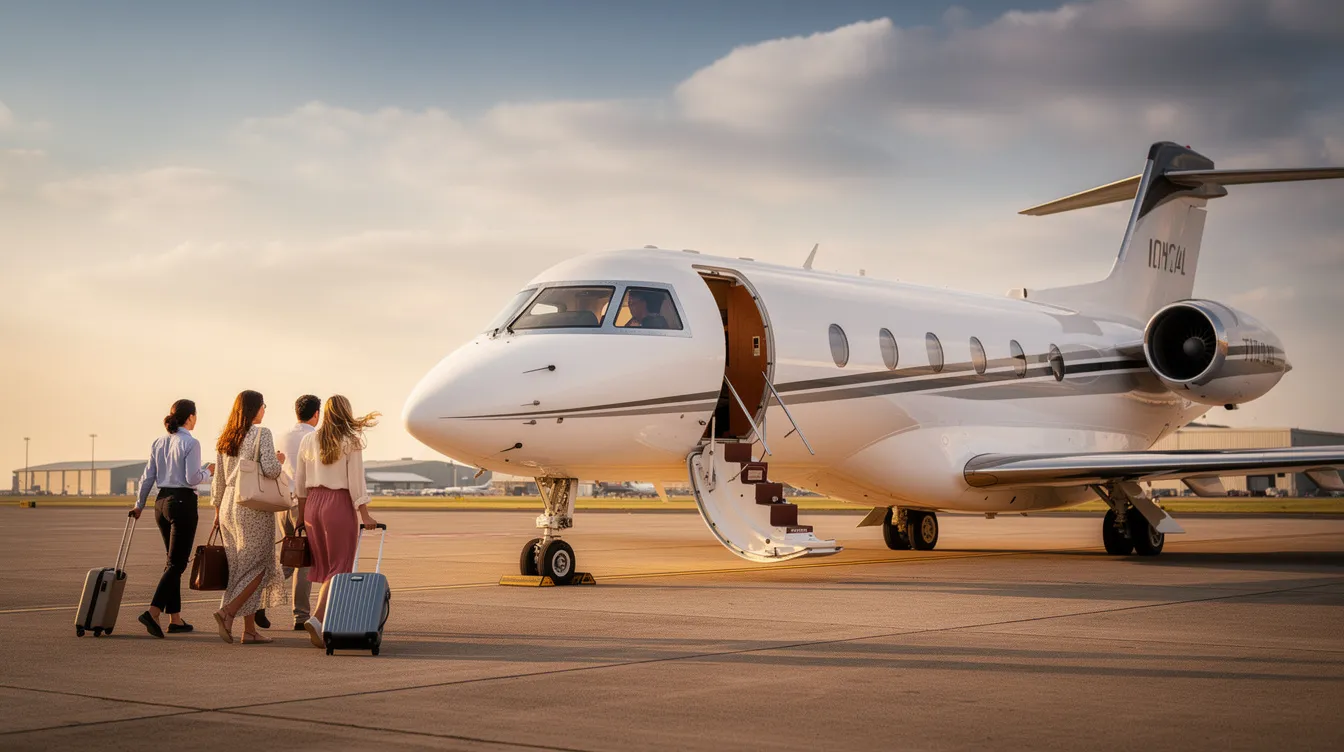
Time Savings vs Cost
Airport Arrival and Security
Consider this contrast: a 2-hour flight from New York to Chicago on a commercial airline typically consumes 4–6 hours door-to-door. You arrive at JFK 2 hours early, navigate 45–90 minute security lines during peak periods, endure boarding delays, wait through 30–45 minutes of taxiing, and add another 20 minutes at baggage claim.
The same trip via private jet from Teterboro? Private jet travelers can often arrive at the airport just 15 minutes before departure, allowing them to avoid crowded terminals, which reduces stress and saves time. You walk directly from the FBO lounge to your waiting aircraft, bags already loaded. Total door-to-door time: 2.5–3 hours. Flying privately can save an average of 2 hours (127 minutes) per flight compared to commercial aviation, saving hours on each trip.
Where the time savings come from:
-
Airport arrival: Arriving 15–30 minutes before departure at an FBO versus 90–180 minutes for commercial flying
-
Security and boarding: Private jet travel allows for a discreet and efficient security process, enabling passengers to bypass crowded lines and enjoy private terminals
-
Baggage handling: Bags loaded curbside with you, no carousel waits
Routing and Airport Access
Private jets have access to over 5,000 airports in the United States, whereas commercial airlines can only reach about 500. This means landing at Teterboro (12 miles from Manhattan) instead of JFK (20+ miles), or Farnborough (45 minutes from London) rather than Heathrow. Private jets can land at smaller airports closer to your final destination, cutting down overall travel time and removing the need for lengthy ground transportation. Flying private also allows you to fly directly to your final destination, bypassing layovers and connecting flights for a more seamless journey.
Private jet charters allow travelers to set their own travel schedule, providing flexibility that commercial airlines cannot match. With private aviation, travelers can often depart within hours of scheduling their trip, allowing for last-minute travel plans without the hassle of busy airports.
Cost Breakdown
The cost reality:
On average, private jet chartering costs between $2,000 to $12,000 per hour, depending on the aircraft type and trip length. Current 2024–2026 rates break down roughly as:
|
Aircraft Type |
Hourly Rate |
Best For |
|---|---|---|
|
Very light jet |
$2,000–$3,000 |
2–4 passengers, short trips, cost-effective option |
|
Light jet |
$2,500–$4,000 |
4–6 passengers, 2–3 hour flights |
|
Super-midsize |
$6,000–$9,000 |
6–8 passengers, coast-to-coast |
|
Large-cabin |
$10,000–$14,000 |
10+ passengers, international |
A Los Angeles–Aspen weekend trip on a light jet runs $12,000–$15,000 one-way versus $1,500 per person in first class on commercial jets via Denver connections.
Valuing Time Savings
Use this framework: (Hours saved × your hourly value) – (Additional flight cost) = rough worth-it gauge. A consultant billing $500/hour, saving 3 hours on a trip,p gains $1,500 in value. For leisure travelers whose time isn’t directly monetized, the calculation shifts toward intangible benefits.
Customization options for private flights include selecting the aircraft size based on passengers and range, optimizing both cost and comfort for your specific needs. Splitting costs with a group or choosing fractional ownership can be a cost-effective option compared to full aircraft ownership.
Rules of Thumb for Time-Based Decisions
-
Back-to-back meetings in two cities (NYC morning, Chicago afternoon) are near-impossible on commercial travel but routine privately.
-
Routes where commercial flying requires multiple connections that double the travel time
-
Trips under 3 hours, where a fixed check-in time represents the largest pain point
In summary, private jet travel offers unparalleled convenience, flexibility, and efficiency for those seeking to maximize their time and comfort.
Productivity Benefits of Private Jet Charter
The Private Jet Work Environment
Many executives justify private aircraft expenses on productivity grounds. The cabin of a private jet serves as a quiet office, ideal for working, conducting a business meeting, or resting, which is difficult in commercial settings.
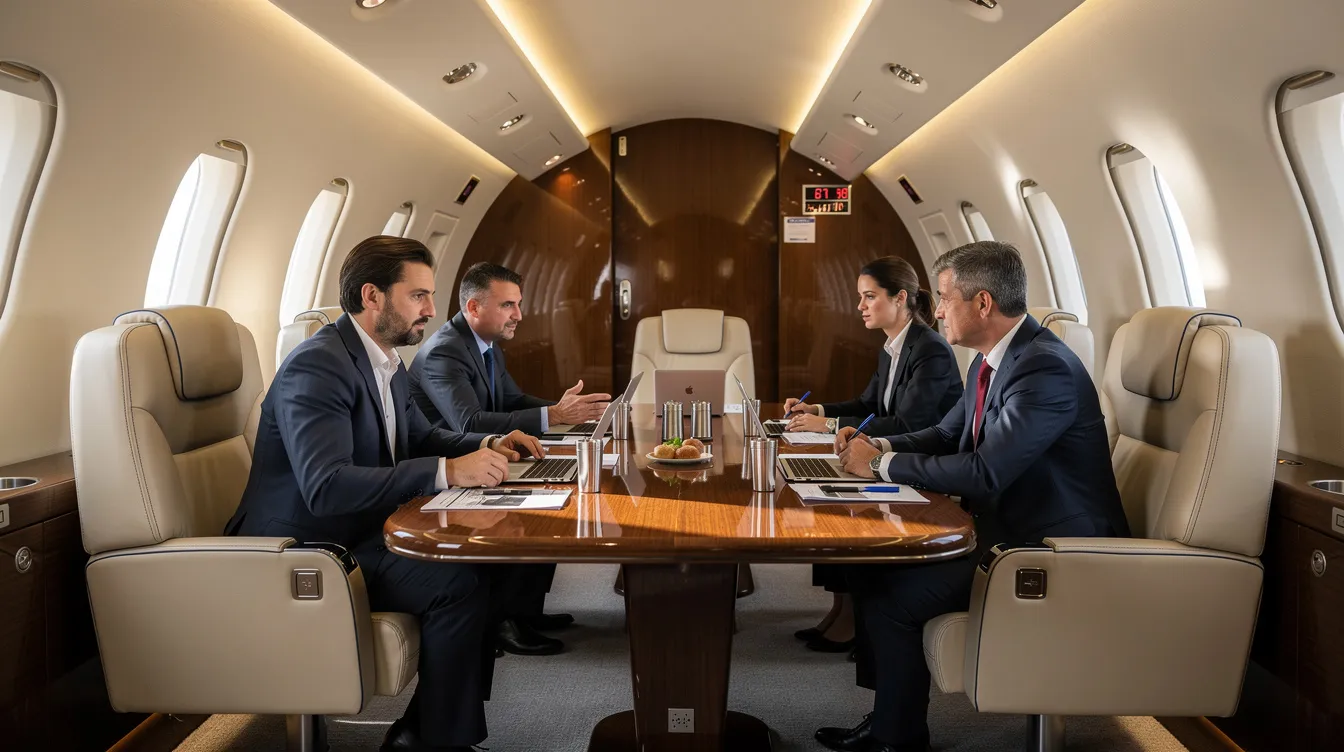
Private jets offer unparalleled privacy, allowing travelers to avoid crowded airports and busy terminals, creating a personal space without interruptions from other passengers. Midsize and larger aircraft feature boardroom-style seating with facing seats, fold-out tables, power outlets everywhere, and Wi-Fi capable of video calls—making it possible to hold a confidential business meeting in-flight.
Private jets offer a customizable flying experience, allowing passengers to tailor every aspect of their journey, including meal choices, seating arrangements, in-flight entertainment, and other services such as personalized amenities or special requests.
Commercial Comparison
Even business class seats and first class cabins on major airlines involve interruptions—trolley service, nearby passengers, public announcements. On U.S. and intra-EU commercial flights, Wi-Fi performance varies widely. A business class seat offers more space than economy but lacks the complete privacy needed for confidential strategy sessions.
Quantified Productivity Gains
On a 3–4 hour flight, a team of four can conduct a full M&A review, legal document analysis, or investor pitch rehearsal without worry of being overheard. Door-to-door time more consistently counts as usable work time, versus commercial air travel, where large chunks disappear into queues and boarding processes.
Confidentiality Matters
Sensitive conversations—negotiations, earnings discussions, HR issues—are safer in a private cabin than in crowded terminals or commercial first class,s where screens and notes are exposed. Some companies explicitly require private flights for specific high-risk discussions.
Wellbeing and Arrival Freshness
Flying privately provides a more luxurious and comfortable experience, with spacious interiors and personalized services that cater to individual preferences. Private jets have a dedicated cabin crew focused on providing personalized service and ensuring passenger safety throughout the flight. Passengers on private jets can enjoy a more luxurious experience with spacious interiors, comfortable seating, and personalized service, making the flight feel more like a relaxing retreat. Quieter cabins, customizable temperature and lighting, and the ability to rest fully mean arriving cognitively sharper.
Private jet travelers often have access to gourmet meals and catering options, allowing them to pre-order meals and select their favorite beverages for a customized culinary experience during the flight. Private jet charters can also include other services such as personalized amenities, special catering, and custom requests to further enhance the travel experience.
A Productivity Test
If the trip outcome depends heavily on your cognitive performance at arrival—closing a deal, high-stakes negotiation—factor that in. But honestly assess whether you truly use in-flight time productively or tend to zone out regardless of cabin type; if anxiety is the main barrier, understanding how an app can help you overcome the fear of flying may be just as important as choosing cabin type.
Group Travel Economics for Private Jets
How Pricing Works
The financial equation transforms when paying for 5–10 people. This is where comparing private jets to commercial flying becomes genuinely competitive.
Private jet charter prices are per aircraft, per flight hour—not per passenger. Chartering a private jet can be more cost-effective for groups, as the total cost can be comparable to business class pricing when split among passengers. There are various private jet offers tailored for group travel, providing options and services that can be customized to your needs, whether for leisure or business. Divide a $20,000 round-trip charter by 8 passengers: $2,500 per person, comparable to high-season commercial first class on many routes.
When considering aircraft types, heavy jets are a popular choice for larger groups or longer trips, offering spacious cabins and extended range. Heavy jet hourly rates typically range from $6,000 to $10,000, making them suitable for those seeking comfort and efficiency on extended journeys.
Concrete Route Examples
|
Route |
Commercial First (8 pax) |
Private Super-Mid |
Per-Person Difference |
|---|---|---|---|
|
Teterboro–West Palm Beach |
$2,500–$4,000/person |
$28,000 total ($3,500/person) |
Similar or slight premium |
|
London–Ibiza (summer) |
£2,000–£2,500/person |
£22,000 total (£2,750/person) |
Within range |
The private option adds direct access to smaller airports closer to final destinations, avoiding crowded airports and the hassle of connection risks.
Hidden Costs for Groups on Commercial
-
Coordinating 8–10 people through long security lines at major airport hubs
-
Risk of split bookings, separated seating, or missed connections affecting the entire group
-
Ground transportation costs from commercial airports (often 45–60 minutes from destinations) versus smaller airports,s minutes away
Corporate Multi-Leg Scenarios
When executives from different cities need to meet in a central location, a private plane can collect them via multi-leg routing, which is impossible on scheduled flights. Example: pick up NYC executives at 6 AM, land in Chicago for the LA team, and continue to the Denver meeting—all in one morning.
Family and Special Occasions
For destination weddings or multi-generation vacations, flying private simplifies logistics dramatically. Pets travel comfortably without cargo holds. Bulky sports gear (skis, golf clubs) loads without additional fees or damage risk. Special dietary needs are handled through personalized catering.
When Commercial Still Wins
Sometimes buying a block of economy or premium economy seats remains cheaper, even for 8–10 people on shorter flights. Run the math: total group cost in a commercial economy versus private jet cost per head before deciding.
Rules of Thumb
-
At 6–8 travelers on busy leisure routes, the private jet's worth becomes a serious calculation.
-
For fewer than 4 people, commercial business or first class is typically more cost-effective unless routing is extremely unfavorable.
-
Factor ground transportation and time costs into the comparison
When Private Jet Worth Makes Sense
Flying private is a precision tool, not a lifestyle default. Chartering a private jet provides a more personalized travel experience, allowing travelers to customize their schedules and avoid the rigid timetables of commercial flying.
Worth It Scenarios
-
Time-critical business trips: same-day round-trip with important business meetings in two cities, medical or legal emergencies
-
Remote locations: island strips, secondary ski resorts, industrial towns where commercial aviation requires 3+ connections
-
Valuable or sensitive cargo: equipment, time-critical samples, situations where reliability outweighs ticket price
Frequent, last-minute travel favors private aviation, while infrequent leisure travel may not justify the significant investment.
Lifestyle Scenarios
-
High-stakes life events where stress reduction matters—weddings, major anniversaries, an unforgettable journey worth protecting
-
Families with small children, elderly relatives, or pets found that avoiding other passengers and crowded terminals dramatically improved the experience
Usually Not Cost-Effective
-
Short hops between major hubs with frequent commercial flights (NYC–Boston, London–Paris) for solo leisure
-
Long-haul international routes where commercial first class offers lie-flat beds, showers, and gourmet meals that close the comfort gap
Environmental Concerns
Private jets have a significantly higher carbon footprint per passenger compared to commercial airliners—5–14x more CO₂ when not full. Growing regulatory scrutiny in Europe includes discussions of bans on ultra-short private flights and higher green taxes. For organizations analyzing route choices and emissions in detail, a flight and turbulence data API can support more informed planning. Mitigation options: carbon offset program, choosing newer, fuel-efficient, larger aircraft, and filling seats fully.
Ownership vs. Charter
If flying over 200+ hours annually, ownership or fractional ownership may be more cost-effective than on-demand chartering. Below that threshold, chartering or jet cards typically offer better economics without the ongoing costs of crew salaries, hangar fees, maintenance, and regulatory compliance.
Private jet ownership involves significant responsibilities beyond the purchase price—experienced companies recommend chartering first to understand your actual usage patterns.
Mental Wellness Considerations
Some anxious travelers feel safer with fewer strangers and more control. Others find smaller jets and turbulence more unnerving than commercial jets, which handle rough air more smoothly due to larger aircraft mass. Tools like the SkyGuru app help anxious flyers understand flight stages, noises, and turbulence in real-time—useful on both commercial and private flights.
Decision Framework
-
Define primary goal: time saving, comfort, productivity, privacy, or reducing stress.
-
Get realistic quotes for both private jet charter and commercial options for your specific date.s
-
Factor in time value, group size, environmental concerns, and mental well-being
-
Decide whether her additional cost delivers enough concrete benefit based on your individual circumstances.
Frequently Asked Questions About Flying Private
How does flying private compare with first class on commercial airlines?
On short-haul routes, private offers superior time savings and direct access to smaller airports. On long-haul international routes, top-tier commercial first class (Emirates, Singapore) offers amenities like showers and lie-flat beds that most private jets lack—at roughly 20% of the cost.
What are the main operating costs if I consider owning a jet?
Aircraft ownership involves capital outlay ($5–$50M depending on aircraft), plus annual operating costs of $1–$5M, including crew salaries, hangar fees, maintenance (typically 10% of hull value), insurance, landing fees, and fuel surcharges. For fewer than 200 flight hours annually, chartering is typically more economical.
Can flying private ever offer cost savings over commercial flying?
Yes—in group travel scenarios where 6–10 passengers split costs, last-minute business trip flexibility, or empty leg flights, which are discounted one-way trips when a private jet needs to reposition. These can offer 30–75% discounts for flexible schedules.
How bad is the environmental impact of private jets?
Private aviation produces 5–14x more CO₂ per passenger than commercial travel when not fully loaded. Emerging sustainable aviation fuels show promise (80% reduction potential), and regulatory pressure is increasing. Full planes and newer aircraft partially mitigate the impact.
Does flying private feel safer or smoother than commercial flights?
Statistically, commercial airlines have superior safety records. Private flight safety depends heavily on operator standards—research on charter operators for safety records, such as ARGUS or Wyvern ratings, is recommended before choosing a service. Turbulence feels more pronounced in smaller aircraft; real-time explanation tools help regardless of flight type.
How should I start evaluating my first private charter?
Compare quotes from multiple experienced companies, verify safety ratings, read fine print on additional fees (deicing, fuel surcharges, repositioning), and honestly assess whether you need private travel versus a well-chosen commercial itinerary. The personalized flying experience is valuable—but only when it genuinely serves your needs.
There’s no universal answer to whether flying private is worth it. The decision depends on your specific circumstances: trip purpose, group size, time value, and personal priorities around passenger safety and comfort.
Run the numbers trip by trip. Compare realistic commercial options against private jet costs for your specific dates and routes. And whichever mode you choose, use available tools—including the SkyGuru app FAQ for flight anxiety management details—to make your journey as smooth as possible.
Conclusion
Is flying private worth it? The answer depends heavily on your individual travel needs, priorities, and budget. Private jet travel offers unmatched time savings, flexibility, and privacy that commercial flying cannot match. For time-critical business trips, group travel with 6–10 passengers, or destinations poorly served by commercial airlines, private aviation can deliver significant value and justify the premium cost.
The productivity benefits of a private jet—quiet, customizable cabins enabling confidential meetings and focused work—are especially compelling for executives and professionals. Additionally, flying privately reduces travel stress and enhances comfort, contributing to better wellbeing and sharper performance upon arrival.
However, for solo leisure travelers on well-served routes, commercial flights, particularly business or first class, often provide better cost-effectiveness. Environmental considerations and the high carbon footprint of private jets also weigh into the decision.
Ultimately, the choice to fly private should be made using a clear framework: evaluate your time value, group size, travel frequency, and the intangible benefits of privacy and comfort. Comparing realistic private charter quotes against commercial flight options for your specific itinerary will help you make an informed decision.
Whether flying commercial or privately, tools like SkyGuru can assist in managing flight anxiety and improving your overall travel experience. Reviewing SkyGuru’s detailed FAQ on features and setup can help you decide if it fits your needs. Use all available resources to ensure your journey aligns with your personal and professional goals.
Flying private is not just a luxury; when chosen thoughtfully, it can be a strategic investment in time, productivity, and peace of mind.
FLEET SELECTION
JET CARDS
COST ANALYSIS


How to Auditing Your Operator's Maintenance Logs
Oct 05, 2025

How to Auditing Your Operator's Maintenance Logs
Oct 05, 2025

How to Auditing Your Operator's Maintenance Logs
Oct 05, 2025
Sky Guru Weekly
The smartest private aviation intelligence in your inbox.
.svg)

