



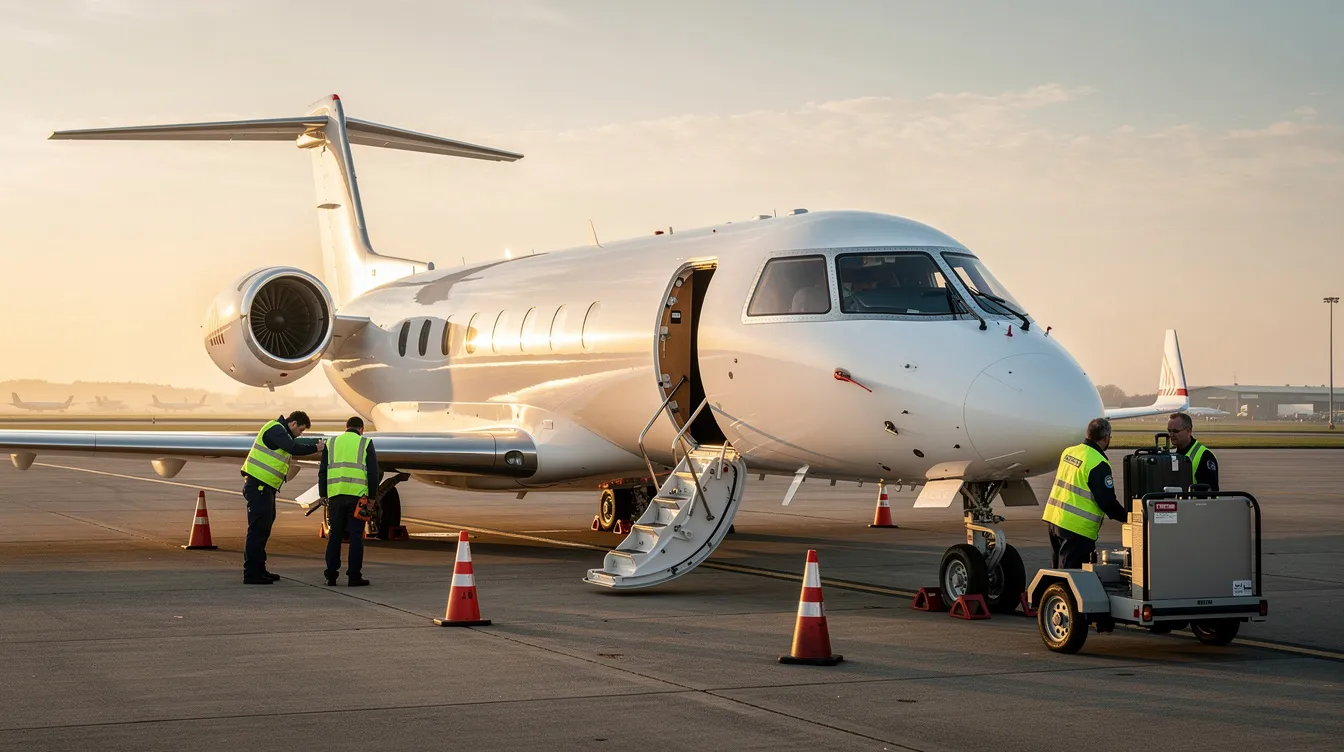
This guide is intended for business aviation professionals, jet owners, and charter clients seeking to understand how replacement private jets are sourced and what to expect during the process. When a replacement private jet is needed—such as when a primary aircraft suddenly cannot fly—a complex chain of events begins behind the scenes. This process is coordinated by a dedicated team of experts who ensure every detail is managed efficiently. In business aviation, a replacement private jet—also called a backup aircraft—is sourced and substituted within minutes to keep high-stakes missions on schedule.
This article covers the key aspects of replacement private jet sourcing, including how alternatives are found quickly, how jet types are matched to mission requirements, timing challenges, and what passengers can expect during the process. Understanding this process reveals the expertise, relationships, and safety protocols that protect passengers even when plans change unexpectedly. This focus on customer satisfaction ensures that clients benefit from comfort, reliability, and peace of mind during these situations.
Finding Alternatives Quickly
Common Reasons for Replacement
A “replacement private jet” in business aviation refers to an alternative aircraft sourced when the primary jet goes AOG (Aircraft on Ground)—any unscheduled maintenance event that grounds the plane beyond routine checks. Data from industry tracking shows AOG incidents affect 12–15% of Part 135 charter flights annually, with 40% requiring same-day replacements.
Common reasons a backup aircraft is needed:
-
Unplanned maintenance findings during preflight checks (avionics faults account for 28% of cases)
-
Crew duty-time limits approaching maximum hours before departure
-
Weather diversions that strand the original aircraft at a different airport
-
Last-minute changes to the mission profile, such as additional passengers exceeding weight limits
Aircraft Classes Considered
Aircraft classes considered for replacement:
-
Light jets: Ideal for short hops, limited luggage, and smaller groups.
-
Midsize jets: Offer more range and comfort, suitable for coast-to-coast flights.
-
Super-midsize jets: Balance range, speed, and cabin space for transcontinental missions.
-
Ultra-long-range jets: Specifically built to carry large groups and luggage over long distances with spacious interiors, these jets can travel between continents on a single tank of fuel and are supported by the majority of airports, including all major airports, though remote or smaller airports may not accommodate them.
How Operators Find Alternatives
How operators find alternatives:
-
Charter operators, brokers, and flight departments maintain real-time access to aircraft availability databases.
-
Platforms like Avinode process over 50,000 daily inquiries, aggregating 5,000+ operators globally.
-
Internal fleet boards and proprietary systems allow sub-30-minute sourcing in many cases.
Decision Hierarchy
The decision hierarchy behind the scenes:
-
Lead dispatcher (FAA-certified) initiates the operations control center conference.The
-
Director of Operations approves via the risk assessment matrix.
-
Maintenance control verifies the backup aircraft’s 100-hour inspection currency.
-
All coordination happens within approximately 52 minutes.
Speed is balanced with safety and legality: a backup aircraft is only confirmed after maintenance status, insurance alignment, and regulatory compliance (Part 135 or equivalent) are cross-checked. Non-compliance risks $30,000+ fines per incident.
-
SkyGuru’s role: When the tail number and schedule suddenly change, our SkyGuru app can still provide live explanations of what’s happening, reducing anxiety caused by unexpected aircraft swaps.
Concrete Scenario
On 14 October 2026, a Gulfstream G550 scheduled from Teterboro to London Heathrow (6 passengers, 5,500nm route) fails a hydraulic servo check during preflight. The operator has under one hour to source a replacement private jet. Dispatchers query databases for G650 or G700 equivalents within 800nm, identifying a Challenger 650 in Westchester (45-minute ferry).
Once a suitable replacement is identified, matching the jet type to the mission requirements becomes the next critical step.
Matching Business Jets Types
Defining Mission Profile
Not every available jet can serve as a backup. The replacement private jet must match range, runway performance, cabin size, and mission profile—not just “have seats.” Defining your mission profile is critical when looking for a replacement private jet to ensure the aircraft meets evolving travel needs.
Hard Constraints Dispatchers Check First
Hard constraints dispatchers check first:
-
Required routing (e.g., New York–São Paulo requires ultra-long-range capabilities)
-
Number of passengers and baggage volume
-
Special needs: ski equipment, medical gear, pets in cabin
-
Passenger and baggage capacity should be considered carefully, as advertised seating may not always reflect comfortable capacity for long-haul flights
Aircraft Class Determines Options
Aircraft class determines options:
|
Class |
Example Models |
Typical Range |
|---|---|---|
|
Light jet |
Cessna Citation CJ4 |
2,000nm |
|
Midsize |
Citation XLS+ |
2,200nm |
|
Super-midsize |
Challenger 350 |
3,200nm |
|
Large cabin |
Gulfstream G550 |
6,750nm |
|
Ultra-long-range |
Bombardier Global 8000 |
8,000nm |
*Typical range values are based on International Standard Atmosphere (ISA) conditions and include NBAA IFR reserves for operational safety.
The Bombardier Global 8000 is the fastest business jet in civil service at Mach 0.95, making it the top speed leader in its class and faster than most rivals. The Gulfstream G-550 can operate across nearly 7,800 nautical miles, while the Falcon 7X can fly more than 6,800 nautical miles—showcasing the extensive range of ultra-long-range business jets.
Range and Fuel Planning Recalculations
-
Replacing a Global 6000 with a Falcon 2000LX might add a Shannon fuel stop (+90 minutes).
-
Crew duty calculations must be updated when travel time changes.
-
Operating costs for ultra-long-range jets typically range from $7,000 to $9,500 per flight hour, making them some of the most expensive jets to operate.
Runway and Airport Performance
-
Runway performance is important for jets frequently using smaller regional airports or high altitude/temperature locations, requiring aircraft with superior takeoff and landing performance.
-
Some backup aircraft cannot use shorter runways; operators may switch from London City (4,948ft) to Luton (7,277ft) when changing aircraft.
Cabin and Layout Considerations
-
Seating configuration (club, divan, conference table) must meet passenger expectations.
-
Consider passenger wellness features such as lower cabin altitude and air purification systems to reduce travel fatigue and jet lag.
-
Reliable, high-bandwidth Wi-Fi is required for business productivity in modern private jets, and aircraft are designed to support various internet connectivity options. Comprehensive product and customer support services are also essential to ensure reliable operation and satisfaction.
-
Ultra-long-range jets are designed with spacious cabin interiors, allowing comfortable travel for large groups.
Corporate Pre-Approval Lists
-
Many flight departments maintain lists of “acceptable” backup types for executives.
-
Market trends favor late-model aircraft (0–5 years old) equipped with modern avionics.
-
Established brands like Cessna, Piper, and Beechcraft retain their value well in the private jet market.
-
The average purchase price for a pre-owned ultra-long-range jet ranges from $20 million to $30 million, while new models can cost up to $65 million.
New Versus Pre-Owned Considerations
-
New jets offer the latest technology, better fuel efficiency, and warranties, but are more expensive compared to pre-owned options.
-
New jets typically offer full warranties but come with higher upfront costs and steeper initial depreciation.
-
Depreciation rates for new jets can range from 7% to 20% in the first year, while pre-owned jets may avoid this initial depreciation hit.
-
Maintenance programs like ‘power-by-the-hour’ can stabilize costs and improve resale value for pre-owned aircraft.
-
Factors influencing the purchase price and operating costs of ultra-long-range jets include the age of the jet, included amenities, and the duration of operation.
Modern Avionics and Technology
-
SkyGuru adapts: The app can explain why a substitute aircraft may climb differently, sound louder or quieter, or experience more/less turbulence due to differences in wing design (such as the Bombardier Smooth Flĕx Wing) and cruise altitude.
Modern avionics in these jets often feature advanced fly-by-wire systems and integrated wiring, enhancing control, safety, and digital cockpit interfaces for improved ergonomics and reliability, and operators can leverage the SkyGuru API platform for detailed flight and weather data to further optimize route and safety planning.
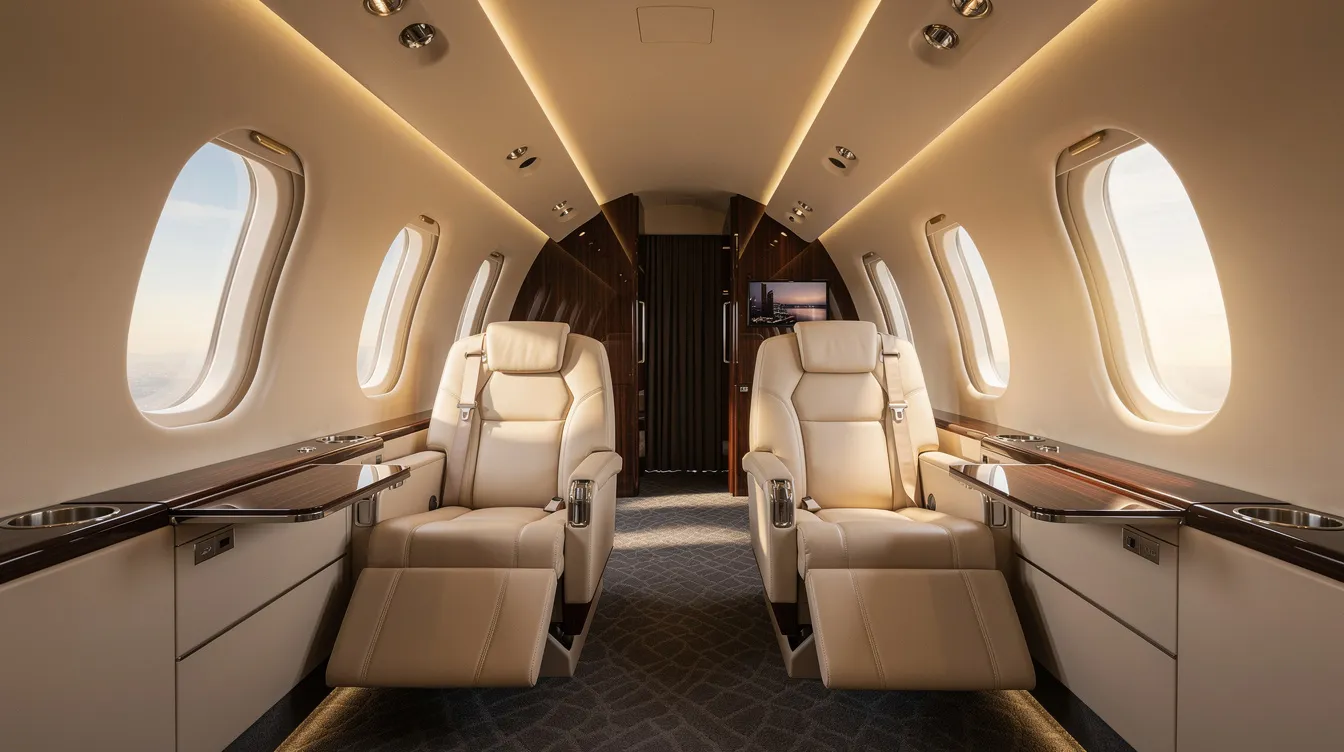
With the right jet matched to the mission, timing becomes the next major operational challenge in the replacement process.
Timing Challenges
Crew Duty-Time and Rest Rules
Timing is the biggest operational challenge in sourcing a replacement private jet. The decision often happens in a 20–90 minute window before scheduled departure. Beyond that window, 60% of missions cascade to the next day.
Crew duty-time and rest rules:
-
Most operators follow 1014-hour maximum duty limits.
-
Swapping aircraft may require a different crew if the original pilots are about to “time out.”
-
10-hour minimum rest requirements must be protected.
How Maintenance Delays Cascade
-
If an inspection overruns by 45 minutes, dispatch must decide: accept the delay, swap aircraft, or reposition.
-
Repositioning means flying an empty aircraft from a nearby base (e.g., Miami to Palm Beach).
-
Investigating an aircraft’s history, including damage and maintenance records, is crucial for pre-owned aircraft being considered as backups, just as leveraging a flight and turbulence data API like SkyGuru’s is vital for analyzing route risks.
Airport Constraints
-
Nighttime curfews (Geneva’s 21:00 deadline).
-
Slot-controlled airports (Heathrow’s 15-minute windows).
-
De-icing queues in winter (60-minute waits at ORD per FAA data).
Concrete Scenario
A business jet scheduled to depart Geneva at 20:30 cannot be delayed past the 21:00 curfew. The operator uses a backup jet already positioned in Zurich—a 40-minute drive for passengers—to avoid missing the departure window.
Ground Handling Realities
-
Even when a backup jet is found quickly, moving catering, loading baggage, and updating flight plans takes 30–60 minutes.
-
Passengers may experience this as “waiting with no visible activity.”
Dispatcher Juggling Act
-
Constantly recalculating ETD (Estimated Time of Departure) and ETE (Estimated Time Enroute).
-
Simultaneously communicating with passengers, crew, maintenance, and airport slots.
-
Understanding the total cost of ownership, including maintenance, fuel, staffing, and depreciation, is essential when managing fleet operations.
-
SkyGuru reduces waiting stress: The app can guide anxious flyers through timing changes, explaining why delays happen (crew rest, maintenance, de-icing) and what safety checks are being prioritized; passengers can consult the SkyGuru FAQ on in‑flight functionality and data use to understand exactly how this works even in airplane mode.
After overcoming timing and logistical hurdles, the passenger experience during a replacement event becomes the final focus.
What Passengers Experience
The Typical Passenger Journey
Being told “we’re changing aircraft” with little explanation can feel confusing and stressful—especially for those who already experience flight anxiety. Uncertainty amplifies worry, but understanding what’s happening behind the scenes transforms that anxiety into informed awareness, and dedicated resources on how an app can help fear of flying or overcome flight anxiety with app-based support can further support anxious passengers.
The typical passenger journey during a backup situation:
-
Initial vague announcement about “technical updates.”
-
Extended time in the FBO lounge (average +45 minutes)
-
Last-minute change of tail number on the manifest
-
Sometimes,s a different cabin interior than expected, with varying aesthetics that enhance comfort and visual appeal through thoughtful design choices
Why Communication Is Often Limited
Is this communication often limited?
-
Crew may be waiting for final approvals from operations, maintenance, or the aircraft owner
-
Promising a specific departure time that could later change creates more anxiety
-
Aviation advisors or consultants can assist in managing complex pre-purchase inspections and legal paperwork, but real-time swaps require rapid internal coordination
Physical Differences Passengers Notice
Physical differences passengers notice:
-
Seat layout and cabin noise levels vary by aircraft type, and some jets are equipped with dedicated meeting spaces and technology for business presentations
-
Climb angle and takeoff speeds differ significantly (e.g., CJ4’s 130kts versus Global 8000’s 160kts)
-
Wing design affects turbulence perception at different cruise altitudes
Airport Changes
-
Sometimes, passengers are driven from a congested major airport to a quieter satellite field.d
-
This is often the fastest safe option when the backup aircraft is based elsewhere .re
-
For some, these experiences prompt consideration of the possibility of owning or chartering such jets, leading clients to assess the feasibility and benefits.
Safety Perspective
An aircraft is replaced precisely because something did not meet strict limits. On April 2, 2011, the second G650 test aircraft crashed during takeoff from the Roswell International Air Center, New Mexico, killing four Gulfstream employees. The aircraft caught fire after the crash, emphasizing the severity of the incident. The National Transportation Safety Board determined that the probable cause was an aerodynamic stall due to failure to properly develop and validate takeoff speeds. Following this investigation, Gulfstream raised the V2 speed from 135 knots to 150 knots. This example illustrates why operators prioritize safety over schedule—factors influencing any purchase price and operating decision include rigorous testing and data analysis. Analyzing your most frequent routes helpsdetermine thee necessary jet category based on range and distance requirements. Many aircraft technologies and branding elements are registered trademarks, underscoring authenticity and credibility.
-
SkyGuru as translator: Once passengers input updated flight details, the app explains unusual sounds, extended ground time, or different climb patterns on the new aircraft in real time—reducing the stress that comes from not knowing what’s normal; additional SkyGuru FAQ guidance on features, compatibility, and pricing helps set expectations before the trip.
Passengers often arrive feeling ready and refreshed for their next activity or meeting, thanks to the comfort and amenities provided onboard, especially when supported by SkyGuru’s real‑time explanations praised across global media that keep anxiety levels low throughout the journey.
The next time your aircraft changes unexpectedly, you’ll understand the expertise, safety checks, and coordinated effort that made it happen. Download SkyGuru to stay informed throughout your flight, transforming uncertainty into confidence, and explore how apps can help you manage fear of flying long before you step onboard.
FAQs About Replacement Private Jets and Backup Aircraft
What is a replacement private jet?
A replacement private jet, also known as a backup aircraft, is an alternative aircraft sourced quickly when the primary jet is unavailable due to maintenance, crew duty limits, or other operational issues. It ensures continuity of travel without significant delays.
How quickly can a backup aircraft be sourced?
Thanks to real-time databases and coordinated operations centers, backup aircraft can often be identified and confirmed within 30 to 60 minutes, balancing speed with safety and regulatory compliance.
How do operators match the replacement jet to the mission?
Operators consider range, passenger capacity, baggage volume, runway performance, and special mission needs to ensure the replacement jet meets or closely matches the original mission profile.
Why might passengers notice differences during a replacement flight?
Different aircraft types have varying cabin layouts, noise levels, climb rates, and onboard amenities. Passengers may also experience changes in departure airport or timing due to logistical constraints.
How does safety factor into sourcing a backup aircraft?
Safety is paramount. Backup jets undergo strict maintenance and certification checks, and operators follow regulations to avoid risks. Historical incidents, such as the Gulfstream G650 crash, reinforce the importance of rigorous safety standards.
Can apps like SkyGuru help during aircraft changes?
Yes. Apps like SkyGuru provide real-time explanations of flight changes, unusual sounds, or delays, helping reduce passenger anxiety by translating behind-the-scenes operations into understandable insights.
Conclusion
Sourcing a replacement private jet involves a highly coordinated, behind-the-scenes operation that balances speed, safety, and passenger comfort. From rapidly identifying suitable backup aircraft—often within an hour—to matching jet types with precise mission requirements, every step demands expert knowledge and real-time decision-making. Timing challenges such as crew duty limits, airport restrictions, and maintenance delays add complexity, requiring seamless communication among dispatchers, maintenance teams, and operators. Passengers may notice changes in cabin layout, aircraft performance, or departure airport, but these adjustments are carefully managed to minimize disruption and maintain safety standards.
The rigorous safety protocols, illustrated by historical incidents like the Gulfstream G650 crash, underscore why operators prioritize thorough checks over schedule pressures. Tools like SkyGuru enhance the passenger experience by providing real-time explanations that reduce anxiety during unexpected aircraft changes, as highlighted in various media reviews of the SkyGuru app’s effectiveness against fear of flying. Understanding what happens behind the scenes in sourcing replacement private jets builds trust and appreciation for the expertise that keeps business aviation reliable and secure, even when plans must change quickly.
FLEET SELECTION
JET CARDS
COST ANALYSIS


How to Auditing Your Operator's Maintenance Logs
Oct 05, 2025

How to Auditing Your Operator's Maintenance Logs
Oct 05, 2025

How to Auditing Your Operator's Maintenance Logs
Oct 05, 2025
Sky Guru Weekly
The smartest private aviation intelligence in your inbox.
.svg)

