



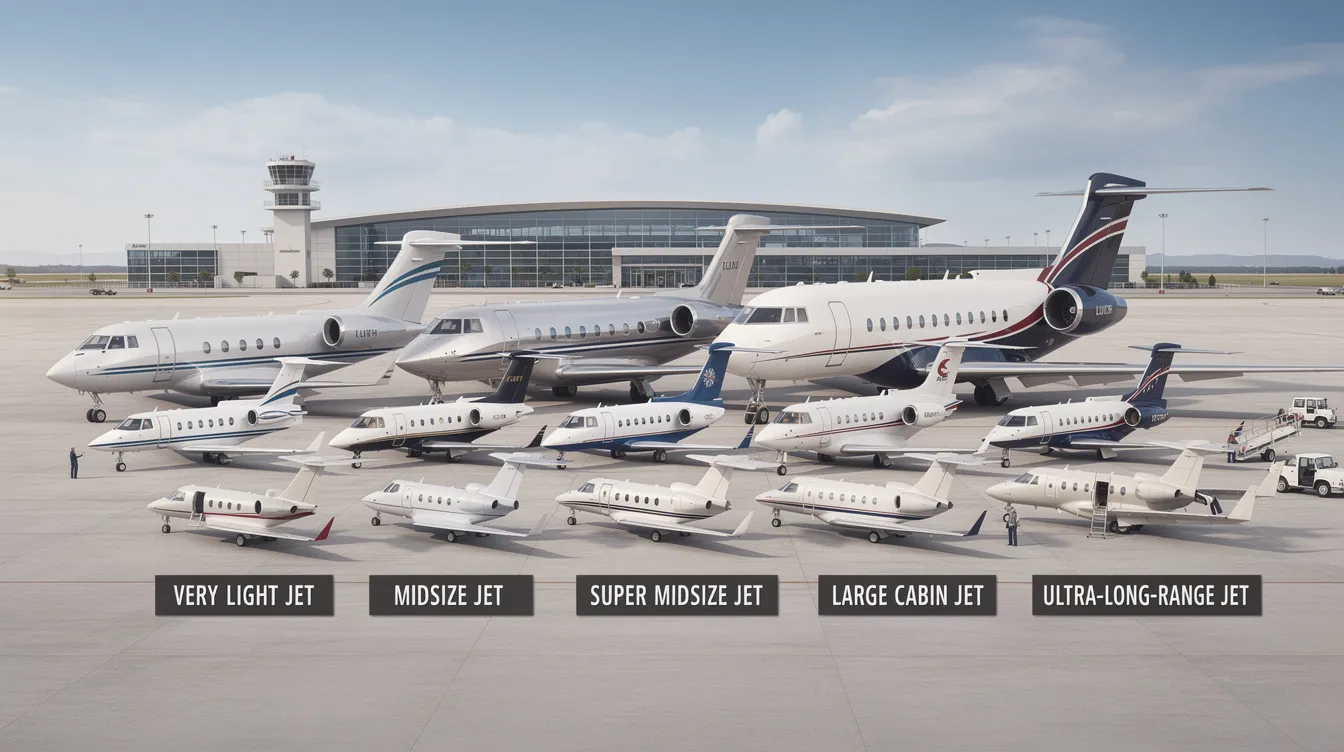
When you start exploring private air travel, the terminology can feel overwhelming. Light jets, midsize jets, heavy jets, turboprops—what do these categories actually mean, and how do they affect your experience on board?
Private jets are typically classified into seven primary categories based on their size, passenger capacity, and range capabilities.
-
Very Light Jets (VLJs): The smallest jet category, typically seating 4–6 passengers, designed for short-haul flights.
-
Light Jets: Slightly larger than VLJs, seating 6–8 passengers, suitable for short to medium-range trips.
-
Midsize Jets: Offer more cabin space and range, accommodating 8–10 passengers for regional or short transcontinental flights.
-
Super Midsize Jets: Bridge the gap between midsize and heavy jets, with extended range and comfort for 8–10 passengers.
-
Heavy Jets: Spacious cabins for 10–12 passengers, designed for long-haul, intercontinental travel.
-
Ultra-Long-Range Jets: Capable of flying over 7,000 nautical miles, seating 12–19 passengers for non-stop global travel.
-
Executive Airliners (Bizliners): Converted commercial jets with custom luxury interiors, offering the ultimate in space and amenities for VIP travel.
Understanding these categories helps you match the right aircraft to your journey, whether you’re hopping between cities for a business meeting or crossing continents with your family.
Think of it like choosing ground transportation. A very light jet is your compact city car—efficient for short trips, cozy inside. A midsize jet works like an SUV—more space, longer range, comfortable for road trips. Heavy jets are the luxury coaches of the sky—designed for long hauls with room to stretch out, work, or even sleep.
This guide breaks down private jet types explained in plain language, focusing on what matters most to passengers: comfort, range, noise, and how each aircraft type actually feels during flight, while the SkyGuru API flight and weather data platform provides the technical route and turbulence information behind those sensations. At SkyGuru, we help nervous flyers understand the sounds and sensations of flight in real time, and media coverage of our fear-of-flying turbulence prediction app highlights how this guidance supports anxious travelers, so we’ll also touch on what you might experience aboard different aircraft types.
What you’ll learn:
-
The practical differences between turboprops and jets
-
What light jets, midsize jets, and heavy jets offer passengers
-
Concrete examples like the Cessna Citation, Gulfstream, Bombardier models, and leading manufacturers such as Dassault Aviation are renowned for their luxury business jets.
-
How to choose the right private jet type for your specific trip
Turboprops vs Jets
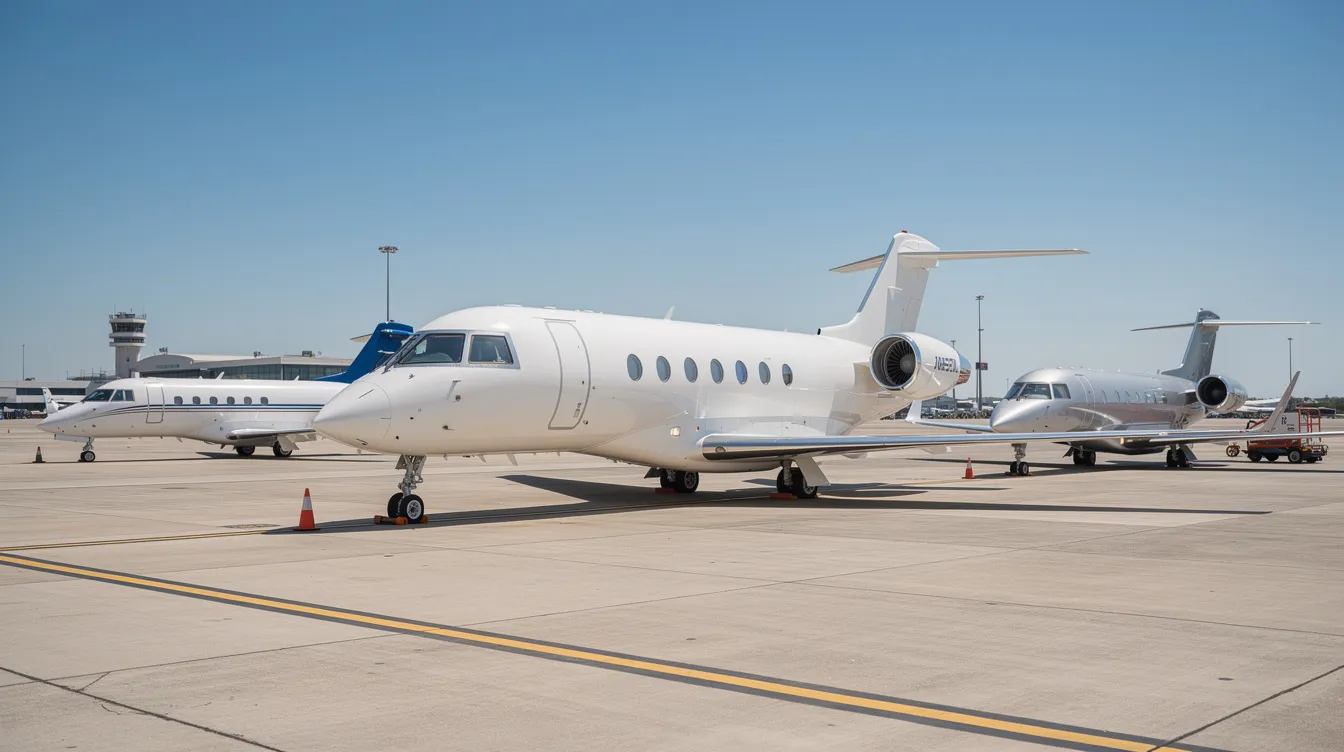
Before diving into jet categories, it’s worth understanding the fundamental split in private aircraft: turboprops versus jets. Both are powered by turbine engines, but they deliver thrust differently, and detailed flight and turbulence data via the SkyGuru API helps explain how these performance differences affect the ride.
A turboprop uses its engine to spin a propeller, which pulls the aircraft through the air. A jet engine, by contrast, produces thrust by expelling hot gases directly backward. This difference affects speed, altitude, noise, and how the flight feels to passengers.
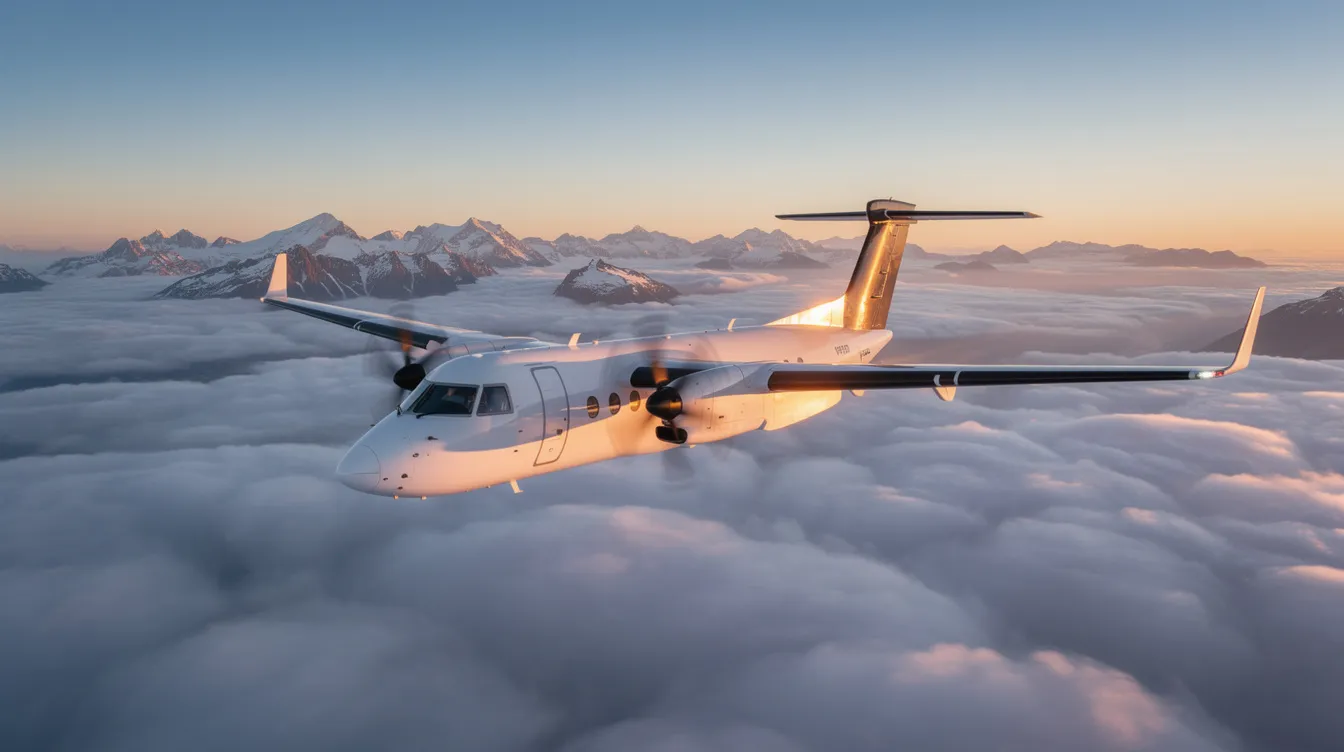
Turboprops excel at short regional hops—typically 500 to 1,000 nautical miles. Routes like London to Paris, Dallas to Houston, or Milan to Geneva are their sweet spot. Popular models include the Beechcraft King Air 350i and the Pilatus PC-12, which can carry up to nine passengers while accessing smaller airports with shorter runways.
Jets climb faster, fly higher, and cruise significantly quicker. While a turboprop cruises at 250–330 knots (roughly 460–610 km/h) at 20,000–30,000 feet, a small business jet pushes 400–500 knots (740–930 km/h) at 35,000–45,000 feet. That altitude difference matters: jets typically fly above most weather conditions, resulting in smoother rides.
Quick comparison: Turboprop vs Jet
-
Cruise speed: Turboprop ~300 knots vs Light jet ~450 knots
-
Typical altitude: Turboprop 20,000–30,000 ft vs Jet 35,000–45,000 ft
-
Cabin noise: Turboprop 90–100 dB vs Jet 75–85 dB
-
Hourly charter: King Air ~€1,000–2,000 vs Cessna Citation CJ3+ ~€2,500+
-
Runway needs: Turboprops often need less than 3,000 ft
-
Passenger capacity: Both typically 4–9 passengers
For comfort, jets generally win, especially for travelers who benefit from apps that help overcome the fear of flying by explaining what they feel on board. Turboprops produce a distinctive propeller vibration (a low-frequency buzz around 10–20 Hz) and higher cabin noise levels. At lower altitudes, turbulence affects the aircraft more noticeably. Jets feel smoother and quieter, which many nervous flyers find reassuring.
That said, both turboprops and jets in business aviation meet strict safety certification standards. The safety difference comes down to operator quality and maintenance practices, not engine type. Whether you’re aboard a King Air or a Citation, modern private aircraft are designed to the same rigorous standards as commercial aviation.
For anxious travelers, turboprops’ slower climb rate (around 1,500 ft/min versus 3,000+ ft/min for jets) means you spend more time at lower altitudes where ground effects and weather are more noticeable. The SkyGuru app can help explain these sensations—the propeller whine, the climb phases, the turbulence—so they feel predictable rather than alarming.
Light Jets
Light jets represent the entry point into jet-powered private aviation. This category spans very light jets (VLJs), small light jets, and super light jets—aircraft designed for trips of two to three hours, covering roughly 1,200 to 2,500 nautical miles.
Very Light Jets (VLJs) are the smallest category of private jets, usually seating 4 to 6 passengers and designed for short-haul flights lasting up to three hours. Their typical maximum flight time is around 2.5 to 3 hours, making them especially suitable for short trips where quick turnaround is key. Light jets accommodate 6–8 passengers, often with limited cabin height, providing a range of approximately 1,500–2,000 nautical miles.
Typical missions include day trips for small groups: Los Angeles to San Francisco (340 nm, about 1.5 hours), London to Geneva (500 nm, under 2 hours), or New York to Chicago (650 nm, under 2 hours). These are “get there and back” flights where passengers prioritize speed and privacy over sleeping space or elaborate catering.
Aircraft examples by sub-category:
-
Very light jets:
-
Embraer Phenom 100EV (4–6 pax, 1,367 nm range, 404 knots cruise)
-
HondaJet Elite S (6 pax, 1,437 nm, 422 knots with notably quiet 80 dB cabin)
-
Eclipse 500 (4 pax, 1,125 nm)
-
-
Small light jets:
-
Cessna Citation CJ3+ (7 pax, 2,040 nm, 416 knots)
-
Cessna Citation M2 (6 pax, 1,550 nm)
-
Hawker 400XP (8 pax, 1,500 nm)
-
-
Super light jets:
-
Embraer Phenom 300E (8–10 pax, 2,010 nm, 453 knots)
-
Cessna Citation XLS+ (8–9 pax, 2,100 nm)
-
Gulfstream G100 (7 pax)
-
Cabin experience on light jets varies. Most feature club-style seating for four passengers facing each other, with additional seats behind. Reclining seats are available in some models, enhancing comfort for longer journeys. You’ll typically find a mini-galley with coffee and snacks, and most models include an enclosed lavatory—though the smallest VLJs may have only a curtained emergency option. Don’t expect a flight attendant; on light jets, the pilots handle any service needs.
The operational advantage of light jets is access. These smaller aircraft can use shorter runways at smaller airports—often 3,000 to 4,000 feet—putting you closer to city centers or remote destinations that larger jets can’t reach. This can save an hour or more of ground travel compared to flying commercial into busier airports.
Charter costs for light jets typically range from €1,500 to €3,500 per flight hour, making them the most cost-effective entry into private aviation for small groups. When comparing light jet vs heavy jet economics, you’re trading cabin space and range for significantly lower operating costs.
For nervous flyers, light jets climb rapidly (often 3,500 ft/min), which can cause noticeable ear pressure changes as cabin altitude adjusts. The lighter airframe also transmits more vibration during turbulence. These sensations are normal—the SkyGuru app FAQ explains what’s happening in real time, helping you understand that these feelings reflect physics, not danger.
Midsize Jets
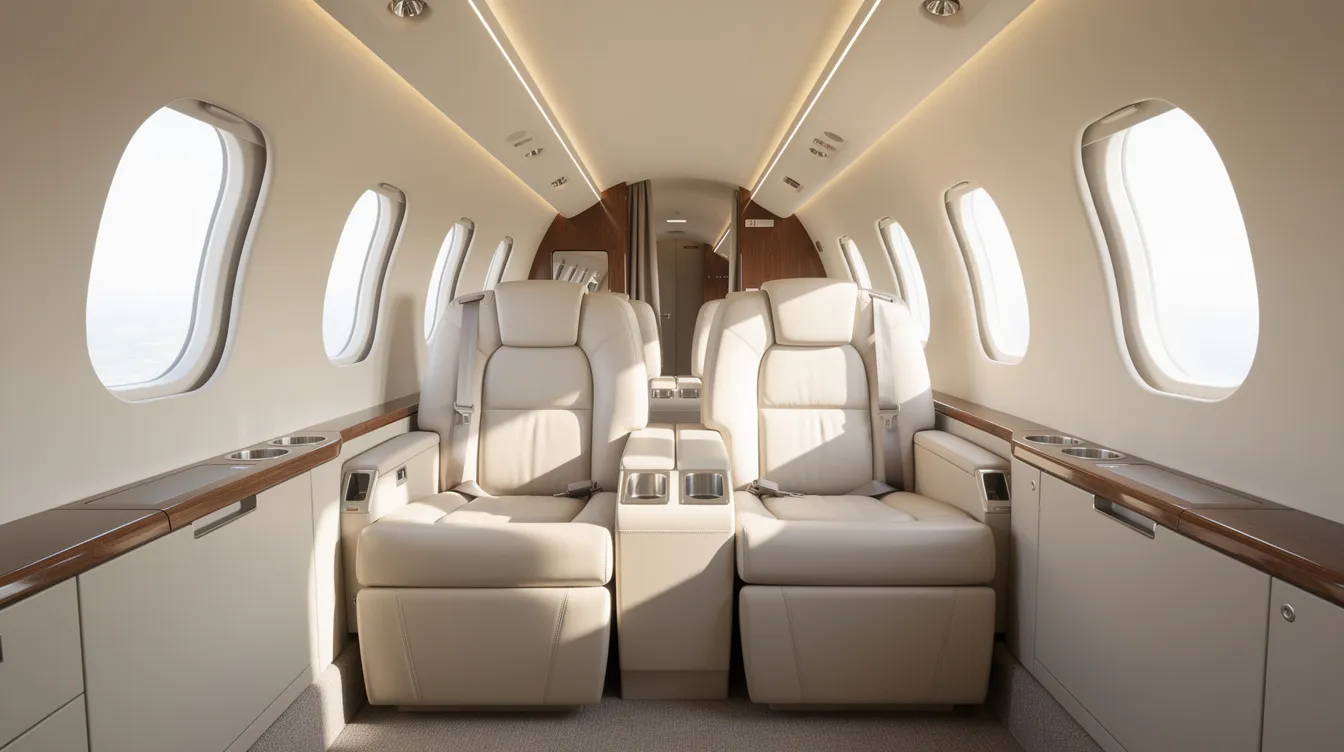
Midsize jets bridge the gap between efficient light jets and spacious heavy jets. The defining upgrade is cabin space: most midsize jets offer stand-up cabins with generous standing capacity, allowing passengers 5’7” to 6’0” to stand upright comfortably, which greatly enhances comfort on longer flights.
Midsize jets can accommodate 8 to 10 passengers and have an average range of up to 3,500 nautical miles, providing extended range suitable for longer regional or short transcontinental flights. Routes like New York to Los Angeles (2,140 nm, about 5 hours), London to Marrakesh (1,200 nm), or Dubai to Istanbul (1,700 nm) fall squarely in midsize territory.
Typical specs include cruise speeds of 450–480 knots at 41,000–45,000 feet, with baggage capacity of 100–150 cubic feet—enough for golf clubs, ski equipment, or luggage for a week-long trip. Midsize jets typically operate with two pilots for safety, efficiency, and regulatory compliance.
Popular midsize models:
-
Cessna Citation Latitude: 9 passengers, 2,700 nm range, full enclosed lavatory and galley, flat floor cabin
-
Cessna Citation Sovereign+: 9–12 passengers, 3,200 nm range, 458 knots cruise
-
Bombardier Learjet 60XR: 8 passengers, 2,240 nm range, Mach 0.81 top speed
-
Gulfstream G150: 7 passengers, 2,350 nm range, excellent fuel efficiency
Super mid-size jets push further still, serving as a bridge to heavy jets. Models like the Bombardier Challenger 350 (10 passengers, 3,200 nm), Gulfstream G280 (10 passengers, 3,600 nm), and the Cessna Citation Longitude offer extended range for transcontinental flights, with additional cabin space, advanced amenities, and performance approaching heavy jet standards. Super mid-size jets are often the go-to choice for travelers needing a balance of range, comfort, and cost efficiency.
The cabin experience improves substantially in midsize jets. Expect flat floors, 6-foot ceiling height in most areas, zoned seating configurations, and a service galley as a key feature for meal preparation and refreshments, ensuring passenger comfort. Full galley capability for hot meals and WiFi are standard. Sound insulation typically keeps cabin noise around 78 dB—quieter than many commercial aircraft. Most operators provide a flight attendant on longer routes.
Ideal use cases include multi-city business travel, family holidays requiring comfortable seating for everyone plus substantial baggage capacity, or any route where you need non-stop capability without paying for heavy jet capacity you won’t use. For many, midsize and super midsize jets are the go-to choice for these missions.
Charter rates for midsize jets typically range from €2,500 to €5,500 per hour, scaling with aircraft size and range capability. Super midsize jets command €4,000–6,000 per hour.
For anxious passengers, midsize jets offer reassurance through altitude. Cruising at 41,000–45,000 feet puts you above most turbulence, which typically peaks between 25,000 and 35,000 feet, but additional support from an app that helps with fear of flying can further ease anxiety. The aircraft’s greater mass also dampens motion, making weather conditions feel less pronounced than in smaller aircraft.
Heavy Jets
Heavy jets represent the pinnacle of private aviation, designed for intercontinental travel with maximum comfort. These are the aircraft you see in business aviation marketing—spacious cabins with multiple zones, lie-flat beds, and the ability to fly 8–12 hours without refueling.
Heavy Jets are designed for long-haul flights, typically seating 10 to 12 passengers and capable of flying approximately 4,300 nautical miles, providing extensive cabin space and premium amenities. Heavy/Ultra-Long-Range jets serve large groups of 10 or more passengers, allowing for luxurious intercontinental travel, and are especially important for longer range travel, with a range exceeding 6,000 nautical miles.
Routes like London to New York (3,000 nm), Dubai to London (3,400 nm), or New York to Rome (4,100 nm) become single-leg flights with time to work, dine, and sleep on board.
Heavy jet examples:
-
Bombardier Challenger 604/605/650: 12–14 passengers, 4,000–4,100 nm range, 488 knots cruise, €6,000–9,000/hr charter
-
Dassault Falcon 900LX: 12–16 passengers, 4,750 nm range, tri-jet design for steep approach capability
-
Gulfstream G450: 14 passengers, 4,350 nm range, industry-leading reliability
-
Gulfstream G550: 16 passengers, 6,750 nm range, ultra-long range capability with 99.9% dispatch reliability
Ultra-Long-Range Jets
Ultra-Long-Range Jets push even further. These aircraft are designed for non-stop global travel, typically seating 12 to 19 passengers and capable of flying over 7,000 nautical miles, connecting virtually any two cities in the world without fuel stops. Their long-range performance is optimized for extensive, intercontinental journeys, offering advanced technology and comfort. Ultra-long-range jets can fly directly between continents without layovers, providing uninterrupted global mobility and enhanced privacy for travelers.
Executive Airliners (Bizliners)
At the top of the scale sit Executive Airliners (Bizliners)—converted commercial jets designed for ultra-high-net-worth individuals, offering luxurious custom-designed interiors and a range exceeding 10,000 miles. Aircraft like the Boeing BBJ and Airbus ACJ320 serve as VIP airliners for heads of state, major corporations, and touring artists requiring bespoke interiors.
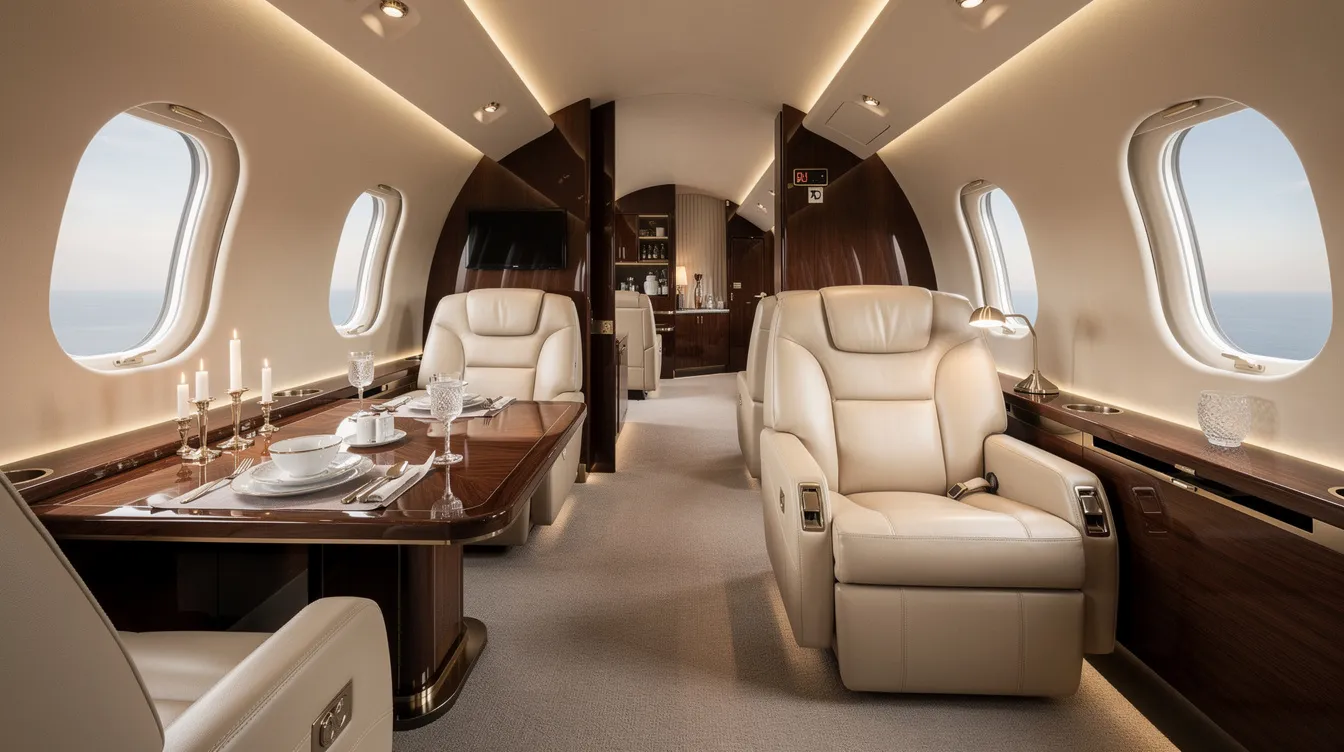
Private jets offer varying luxury levels from basic amenities in smaller jets to full galleys and bedrooms in larger models, catering to diverse passenger needs and preferences. Heavy jet cabins typically feature four or more distinct zones: office/conference rooms, dining areas, lounges with comfortable seating, and private bedrooms with lie-flat beds. Ceiling heights exceed 6’3”, cabin widths reach 8 feet, and noise levels drop to 75 dB. Multiple enclosed bathrooms, full-service galleys capable of gourmet meal preparation, and baggage holds of 200–400 cubic feet are standard.
Operational requirements scale with capability. Heavy jets need 6,000–8,000-foot runways, limiting them to larger airports. Charter costs range from €5,000 to €15,000+ per hour. They consume 400–600 gallons of fuel hourly, two to three times more than light jets.
Calculations suggest that people traveling in their own private jets leave a disproportionate carbon footprint relative to those who use commercial jetliners or other means of travel. Some individuals travel over 350,000 km (220,000 mi) annually, generating thousands of tons of CO2 emissions. As a reaction to the disproportionate emission of greenhouse gases by private jets, projects dedicated to tracking the movement of these airplanes have gained widespread attention from the internet public and the media.
For nervous flyers, heavy jets offer the calmest private aviation experience, and many find reassurance in using a fear-of-flying support app covered in the media alongside these aircraft’s natural stability. High mass creates inertia that dampens turbulence perception—Gulfstream studies suggest passengers feel roughly 50% less motion than in lighter aircraft. Optimized pressurization (cabin altitude around 6,000 feet versus 8,000 feet in commercial aircraft) reduces fatigue and ear discomfort, while sophisticated climate control and lighting systems minimize physiological stress.
How to Choose the Right Private Jet Type for Your Trip
Selecting the right private jet type comes down to matching aircraft capability to trip requirements. Start with these core factors: distance, passenger count, luggage volume, cabin preferences, airport access, and budget.
Match your journey to the aircraft category:
|
Trip Type |
Distance |
Best Aircraft Category |
|---|---|---|
|
Short regional (Milan–Nice) |
Under 500 nm |
Turboprop or light jet |
|
Medium regional (London–Moscow) |
1,500–2,500 nm |
Midsize jets or super midsize jets |
|
Transcontinental (NY–LA) |
2,000–2,500 nm |
Midsize or super midsize |
|
Long-haul (NY–London) |
3,000–4,000 nm |
Heavy jets |
|
Ultra-long (Dubai–Tokyo) |
5,000+ nm |
Ultra-long-range jets |
The decision flow works like this: First, calculate your route distance in nautical miles. If under 1,000 nm with a small group, turboprops or light jets are most efficient. For 1,000–3,000 nm with larger passenger capacity requirements, step up to midsize or super midsize jets. Beyond 4,000 nm, you need heavy jets or ultra-long range capability.
Charter brokers and operators use these same categories—light jets, midsize jets, heavy jets—when quoting flights. Understanding the terminology helps you evaluate quotes and ask informed questions about aircraft types.
Ownership and Usage Models
Fractional ownership allows multiple parties to share the costs and benefits of owning a private jet, with each owner purchasing a share of the aircraft and receiving a set number of flight hours per year. In fractional ownership, partners can sell their equity position in the aircraft, which typically involves paying monthly management fees and additional costs for services like catering and ground transportation.
The pay-as-you-fly model allows clients to pay only for the flight hours they use, similar to commercial airline practices, but it can lead to challenges in securing flights due to high demand. Flat rate models for unlimited jet usage have largely been discontinued due to past abuses, but some companies now implement a fair usage policy to manage access.
Environmental considerations matter. Larger jets consume more fuel per flight, so choosing the smallest aircraft that safely and comfortably meets your needs reduces both cost and carbon footprint. A four-person team flying 400 miles doesn’t need a Gulfstream G550—a Phenom 300E serves the mission at a fraction of the fuel burn.
Regardless of which aircraft type you choose, the sensations of flight—engine sounds during takeoff, the feeling of climb and descent, turbulence encounters—can trigger anxiety, and understanding how an app can help your fear of flying can make these experiences more manageable. Using a real-time in-flight guide like the SkyGuru in-flight information app helps make any flight feel predictable by explaining what’s happening moment by moment.
Here’s the reassuring bottom line: all modern business jets and private aircraft—from VLJs to heavy jets—are designed and certified to rigorous safety standards equivalent to commercial aviation. Understanding different types of private jets is primarily about matching capability to your journey, not about safety differences.
Whether your next flight is a 90-minute hop on a light jet or an overnight crossing on a Bombardier Global, knowing what to expect from each private jet type helps you travel with confidence.
Frequently Asked Questions (FAQs)
What is the main difference between turboprops and jets?
Turboprops use propellers driven by turbine engines and are best for short regional flights with lower speeds and altitudes. Jets use turbine engines that expel gases to generate thrust, allowing faster speeds, higher altitudes, and smoother rides over longer distances.
How do light jets compare to heavy jets in terms of comfort and range?
Light jets typically seat 6–8 passengers and cover shorter ranges (around 1,500–2,000 nautical miles), offering a compact cabin ideal for quick trips. Heavy jets accommodate 10–12 passengers or more, provide spacious cabins with luxury amenities, and can fly long-haul distances exceeding 4,000 nautical miles.
What does "single pilot operations" mean in private jets?
Single-pilot operations refer to aircraft certified to be flown safely by just one pilot instead of the usual two. This is common in smaller jets like Very Light Jets (VLJs), reducing operational costs and simplifying scheduling.
Why do jets typically fly at higher altitudes than turboprops?
Jets cruise at higher altitudes (35,000–45,000 feet) to avoid weather disturbances and turbulence, resulting in smoother and faster flights. Turboprops usually fly lower (20,000–30,000 feet) due to engine and aerodynamic limitations.
What is a wide-body private jet?
A wide-body private jet has a cabin width that allows passengers to walk comfortably and often includes multiple seating zones, full galleys, and bedrooms. These jets provide enhanced space and luxury, typically found in heavy jets and executive airliners.
Conclusion
Understanding private jet types helps you choose the right aircraft for your travel needs, balancing comfort, range, and cost. From the efficient turboprops ideal for short hops to the luxurious heavy jets and ultra-long-range models designed for intercontinental flights, each category offers unique benefits. Whether you prioritize speed, cabin space, or accessibility to smaller airports, knowing these differences ensures a smoother, more enjoyable journey. Additionally, tools like the SkyGuru app can ease flying anxiety by explaining in-flight sensations, making private aviation accessible and reassuring for all travelers. Ultimately, selecting the appropriate private jet type enhances your travel experience, giving you confidence and comfort every step of the way.
FLEET SELECTION
JET CARDS
COST ANALYSIS


How to Auditing Your Operator's Maintenance Logs
Oct 05, 2025

How to Auditing Your Operator's Maintenance Logs
Oct 05, 2025

How to Auditing Your Operator's Maintenance Logs
Oct 05, 2025
Sky Guru Weekly
The smartest private aviation intelligence in your inbox.
.svg)

