




When you request a private jet charter from New York to Los Angeles, what happens next involves far more than simply assigning an available aircraft. Behind every confirmed departure time sits a complex orchestration of aircraft positioning, crew availability, airport slots, maintenance windows, and regulatory constraints that most travelers never see.
Private jet scheduling is the operational backbone that makes private aviation work. While the booking process is what clients experience—submitting trip details, receiving quotes, selecting an aircraft—clients can now book a private jet through streamlined digital platforms, making it easy to book flights and manage travel plans. The chartering process involves steps such as selecting the right aircraft, reviewing instant pricing, and understanding charter pricing to ensure transparency and efficiency. Scheduling is what dispatchers, operators, and crew coordinators manage to turn that request into a feasible flight. Private jet scheduling operates on a demand-driven model where the aircraft’s schedule is tailored to the client’s specific needs, unlike commercial airlines that operate fixed routes regardless of individual passenger preferences.
This article pulls back the curtain on how private flights are actually scheduled. Using real examples like Teterboro to Los Angeles and London to Dubai, we’ll walk through aircraft routing decisions, multi-leg logistics, time zone coordination, and the airport restrictions that shape when you can actually depart. The scheduling process for private jets typically includes:
-
Initial inquiry
-
Feasibility and quoting
-
Logistics coordination
-
Real-time monitoring
These stages happen largely invisibly to the passenger.
From SkyGuru’s perspective as an independent, tech-driven flight companion app, understanding these mechanics serves a practical purpose. When you know why your departure was shifted by 45 minutes or why the crew needs an overnight stop, the “mystery” dissolves. Studies from aviation psychology research indicate that procedural knowledge can reduce perceived risk by 25-40% during delays or route changes. For anyone who experiences anxiety during travel, knowing the “why” behind schedule changes transforms uncertainty into manageable information. The private jet booking process typically involves four main stages:
-
Initial inquiry
-
Planning
-
Booking
-
Post-flight support
These stages help travelers efficiently organize their travel plans, ensuring a seamless and personalized travel experience.
Aircraft Routing Explained
A private jet doesn’t sit at one airport waiting for a single client. Its day is built from a sequence of flights—some paid charters, some unpaid repositioning legs—stitched together to maximize the aircraft’s utility while minimizing costly empty flying. Selecting the right aircraft depends on several factors, including flight distance, passenger count, and onboard amenities, ensuring optimal comfort and cost-effective travel for each mission. Some travelers may prefer to charter the entire aircraft for privacy and flexibility, while others might consider smaller jets for regional travel needs.
Consider a typical day for a midsize jet: morning departure from Teterboro to Chicago for a business client, then an empty repositioning flight to Los Angeles in the afternoon, followed by an evening paid charter from Los Angeles to Dallas, and finally an overnight ferry back to Teterboro. Each leg connects to the next, and dispatchers use scheduling software to optimize this chain across a fleet of aircraft.

The key players coordinating this include:
-
Aircraft operators (the Part 135 certificate holders responsible for the aircraft)
-
Dispatch teams using platforms like ForeFlight or Jeppesen for dynamic routing
-
Crew schedulers managing pilot duty times through systems like ARINC Crew
-
Brokers aggregating requests via platforms that scan global fleet availability
Positioning legs are the unpaid flights that move aircraft into position for revenue trips. If you book a charter from San Diego to Cabo San Lucas, but the nearest suitable jet overnighted in Van Nuys, that aircraft flies empty from Van Nuys to San Diego before your trip begins. This repositioning might cost the operator $8,000-$12,000 unfilled, but it enables a $45,000 paid charter. The cost of chartering a private jet can vary significantly based on the aircraft size, flight distance, and flight duration, with prices ranging from $2,000 to $15,000 per hour depending on the specific aircraft and additional services required. Reviewing charter pricing details is essential to avoid hidden costs such as landing fees, surcharges, and ancillary charges, ensuring transparency and helping travelers make informed, cost-effective decisions. Private jet charters can also be a cost-effective alternative to full aircraft ownership.
Private jet categories directly influence routing decisions:
|
Category |
Example Aircraft |
Seats |
Range (miles) |
Runway Requirement |
Hourly Cost |
Notes |
|---|---|---|---|---|---|---|
|
Very Light Jets (VLJ) |
Eclipse 500 |
Up to 4 |
1,000-1,500 |
3,500 ft |
$2,000-$3,000 |
Short regional trips, fuel stops needed |
|
Light Jets |
Citation CJ3 |
5-8 |
Up to 2,000 |
4,000 ft |
$3,000-$4,500 |
More comfort and speed |
|
Midsize Jets |
Learjet 60 |
6-9 |
3,000+ |
5,000 ft |
$4,500-$7,000 |
Coast-to-coast, spacious cabins |
|
Super Midsize Jets |
Citation X |
8-10 |
Up to 3,500 |
5,500 ft |
$6,000-$8,000 |
Enhanced amenities, long-distance flights |
|
Heavy/Large Jets |
Gulfstream G550 |
10-14 |
4,000-6,000 |
6,000+ ft |
$8,000-$15,000+ |
Full-standing cabins, extended baggage |
Dispatchers constantly balance empty-leg minimization against client preferences. A same-day scenario might look like this: morning business flight Los Angeles to San Francisco on a light jet (340 nautical miles, 45-minute flight), then afternoon repositioning to Las Vegas (240 nautical miles) for an evening leisure charter. If the morning client runs late, the entire afternoon sequence shifts. Private jet travel costs typically range from $1,200 to $4,000 per flight hour for turboprops and light jets, influenced by factors such as aircraft type, route length, and seasonal demand. Cost-effective travel options are available, especially when optimizing aircraft choice and routing to match specific needs and budgets.
How Private Jet Charter Operators Match Aircraft to Your Request
When a charter request arrives—say, New York (Teterboro) to Miami, December 12, 2026, with 8 passengers, 1,000 lbs of baggage, and a preferred departure window of 9:00-11:00 AM—dispatchers initiate a systematic matching process.
Step One: Inventory Scan
Schedulers query databases of available aircraft, checking which jets are free on that date, where they’re currently located, and whether they can physically reach Teterboro in time. Safety certifications from organizations like ARGUS and Wyvern are key considerations when scheduling a private jet, so operators filter for aircraft meeting audit standards.
Step Two: Feasibility Check
For each candidate aircraft, dispatchers verify:
-
Current overnight location (Is a Phenom 300 already at Teterboro? Does a Challenger 350 need to reposition from nearby White Plains?)
-
Block time calculation (Teterboro to Miami is roughly 1,080 nautical miles, about 2.8 hours on a midsize jet)
-
Crew duty limits (Can pilots legally complete this trip without exceeding maximum duty hours?)
-
Passenger count and flight distance are crucial variables in this step, as they determine the right aircraft for the trip—ensuring the selected jet can accommodate all travelers comfortably and has the necessary range for the planned route.
Step Three: Option Comparison
The scheduler might present two choices:
-
A light jet is already based at Teterboro for $28,000
-
A larger midsize jet that requires a $7,000 repositioning fee from White Plains but offers more passenger comfort for $42,000 total
Operational Constraints
Operational constraints often require adjustments. Maintenance downtime can ground a plane, requiring schedulers to find a replacement aircraft quickly to avoid disruptions. Winter operations at northeastern airports like Teterboro mandate de-icing buffers of 30-60 minutes (Type IV fluid remains effective for about 24 hours). Hangar space at Signature FBOs typically books 48 hours in advance. If de-icing operations cause delays, the operator might propose a 9:30 AM departure instead of 9:00 AM.
SkyGuru’s app can later explain these shifts in real time—displaying “Ground hold: de-icing operations at TEB due to -5°C temperatures” rather than leaving passengers wondering why they haven’t pushed back yet. According to ARGUS data, roughly 12% of charters shift by 30 minutes or more due to maintenance factors alone.
Empty Leg Flights and Optimization
An empty leg is a repositioning flight without paying passengers. They exist because aircraft must move to their next assignment, regardless of whether anyone has booked that specific segment.
Here’s a concrete example: A Gulfstream G550 flies a paid charter from London Heathrow to Nice on May 20—a 2,100-nautical-mile trip costing around $80,000. After dropping passengers in Nice, the aircraft needs to return to London for its next booking. This creates an empty leg from Nice to London that operators try to sell at a 50-70% discount, typically $25,000-$35,000 through platforms like EmptyLegs.com or Victor.
Scheduling software and human dispatchers work to link trips together. A morning Los Angeles to Aspen paid charter (622 nautical miles) might connect with an afternoon Aspen to Dallas segment sold as a discounted empty leg for $18,000. Algorithms can match 60-70% of empty legs with buyers seeking flexible schedules.
However, empty leg flights carry inherent fragility. Because they depend on the “primary” flight maintaining its schedule, any change to the original booking affects the empty leg. If the primary trip delays, cancels, or changes routing—which happens in roughly 20% of cases according to JetNet data—the empty leg buyer faces disruption. Factors influencing private jet pricing include:
-
Aircraft type
-
Route length
-
Seasonal demand
-
Additional fees (which can add 20-40% to the base rate)
When booking discounted flights, it’s important to review all potential hidden costs, such as landing fees, fuel surcharges, overnight crew expenses, and other ancillary charges, to avoid unexpected expenses and ensure transparent pricing.
From the passenger’s perspective, a sudden time shift or cancellation of an empty leg often feels arbitrary. In reality, it’s the invisible result of routing changes on the primary charter. Brokers sometimes mitigate this risk by offering “flex pricing” with a 10-20% premium for more reliable empty leg commitments. Travelers seeking cost savings may also consider shared flights or public charters, which provide private-style amenities at lower prices by allowing passengers to book individual seats or join scheduled set-route flights.
Multi-Leg Flights
Multi-leg itineraries chain one aircraft and crew through several stops in sequence. Unlike simple out-and-back charters, these trips might span New York to Chicago to Denver to Los Angeles over 48 hours for a corporate roadshow, or connect three European cities for a family vacation. Business jets are frequently chosen for both business and leisure travel, offering the speed, comfort, and range needed for time-sensitive trips, while enabling access to more airports—including smaller regional airports—thus supporting regional travel and maximizing convenience.
Business travelers and executives often book multi-leg trips for efficiency—conducting meetings in multiple cities without returning home between each. According to NBAA data, roughly 40% of private charters involve multi-leg itineraries.

Backward Planning
Dispatch builds these itineraries through backward planning, working from the final destination and required arrival time, then layering in:
-
Fuel requirements and potential fuel stops
-
Crew rest requirements (minimum 10-12 hours between duty periods)
-
Overnight parking at FBOs ($1,000-$3,000 per night)
-
Local services like catering, ground transportation, and customs clearance
Operators leverage a global network and specialized flight and weather data APIs to coordinate complex itineraries across multiple cities and countries, ensuring seamless travel logistics for clients worldwide.
Three-Day Roadshow Example
Three-day roadshow example:
-
Day 1: Los Angeles to Dallas (1,234 nm, depart 7:00 AM local, arrive 1:30 PM), then Dallas to Nashville (680 nm, 45-minute turn, depart 2:30 PM, arrive 4:30 PM)—total duty approximately 12.5 hours
-
Day 2: Nashville to Atlanta (214 nm, depart 9:00 AM, arrive 10:00 AM, 2-hour turn including catering refresh)
-
Day 3: Atlanta to Los Angeles (1,742 nm, depart 1:00 PM, arrive 2:30 PM, P acific)
Each departure time affects the feasibility for the following day. A late Day 1 departure risks pushing crew duty over the 14-hour cap, potentially requiring an overnight in Nashville rather than continuing.
Private jet charters allow for customization of travel needs, including the choice of aircraft, destination, and schedule, providing flexibility that commercial flights do not offer. In-flight services on private jets often include high-speed Wi-Fi, advanced entertainment systems, and the ability to customize the cabin environment for comfort and productivity.
Turn Times and Ground Logistics
Turn time is the ground duration between landing and the next takeoff. Real-world ranges vary significantly:
-
Quick fuel turn: 30-45 minutes (fuel only, minimal cabin service)
-
Full service turn: 60-90 minutes (refueling, cleaning, lavatory service, in-flight catering reload)
Schedulers validate whether requested times allow realistic turns, especially during peak travel periods. The Sunday after Thanksgiving, for instance, sees slot queues that can double standard turn times to 90 minutes at congested airports.
Dependencies affecting turn time:
-
Fuel truck availability (heavies get priority at busy FBOs)
-
Catering delivery from vendors (typically requires a 2-hour lead time)
-
Crew weather briefings (15-20 minutes)
-
Passenger ground transportation connections
Example of an unrealistic plan: Landing in Zurich at 9:55 AM with a scheduled departure at 10:10 AM leaves only 15 minutes—impossible for even basic fuel and lavatory service. Operations would push that departure to 10:45 AM for a practical 50-minute turn (fuel truck arrives by 10:05, catering unload by 10:10, departure preparation complete by 10:40).
Last-minute changes ripple through the day’s schedule. A late passenger arrival forces subsequent legs to be delayed, sometimes requiring operators to swap to a fresh aircraft or crew if the original plan exceeds duty limits.
Staying Within Crew Duty and Rest Limits
Even in private aviation, flight crew operate under strict maximum duty hours and minimum rest requirements similar to airline pilots. Schedulers must ensure pilots have legally mandated rest periods and that their certifications are up-to-date as part of crew legality regulations.
Typical operator limits (many companies self-impose stricter standards than regulatory minimums):
-
Maximum duty period: 12-14 hours (from report time to final shutdown)
-
Minimum rest: 10-12 hours between duty periods
-
Weekly flight time caps: approximately 30 hours
Multi-leg duty calculation example:
A crew reports at Van Nuys at 6:30 AM for a four-leg day:
-
VNY to Seattle (950 nm, depart 8:00 AM, arrive 10:30 AM)
-
Seattle to Calgary (160 nm, 45-minute turn, depart 11:30 AM, arrive 12:00 PM)
-
Calgary to Denver (800 nm, depart 1:15 PM, arrive 2:30 PM)
Total duty: 8 hours flying plus 4 hours ground time equals 12 hours. The crew must be released by approximately 6:30 PM local for a legal rest period starting no later than 7:00 PM.
If the Seattle departure is pushed to 9:00 AM due to weather, the entire sequence shifts. The Denver arrival might now exceed 13 hours of duty, forcing options:
-
Overnight, the crew in Calgary ($2,500 for hotel and meals)
-
Fly a relief crew commercial to Calgary ($5,000)
-
Move the Denver leg to the following morning
When passengers experience an “unexpected overnight in an unplanned city,” it’s almost always crew duty rules protecting safety—not a convenience failure. SkyGuru can display messages like “Crew duty clock: 11.2/14 hours remaining, rest required post-arrival” to help anxious travelers understand these safety-driven decisions.
Time Zones and Global Travel
Time zones add significant complexity to private jet scheduling on long-range and ultra-long-range flights. While a 340-nautical-mile hop from Los Angeles to San Francisco involves minimal time zone consideration, transcontinental flights and international travel demand precise coordination across multiple time references. For frequent international travelers, jet card memberships can offer priority booking and cost savings, making it easier to book flights globally with added flexibility, while specialized apps for fearful flyers can make those trips feel emotionally manageable.
Schedulers plan primarily in Zulu time (UTC) to avoid confusion when coordinating across continents, often supported by detailed flight and turbulence data platforms to refine routes and timings. Local times appear on passenger itineraries, but operational planning—crew duty tracking, slot requests, overflight permits—all reference UTC.
Coordinating Departure Times Across Continents
A request like “arrive in Geneva by 9:00 AM local on March 3 for a meeting” triggers backward planning from the required arrival time.
Calculation sequence:
-
Required arrival: 9:00 AM CET (08:00Z) March 3
-
Build in a 75-minute buffer for customs, ground transportation: must land by 7:45 AM CET
-
Flight time Teterboro to Geneva: approximately 6.8 hours
-
Add winter headwind buffer: +1 hour
-
Add taxi/departure buffer: +30 minutes
-
Required departure: 10:00 PM EST March 2 (03:00Z March 3)
The dispatcher also checks crew considerations. An overnight eastbound flight pushes duty into the fatigue-prone early-morning window (3:00-6:00 AM body clock time). Some operators limit such flights or require augmented crews.
Ground coordination must align with flight timing. Chauffeur pickup at Geneva is scheduled for 8:00 AM, hotel early check-in confirmed, and concierge services arranged for document handling. Private aviation clients flying into smaller European airports with limited night operations face additional constraints—some fields restrict movements entirely after 11:00 PM local.
Crossing the Date Line and Very Long Range Trips
Ultra-long range routes crossing the International Date Line create unique scheduling challenges. Flights like Los Angeles to Sydney or Tokyo to Los Angeles involve block times exceeding 14 hours and calendar dates that seem to contradict normal logic.
Concrete itinerary: Los Angeles to Sydney
-
Depart LAX: 8:00 PM PDT June 10 (05:00Z June 11)
-
Block time: approximately 15 hours
-
Cross 180° longitude (International Date Line)
-
Arrive Sydney: 6:30 AM AEST June 12 (20:30Z June 11)
June 11 effectively disappears from the calendar. The return journey reverses this—departing Sydney on June 13 and arriving in Los Angeles on June 13, appearing to “gain” a day.
These flights affect:
-
Crew rest: Ultra-long flights typically require two crews (one operating while the other rests) or extended layovers of 36+ hours in destination cities
-
Hotel bookings: Travelers must book Sydney accommodation for June 12 check-in, not June 11
-
Meeting schedules: Jet lag planning becomes critical for business executives arriving after 15 hours of flight time
Operators flying Gulfstream G650ERs (7,500-nautical-mile range) on these routes build rest requirements into pricing—augmented crew costs add $15,000-$25,000 to ultra-long charters. SkyGuru can display clear timelines showing what to expect at each stage—takeoff, cruise phases, turbulence-prone areas over the Coral Sea, and descent—even when days and dates blur together.
Airport Slots and Restrictions
Airport slots are pre-approved takeoff or landing times required at congested or noise-sensitive airports. Unlike commercial aviation assumptions, private aviation clients cannot always depart “whenever they want.”
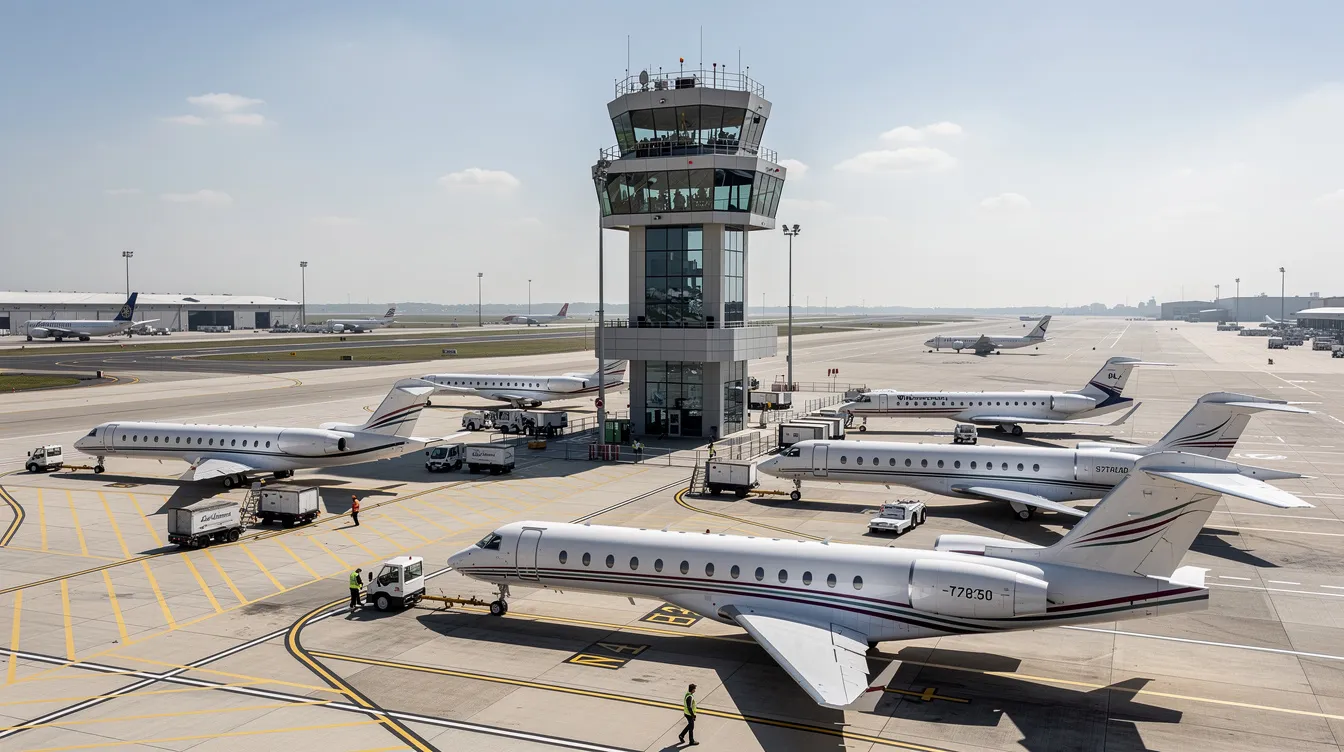
Busy or high-demand airports require airport slots, which are specific time windows for takeoff and landing that must be applied for in advance. IATA classifies airports into coordination levels:
-
Level 2: Schedule facilitation recommended (some coordination needed)
-
Level 3: Full slot coordination required (slots mandatory for all operations)
Slot-controlled airports affecting private jet travel:
-
London Heathrow (LHR): Approximately 50 slots per hour total, private jets receive fewer than 10%
-
London City (LCY): Steep approach requirements limit aircraft types; heavy jets cannot operate
-
Milan Linate (LIN): Noise caps restrict night operations
-
New York area: Peak hours at Teterboro, LaGuardia, and JFK involve flow control
-
Los Angeles area: Van Nuys operates with fewer restrictions than LAX, making it preferred for private terminals
Choosing alternative airports—Van Nuys instead of LAX, Teterboro instead of JFK, Farnborough instead of Heathrow—is often a deliberate scheduling decision to avoid slot and congestion issues. Private aviation enables travelers to access over 10,000 regional airports, significantly enhancing convenience and reducing travel time by avoiding congested major hubs.
When an operator suggests a slightly earlier or later departure, it’s frequently to secure a viable slot and avoid long ground delays that would affect the entire itinerary.
Curfews, Noise Rules, and Preferred Airports
Many airports impose curfews restricting aircraft movements during nighttime hours to reduce noise impact on surrounding communities.
Specific curfew examples:
-
Sydney (SYD): No jet movements for aircraft over 50,000 kg between 11:00 PM and 6:00 AM
-
Biarritz (LFBZ): Summer operations restricted after 10:30 PM
-
London City (LCY): No movements on Saturday afternoons or Sunday mornings
-
Santa Monica (SMO): Historically had severe restrictions; now closed to jets entirely
Noise chapter certification affects access. Modern Chapter 4-compliant jets operate at most airports, while older Chapter 2 aircraft face restrictions or outright bans at noise-sensitive fields.
Scenario: Coastal airport curfew
A client wants to land at a Mediterranean coastal airport with a 10:00 PM curfew. Working backward:
-
Required arrival: before 10:00 PM local
-
Flight time from London: 2.5 hours
-
Buffer for routing/weather: 30 minutes
-
Latest departure: 6:30 PM London time
If departure slot unavailability pushes the London departure to 7:30 PM, the arrival exceeds curfew. Options:
-
Divert to a 24-hour airport 45 minutes away and arrange ground transportation
-
Delay the entire trip to the following morning
Heavy jets face compounded challenges—a Gulfstream G650 requiring 6,250 feet of runway cannot operate at shorter fields like London City (4,948 feet), limiting aircraft options regardless of curfew timing.
How Weather and Air Traffic Control Affect Slots
Weather conditions reduce airport capacity, triggering air traffic control flow programs that delay or shift slots for both commercial travel and private flights equally.
Example: Summer thunderstorms affecting New York operations
-
Date: July 18, afternoon
-
Forecast: Thunderstorm development over the New York area between 2:00 PM and 6:00 PM
-
ATC response: 60-minute ground delay programs for all departures to the affected airspace
-
Original plan: Private flight Teterboro to Miami, 3:00 PM departure
-
Revised plan: Ground delay holds aircraft until 4:15 PM; arrival shifts 75 minutes later
Flight planners often need to maneuver around storms or delay departures to ensure safety due to private jets being more sensitive to weather conditions than large commercial aircraft in some turbulence scenarios, and many passengers now rely on turbulence‑prediction apps covered in the media to understand these weather‑driven changes.
Dispatchers monitor NOAA SIGMETs and aviation weather forecasts 12-24 hours in advance. When disruption appears likely, they may propose earlier departures (7:00 AM instead of 9:00 AM) to avoid peak weather windows, or later departures (8:00 PM after storms clear) with ground transportation arranged for interim hours.
Even with a confirmed slot, aircraft may be held on the ground or given a longer routing to avoid weather cells. SkyGuru can explain these real-time changes—“Reroute: +20 minutes for Chicago thunderstorm avoidance”—transforming mysterious delays into understandable safety decisions.
These changes are system-wide and safety-driven. Private operators can sometimes react more flexibly than scheduled service airlines by selecting alternate airports or adjusting timing, but they remain subject to the same ATC constraints when weather reduces airspace capacity.
What This Means for You as a Passenger
Understanding aircraft routing, multi-leg planning, time zones, slots, and weather transforms mysterious schedule changes into logical operational decisions. When you know why your departure was shifted 45 minutes or why the crew needs an overnight stop, travel anxiety decreases significantly.
Practical Expectations
-
Build in 30-60 minutes of flexibility. Even with private aviation, slots, weather, and crew considerations may adjust your departure window.
-
Understand aircraft swaps. If your scheduled jet requires maintenance, operators will arrange a replacement aircraft quickly—this protects your safety, not your convenience preferences.
-
Ask about routing. If a suggested airport or timing seems unusual, ask your broker or operator to explain. You might learn you’re avoiding slot congestion or positioning for the next leg.
-
Last-minute overnights have reasons. Crew duty limits exist to protect safety. An unexpected overnight in an intermediate city means regulations are working as designed.
-
Review charter pricing details carefully. To ensure cost-effective travel, always request a full breakdown of charter pricing—including landing fees, surcharges, and additional service charges—to avoid hidden costs and compare options accurately.
Booking Tips
-
Booking as early as possible, particularly during peak seasons, increases the likelihood of obtaining preferred flight options and cost savings.
-
Booking 1-2 weeks in advance generally ensures near 100% availability for private jet charters, though booking 1-3 months in advance offers better options for high-demand periods.
Time Savings
-
When chartering a private jet, travelers can often check in just 15-30 minutes before departure, significantly reducing wait times compared to commercial flights and avoiding long security lines at major terminals.
-
Passengers on private jets can enjoy significantly reduced check-in times compared to the lengthy processes at commercial airports.
-
Private jet travel can save travelers between 90 and 180 minutes on many business routes due to expedited check-in and direct access to smaller airports.
Traveling by private jet can significantly enhance comfort and convenience, as passengers can avoid crowded terminals and long security lines, leading to a more enjoyable journey compared to commercial air travel. Private aviation allows for a more personalized travel experience, enabling passengers to customize their journey, including departure times and onboard services, which is not possible with commercial flights.
For frequent travelers or anyone who experiences anxiety when flying, technology designed to help with the fear of flying makes knowledge the antidote to uncertainty. SkyGuru helps by letting you enter private travel or commercial flight details to receive real-time explanations of turbulence forecasts, route changes, and timing shifts directly on your phone. When you understand that a delay is crew duty compliance or ATC flow control—not some unexplained risk—especially with the help of an app praised in the media for easing fear of flying, the private jet experience transforms from mysterious luxury to informed travel.
Whether you fly private occasionally or regularly, understanding scheduling mechanics—and knowing how an app can help your fear of flying—gives you better conversations with operators, more realistic expectations, and ultimately, a more seamless experience in the air.
Conclusion
Private jet scheduling is a finely tuned orchestration that balances aircraft availability, crew regulations, airport constraints, and client preferences to deliver a seamless travel experience. Unlike commercial airlines, private aviation offers unparalleled flexibility, personalized service, and access to thousands of regional airports, enabling travelers to explore destinations on their own terms. Understanding the behind-the-scenes complexities—such as multi-leg routing, time zone coordination, and slot management—helps demystify schedule changes and enhances confidence during travel. For high-net-worth individuals and many travelers seeking efficiency, luxury amenities, and exclusive access, private jet scheduling ensures every journey is tailored, reliable, and optimized for comfort. By appreciating these operational nuances, passengers can better navigate their private flights and fully enjoy the unique advantages that private aviation provides.
FLEET SELECTION
JET CARDS
COST ANALYSIS


How to Auditing Your Operator's Maintenance Logs
Oct 05, 2025

How to Auditing Your Operator's Maintenance Logs
Oct 05, 2025

How to Auditing Your Operator's Maintenance Logs
Oct 05, 2025
Sky Guru Weekly
The smartest private aviation intelligence in your inbox.
.svg)

