



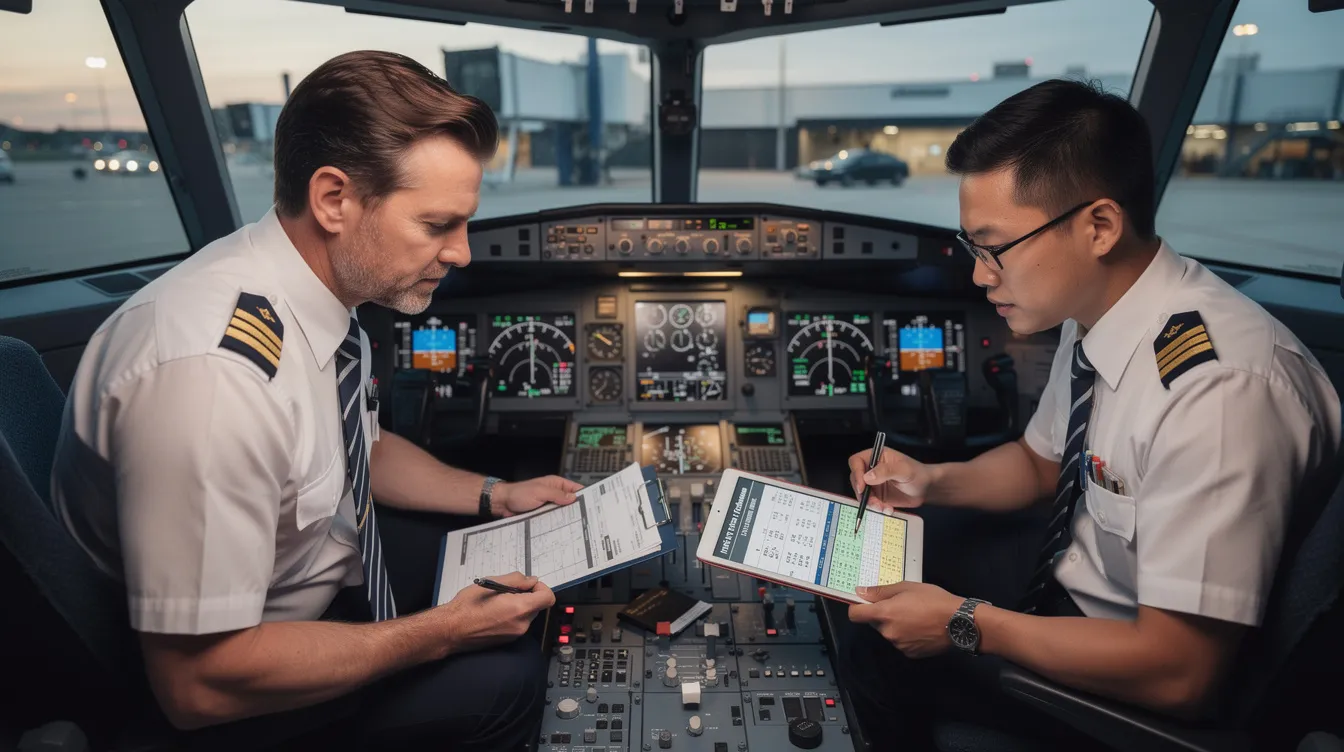
Ever wondered why your flight departure suddenly shifted, or why the crew mentioned needing to “time out”? Behind every schedule change lurks a set of regulations most passengers never see. Pilot duty time rules govern exactly how long your crew can work before they must stop flying. These aren’t suggestions—they’re legally enforced safety boundaries designed to prevent fatigue from compromising your flight.
Duty Time Limits Explained
When your private jet departure gets moved or your airline connection changes, pilot duty time rules are often the invisible hand at work. These regulations apply to every flight crewmember, including pilots and other essential crew members involved in commercial flying operations. They exist because fatigued pilots make errors, and errors at 40,000 feet have consequences. Cognitive performance is crucial for pilots during high-workload phases such as takeoffs and landings, making adequate rest essential.
The framework breaks down into three distinct measurements:
-
Duty period: The total time from when a pilot reports for work (briefing, paperwork, weather checks) until post-flight tasks are complete—typically 30 minutes after parking the aircraft at the gate
-
Flight duty period: From reporting for the first flight until the parking brake is set on the final leg of that duty
-
Flight time: The actual “block time” from brake release for taxi until brake set at destination
The duty period begins when a pilot checks in at the airport to start their pre-flight responsibilities and ends once they have finished post-flight duties, usually about 30 minutes after the aircraft is parked at the gate. Duty periods are distinct from flight duty periods, which only cover the time from when pilots check in for their flight until the aircraft comes to a stop at the destination. This matters because a crew can legally be on duty for 12–14 hours while only logging 6–8 hours of actual flight time. The difference? Ground duties, weather delays, passenger boarding, and all the safety-critical work happening before you even step aboard.
Airlines operating under FAA Part 121 and charter operations under Part 135 both enforce these limits, though details differ. Private owners flying under Part 91 face almost no regulatory limits, but professional pilots and insurers typically self-impose conservative boundaries anyway.
Duty Period vs Flight Duty Period vs Flight Time
Here’s what a typical private jet day actually looks like:
A crew member reports at 05:30 for pre-flight preparation. First takeoff happens at 06:30. They fly three legs throughout the day, with the final landing at 17:00. Post-flight paperwork wraps at 17:30.
In this scenario:
-
Duty period: 12 hours (05:30 to 17:30)
-
Flight duty period: approximately 11 hours (from first-flight report to final brake set)
-
Actual flight time: perhaps 6–7 hours total across all legs
The duty period usually starts 60 minutes before scheduled departure on short-haul flights and 90 minutes before on long-haul or complex operations involving international clearances, de-icing, or special security briefs. When passengers see pilots on the flight deck, those crew members are already well into their duty period. Much of the safety-critical work—fuel calculations, weather analysis, aircraft inspections—happens before boarding begins.
Maximum Duty Time in a Day, Week, and Month
The FAA regulations stipulate that pilots can work a maximum of 14 hours in a duty day, depending on the time of day they report for duty and the number of flight segments they are scheduled to fly. The maximum duty day for pilots is generally 14 hours, which must be followed by a minimum rest period of 10 hours.
Daily Flight Duty Period can range from 9 to 14 hours, depending on start time and complexity. Early-morning or overnight starts shorten allowable hours because cognitive performance degrades faster during circadian low points. The maximum flight time for a pilot is limited to 8 hours for a single-pilot crew and 10 hours for a two-pilot crew within 24 hours.
Rolling limits prevent chronic fatigue accumulation:
-
60 flight duty hours maximum in any 168 consecutive hours (7 days)
-
100 flight hours in any 672 consecutive hours
-
1,000 flight hours in a calendar year
A concrete weekly example: a business jet captain flies four consecutive days with 10-hour duties each, accumulating 25 flight hours. By day five, they need a lighter schedule or longer rest to stay within cumulative limits across two consecutive calendar quarters of tracking.
What Happens When Delays Push the Limits?
Picture this: your private jet crew reports at 06:00 for a Teterboro-to-LAX trip. Weather holds add two hours. Late passenger arrival adds another hour. By the time you’re ready for the planned return leg, completing it would push the crew past their maximum hours.
The operator must now cancel, arrange a second crew, or plan an unplanned overnight stop. This isn’t discretionary—it’s legally mandated.
Delays known before departure must be factored into planning. Unforeseen delays after takeoff allow some flexibility to complete the assigned flight, but only within strict boundaries. “Out of hours” is a legal concept: the flight crewmember’s logged duty or flight time would exceed regulations regardless of how subjectively alert they feel.
Pilot Duty Time Limits Summary Table
|
Parameter |
Limit / Range |
Notes |
|---|---|---|
|
Maximum duty day |
Up to 14 hours |
Dependent on start time and number of flight segments |
|
Maximum flight time (single pilot) |
8 hours |
Within any 24-hour period |
|
Maximum flight time (two pilots) |
10 hours |
Within any 24-hour period |
|
Maximum flight duty hours (7 days) |
60 hours |
Rolling 168-hour period |
|
Maximum flight hours (28 days) |
100 hours |
Rolling 672-hour period |
|
Maximum flight hours (calendar year) |
1,000 hours |
Annual limit |
|
Minimum rest before duty |
10 hours |
Allows for 8 hours of uninterrupted sleep |
|
Weekly minimum off-duty period |
30 consecutive hours |
Increased by 25% over previous requirements |
|
Captain’s discretion extension |
Up to 2 hours (3 hours with 3+ pilots and bunks) |
Only in exceptional, unplanned circumstances |
Rest Requirements
Think of pilot rest requirements like professional athlete recovery standards. Performance tomorrow depends entirely on how solid today’s rest period was.
Pilots must have a minimum rest period of 10 hours before reporting for duty, which allows for 8 hours of uninterrupted sleep. This is two hours longer than previously required, reflecting scientific understanding of how much rest pilots actually need. Many operators schedule 12 hours off to account for hotel transport, meals, and a genuine sleep opportunity.
The FAA regulations stipulate that pilots must have at least 30 consecutive hours off duty rest period every week—an increase of 25% over previous requirements. Regulations help maintain operational safety by capping duty hours and enforcing minimum rest immediately following demanding days.
How Much Rest Do Pilots Need Between Flights?
Common patterns in commercial flying and charter flight operations:
-
8-hour duty day → 12 hours rest time
-
12-hour duty day → 12–14 hours crew rest
-
16-hour augmented long-haul duty → 16–18 hours rest
If a pilot’s duty period exceeds 12 hours, they must have a duty rest period equal to the length of that duty period. This proportional approach ensures adequate recovery after particularly demanding days.
Reduced rest (down to 9 hours) may be permitted away from home base under special conditions, but must be “paid back” with longer rest later. Private jet passengers often see this as an overnight stop instead of an immediate return—the crew is legally required to sleep before flying back.
Controlled Rest on the Flight Deck
On longer sectors, a flight crew consisting of two pilots may use “controlled rest”—a supervised nap of up to 45 minutes during low-workload cruise phases. This isn’t sleeping on the job; it’s a structured alertness management technique.
Safeguards include seat belts fastened, cockpit alarms set, and cabin crew notification. The resting pilot takes a brief recovery period before resuming full duties. On an 8-hour transcontinental private jet leg, one pilot might rest during cruise to ensure sharper performance during descent and landing.
This is treated differently from bunk rest or hotel rest—it boosts short-term alertness but doesn’t reduce legal rest requirements between duty periods.

Why Crew Availability Affects Your Flight
Aircraft mechanical status and weather aren’t the only constraints on your schedule. Your pilot crews’ availability under duty time rules is often the hidden factor.
Operators build daily rosters balancing each crew member’s maximum daily duty time, recent flight hours, legal rest, and upcoming trips. In small private jet fleets with limited standby crews, a seemingly simple schedule change—pushing departure from 17:00 to 21:00—can extend crew duty past legal limits, forcing a fresh crew or overnight delay.
A program manager tracking these hours knows that late decisions (extra dinner stops, added airports, late passenger boarding) can push crews over limits more easily than in large airline operations. Your pilot cannot “just push on” past the limit without risking their license, the operator’s certificate, and safety.
Captain’s Discretion and Why It’s Not a Loophole
The Captain has the authority to exercise “discretion,” which allows for an extension of the maximum flight duty period by up to 2 hours, or 3 hours if there are 3 or more pilots qualified on board with access to crew bunks for rest.
The captain’s discretion is invoked only in exceptional circumstances on the day of the flight, such as delays due to technical issues or air traffic control. It cannot be planned. The decision rests solely with the captain, who must assess whether it is safe to extend based on crew fatigue, time of day, destination complexity, and operational conditions.
Example: a private jet delayed 90 minutes by last-minute customs clearance might still depart if the captain deems the crew fit, and the extension stays within the 2-hour window. Captains are trained to say “no” when uncertain—refusing discretion is a safety-positive decision, not an inconvenience.
“Out of Hours” and Last-Minute Cancellations
When a crew reaches their limit, they’re legally “out of hours.” The account is closed for that calendar quarter tracking period.
Options for operators:
-
Cancel or postpone the next leg
-
Arrange a relief crew to take over
-
Plan an unplanned overnight stop
These decisions are recorded and auditable. Pilots and operators face the risk of penalties if they knowingly exceed limits. Passengers can reduce “crew timing out” scenarios by being punctual—a short delay at day’s start can snowball into legal limit problems by evening.
Long Flights and Multiple Crews
For augmented operations with more than two pilots, the maximum flight duty period can extend up to 19 hours, depending on the number of pilots and available rest facilities. When one flight would exceed what a two-pilot crew can safely handle, a third or fourth pilot joins.
The design and range of a plane play a crucial role in flight planning for long-distance travel, as they determine how far the aircraft can fly without refueling, influence the need for crew rotations, and dictate the number of fuel stops required to maintain safety and operational efficiency.
Long-range private jets on routes like New York–Tokyo often carry extra pilots. A four-pilot crew configuration with proper bunks enables ultra-long sectors that would be impossible otherwise.
Pilot Rest Areas and Bunks
Most aircraft capable of ultra-long flights feature crew bunks—lie-flat beds located above the cabin ceiling or in partitioned sections with sound insulation, darkness, and climate control.
On a 12-hour leg with three pilots, duty/rest rotations ensure one pilot is always fresh for approach and landing. Regulations distinguish “classes” of rest facilities; better facilities (full bunks vs. recliners) permit longer flight time limitations.
Ultra-Long Flights and Fuel Stops
Beyond roughly 10–11 hours of flight time for two pilots, operators must add crew, schedule a fuel/crew rest stop, or split the route. Even when shorter flight options exist, crew duty rules often dictate stops.
A Los Angeles–Sydney charter might stop in Iceland—not for fuel, but for crew rest. The aircraft’s 13-hour range exceeds the number of hours the crew can legally operate. These breaks are deliberate safety pauses, giving crews time to fully reset.
Private Jet vs Airline: Different Rules, Same Goal
Regulations governing pilot duty time differ by region and operation type, with notable frameworks including FAA Part 117 and EASA Flight Time Limitations. Airlines and private operators both maintain strict daily and cumulative limits, require minimum rest windows, and track consecutive calendar periods carefully.
Private owners under Part 91 may lack explicit flight time limitations in one day, but professional crews apply conservative limits regardless. Whether you’re on a major airline or business jet, someone is watching exactly how many maximum hours your crew has accumulated this day, week, and month.
The regulations help prevent fatigue from ever reaching the flight deck. Pilot fatigue factors into 15–20% of aviation accidents—rules like these have cut incidents significantly since their implementation. Next time your schedule shifts unexpectedly, remember: someone is watching the clock for your safety, and that’s exactly how it should be.
Frequently Asked Questions (FAQs)
What exactly is a pilot's duty period?
A pilot's duty period starts when they report for work, including pre-flight preparations like checking weather and flight plans, and ends after completing post-flight tasks, typically about 30 minutes after the aircraft is parked. This period includes all time spent on duty, not just flying.
How does pilot rest affect flight safety?
Adequate rest is critical to maintain cognitive performance, especially during takeoff and landing. Regulations require pilots to have a minimum rest period of 10 hours before duty, allowing for 8 hours of uninterrupted sleep to reduce fatigue and ensure alertness.
Can pilots extend their duty time if a flight is delayed?
Yes, under "Captain's discretion," a pilot may extend the maximum flight duty period by up to 2 hours, or 3 hours if there are three or more qualified pilots onboard with crew bunks. This extension is only used in exceptional, unplanned circumstances and at the captain's sole judgment.
Why do some long flights require multiple pilot crews?
Long flights exceeding the maximum allowable duty time for two pilots require augmented crews to ensure continuous alertness. Multiple pilots rotate rest periods using onboard bunks, allowing flights to extend up to 19 hours safely.
How do pilot duty time rules impact private jet schedules?
Scheduling must account for pilot duty limits and rest requirements. Delays or late departures can push crews beyond legal limits, forcing operators to arrange fresh crews or overnight stops, which may affect flight timing and routing.
Conclusion
Pilot duty time rules are the unseen guardians of aviation safety, ensuring that every flight crew member operates at peak alertness when it matters most—especially during critical phases like takeoff and landing. These regulations balance operational demands with human limitations, mandating strict limits on how many hours pilots can work and requiring sufficient rest to prevent fatigue. Whether it’s managing daily duty periods, navigating unexpected delays, or coordinating multiple crews on ultra-long flights, these rules shape every aspect of flight planning behind the scenes. Understanding the complexity and rigor of pilot rest requirements in private jet operations reveals the careful orchestration that protects passengers and crew alike. Next time your flight schedule changes or a delay occurs, remember it’s not just logistics—it’s a vital safety protocol designed to keep the skies secure.
FLEET SELECTION
JET CARDS
COST ANALYSIS


How to Auditing Your Operator's Maintenance Logs
Oct 05, 2025

How to Auditing Your Operator's Maintenance Logs
Oct 05, 2025

How to Auditing Your Operator's Maintenance Logs
Oct 05, 2025
Sky Guru Weekly
The smartest private aviation intelligence in your inbox.
.svg)

