



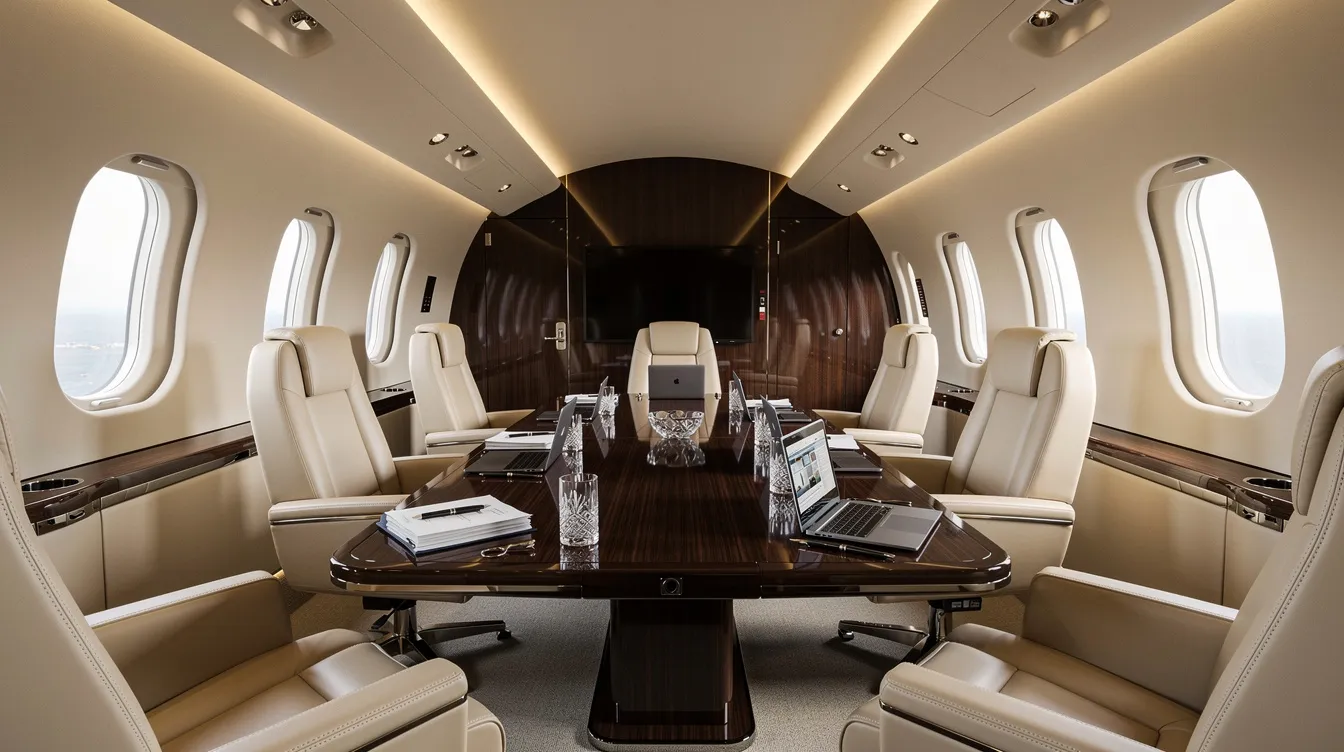
Companies in 2024 are reassessing how they move their executives. Schedule disruptions—the FAA reported over 22,000 U.S. flight cancellations during peak summer months—combined with crowded terminals and intensifying pressure on executive time, have shifted the calculus. Corporate private jets serve as strategic business tools that provide a competitive edge by maximizing executive time and operational agility, with key benefits including flexibility, privacy, and operational efficiency. This guide breaks down corporate private jet benefits versus personal use, helping decision-makers and business leaders evaluate costs, tax implications, and the right access model for their organization. Private jets offer a secure, comfortable, and flexible travel solution for business leaders. In addition to these advantages, private jets typically feature luxurious amenities such as spacious cabins, comfortable seating, and state-of-the-art entertainment systems, providing a level of comfort that commercial airlines cannot match.
This guide is intended for business leaders, travel managers, and executives evaluating private aviation options for their organizations.
Corporate private jets are aircraft owned or leased by companies for business travel, serving as strategic business tools that provide a competitive edge by maximizing executive time and operational agility (see fact 1). Personal private jet use refers to individuals using private aircraft for leisure or non-business purposes.
Business Travel Advantages
Key Differences Between Corporate and Personal Use
Corporate private jet use centers on structured business travel programs designed to optimize efficiency and productivity, with private jet charters being a popular option for business travel due to their convenience and flexibility. Personal jet travel typically revolves around leisure, family vacations, or ad hoc non-business trips. This distinction matters because corporate programs emphasize scalable access models like fractional ownership or jet cards, while personal use often relies on individual charters or wholly owned light jets.
Commercial Air vs Corporate Private Jet vs Personal Jet Use
|
Criteria |
Commercial Airlines |
Corporate Private Jet |
Personal Jet Use |
|---|---|---|---|
|
Time Savings |
4-6 hours door-to-door per leg |
2-3 hours via private terminals |
Similar to corporate, less crew coordination |
|
Productivity |
Limited (60% Wi-Fi reliability) |
High (95% secure Wi-Fi, meeting tables) |
High but without team coordination |
|
Privacy |
Low (open seating, public exposure, shared with other passengers) |
High (anonymized tail numbers, controlled environment, no other passengers on board) |
Moderate (individual visibility risk) |
|
Airport Network |
~500 U.S. commercial airports |
5,000+ public airports |
Same network access |
|
Cost Predictability |
Low (dynamic pricing, up 20% in 2024) |
Medium-High (fixed hourly rates) |
Low ($1-2M annual fixed costs for ownership) |
Many private jets are used by business travelers and corporate leaders for secure, flexible, and efficient travel, offering significant advantages over commercial travel, such as privacy, convenience, and the ability to access smaller airports for time savings. Compared to commercial travel, private jet options like private jet charters provide greater flexibility, efficiency, and privacy, making them ideal for executives who need to maximize productivity and minimize downtime.
Time Savings and Network Access
Direct Airport Access
Private jets can access over 5,000 airports in the U.S., compared to just a few hundred served by commercial airlines, allowing for quicker access to remote or underserved destinations. This network enables point-to-point routing that commercial air travel simply cannot match. Private jets also offer direct flights to a wide range of destinations, reducing travel time and eliminating layovers.
Consider a practical scenario: a team visiting three manufacturing sites—Dallas, Tulsa, and Wichita—in one day. Private jet travel allows for multiple stops in one day without the hassles of layovers or routing restrictions. Commercial flights require two overnights, four flight segments, and 8+ hours of layover time. A midsize Citation Latitude completes the same route same-day in approximately 6 flight hours total, saving 24+ hours including hotel stays.
Private jet travel allows for same-day round trips, enabling executives to attend multiple meetings in different cities within hours, which is often not feasible with commercial flights. Allowing executives this flexibility increases agility and decision-making speed. Travelers using private jets benefit from flexible departure times, enabling them to customize their schedules and avoid delays. They can arrive at the airport just 15 minutes before departure, significantly reducing waiting times compared to the two hours typically required for commercial flights. Private jet travel minimizes flight delays and avoids long lines and long queues at airports, helping employees save time and avoid disruptions. Private jet travel allows employees to avoid long security lines and crowded terminals, enabling them to focus on important tasks rather than waiting, which enhances overall productivity.
Private jets can fly directly to smaller airports, reducing ground travel time and allowing business executives to reach their final destination faster than commercial flights offer through hub connections.
Productivity, Privacy, and Security in Transit
Onboard Productivity Features
Passengers on private jets are over 50% more productive than on commercial flights, according to research from the National Business Aviation Association (NBAA). The difference comes down to environment and results in increased productivity for business travelers.
Onboard private jets, employees can work in a quiet, spacious environment with reliable Wi-Fi, allowing them to hold meetings or complete tasks without interruptions, which significantly boosts productivity. Private jets typically feature luxurious amenities such as spacious cabins, comfortable seating, and meeting tables. The exclusive interiors of private jets enable uninterrupted work, with features like Wi-Fi and spacious seating areas that create an environment suitable for confidential discussions and effective meetings. Private jet travel also enables business leaders to pursue business opportunities more efficiently by facilitating quick, secure travel for same-day meetings and accelerated decision-making.
Commercial flights present the opposite: open 3-3 seating, spotty Wi-Fi with up to 40% downtime, and cabin noise that makes confidential meetings impractical. Consider a board continuing an M&A strategy session mid-flight—on a private aircraft, proprietary information stays protected. On commercial air, that conversation becomes a security risk.
Security and Confidentiality
Private jets provide a secure, controlled environment for corporate leaders to discuss sensitive or proprietary information while traveling, significantly reducing the risk of eavesdropping compared to commercial flights. Private jet travel allows companies to implement customized security protocols, ensuring safety through advanced safety systems and protocols on private jets, so executives and teams travel safely and securely, which is crucial for businesses handling confidential deals or sensitive negotiations.

Flexibility for Business Travel and Crisis Response
Crisis Response Capabilities
Corporate jets depart on the company’s schedule. Jet cards typically offer 2-4 hour notice departures, and private jet services can often adjust flight schedules even at short notice, accommodating client shifts or weather without the constraints of fixed flight schedules.
Private jet travel allows for spontaneous changes to itineraries, enabling last-minute bookings and adjustments that are not possible with commercial flights. This flexibility helps maintain reliable travel plans even when commercial options are disrupted. Private jets have access to over 5,000 airports across the U.S., far surpassing the few hundred served by commercial airlines, which provides significantly enhanced flexibility in choosing travel destinations.
Example: an engineering team must reach a facility breakdown within hours. Next commercial option? 18 hours later with connections. The private charter arrives in 3 hours. This agility supports faster decision cycles, strengthens client relationships through face-to-face time, and enables rapid response during disruptions like weather events or strikes.
Private jet travel minimizes disruptions caused by long layovers and unpredictable schedules, helping employees arrive at their destination feeling refreshed and ready to perform, which contributes to better productivity. The comfortable onboard environment and amenities of private jets also help reduce jet lag for business travelers, further enhancing efficiency and comfort.
Employee Well-Being and Talent Retention
Access to private travel reduces employee burnout and travel-related stress, helping firms attract and retain top-tier talent. For employees who frequently travel for business, private jet travel is especially beneficial, enabling them to maintain productivity and well-being by minimizing time away from home and reducing the hassles of commercial flying. Corporate private jet use eliminates red-eye flights, reduces hotel nights by 40-60%, and cuts airport fatigue substantially.
Scenario: A CFO flies to an 8 AM client meeting and returns the same evening—4 hours door-to-door versus an overnight stay required by commercial air travel schedules. That saved night translates to better work-life balance and sharper performance.
Offering private aviation access can be framed strategically as a retention perk. Among Fortune’s “Best Places to Work,” 86% use private jets for key personnel. Clear policies defining when private is justified versus commercial flights ensure responsible use while delivering the benefit.
Cost Allocation Strategies
Studies indicate a measurable return on investment (ROI) for companies using business aviation due to saved compensation hours of high-value executives. Evaluating corporate private jet benefits requires examining both direct costs and indirect savings: time, productivity, reduced hotel nights, and faster decision cycles. For your next business trip, consider private jet travel to maximize efficiency and cost savings.
The framework for matching business travel patterns to access models depends on annual flight hours, route patterns, and budget constraints.
Ownership vs Fractional vs On-Demand Charters
Full ownership suits companies flying 300+ hours annually with dedicated flight departments and predictable routes. Owning a private jet incurs high upfront costs, ongoing maintenance, crew salaries, insurance, and storage fees, making private jet memberships a cost-effective alternative for businesses with fluctuating travel needs.
Fractional ownership (50-400 hours/year) spreads capital and operating costs across multiple owners while providing guaranteed aircraft access. Corporate private jet memberships allow companies to pay only for the flights they need, avoiding depreciation costs and unexpected maintenance expenses, which leads to significant savings compared to full aircraft ownership. Private jets offer unmatched flexibility, enhanced privacy, and tailored solutions for business travelers, making these models especially attractive for companies seeking secure and confidential travel options.
Jet cards and on-demand charter flights work best for businesses with irregular or low annual usage under 150 hours. Lower commitment, high adaptability.
Decision example: A consulting firm with fluctuating 40 hours/year picks charter flights—no fixed costs. A manufacturing group with 200 steady plant-visit hours chooses fractional for 25% savings versus full ownership.
Calculating Cost Efficiency Beyond Ticket Prices
Use this framework: (travel time × fully loaded hourly value of travelers) + direct travel spend + lodging and meals + opportunity costs. By choosing private jet travel, companies can save time through streamlined boarding, avoiding long lines, and flying direct routes, which translates into significant cost savings.
|
Criteria |
Commercial Itinerary |
Private Jet Itinerary |
|---|---|---|
|
Travel Time |
20 hours |
8 hours |
|
Loaded Hourly Rate |
$600/hour |
$600/hour |
|
Total Compensation Cost |
$12,000 (20 x $600) x 4 = $48,000 |
$4,800 (8 x $600) x 4 = $19,200 |
|
Flight & Hotel Cost |
$4,000 |
$30,000 |
|
Total Expenses |
$76,000 |
$49,200 |
Example: Four senior business executives on a two-day commercial itinerary spend 20 hours traveling at a $600/hour loaded rate ($72K) plus $4K in flights and hotels—$76K total. The same-day private flight costs $30K plus 8 hours of travel time ($34.8K total)—$64.8K, representing 15% savings despite the higher flight cost, largely due to the time saved.
Private jet travel can be more cost-effective for larger groups, as the cost can be split among passengers, reducing the overall expense compared to commercial flights and lengthy travel itineraries. For many businesses flying 100+ hours annually, reduced overnight stays and increased billable hours—thanks to time saved—offset the premium.
Internal Chargeback and Policy Design
Larger organizations allocate private jet usage costs back to business units via internal chargeback rates tied to flight hours. Clear corporate travel policies define when private aviation is justified:
-
No viable commercial flights on the route
-
Multi-stop itineraries where charter flights save significant time
-
Time-critical client meetings or emergencies
-
Travel to high-risk areas requiring enhanced security
-
Avoidance of time-consuming security checks and other airport delays associated with commercial flights
Governance practices include usage approval workflows, documentation for each trip’s business purpose, and alignment with travel budgets. This ensures cost control and fairness across departments.
Tax Considerations Overview
This section is informational only. Companies and aircraft owners must consult qualified tax advisors and legal counsel before acting.
Tax treatment differs significantly between corporate aircraft used purely for business, mixed business and personal use, and personally owned aircraft used for corporate travel. Rules vary by jurisdiction—U.S. IRS frameworks differ from EU VAT treatment.
Business Use vs Personal Use Allocation
Tax authorities require a clear allocation of flight hours between business travel and personal use, with different deductibility consequences.
Example: An aircraft flying 400 hours per year with 300 hours for corporate travel and 100 hours for executives’ personal trips. Only the business portion (75%) may be treated as a deductible business expense. Personal use by executives may be considered a taxable fringe benefit, requiring valuation at the fair market value of comparable charter flights and inclusion in compensation.
Depreciation, Deductions, and Limitations
Companies owning aircraft may depreciate the jet as a business asset. Bonus depreciation—80% in 2023, phasing to 40% by 2025—accelerates write-offs for the business portion. Limitations exist: potential caps on deductibility for entertainment-related flights or primarily personal trips.
A company modeling after-tax cost of ownership considers depreciation deductions, operating costs, and how various levels of personal use affect the overall tax position.
Compliance, Record-Keeping, and Risk Management
Detailed flight logs documenting passengers, purpose, routes, and dates underpin tax and regulatory compliance. Mixed business and personal flights—executives adding weekend stays to business meetings—require careful cost allocation between deductible and non-deductible portions.
Align accounting practices, HR policies, and travel approvals with aviation use. Integrated advice from aviation counsel, tax advisors, and corporate finance teams reduces the risk of misclassification disputes.
Use Cases by Profile
Different user profiles—corporate owners, executives, entrepreneurs, and individual aircraft owners—structure private jet use differently. Each profile below highlights typical travel patterns and how to balance commercial flights, charter flights, and private jet options.
Large Corporations and Business Executives
Multinationals with frequent international business travel and multiple regional offices often combine a corporate flight department for key routes with commercial air and on-demand charters for overflow.
Example uses: investor roadshows covering five cities in three days, multi-city client tours, emergency site visits, and time-sensitive negotiations. Governance aspects include board oversight, equity of access, and clear policies separating business travel from executives’ personal vacations.
Mid-Size Firms and High-Growth Businesses
Regional engineering firms, private equity groups, and tech scale-ups frequently send small teams to secondary cities poorly served by commercial airports. These organizations rely on charter flights or jet cards due to variable demand.
Example: A private equity firm visiting multiple portfolio companies in smaller regional airports over two days. Chartered business aircraft allow efficient routing to multiple cities and reduced hotel nights. Build a clear decision tree: use private aviation when trip complexity, team size, and time savings justify the premium.
Entrepreneurs and Individual Aircraft Owners
Entrepreneurs owning light jets for family trips can structure agreements with their companies for reimbursement on bona fide business flights. Document business versus personal legs carefully for tax purposes.
Benefits include reaching remote clients, visiting multiple prospects, and attending time-critical meetings underserved by commercial air travel. Pay attention to tax rules on personal aircraft used for business and insurance coverage for carrying employees or clients.
Health, Safety, and Anxiety-Sensitive Travelers
Executives and frequent business travelers experiencing high stress or fear of flying benefit from private jet travel’s reduced exposure to crowds, and many can further ease this anxiety by using apps designed to help with fear of flying, including solutions that support anxious flyers on both business and personal trips and broader app-based tools to manage fear of flying. Traveling via private jets minimizes exposure to crowded spaces, reducing the risk of illness and enhancing overall health security for employees, which is particularly important in the post-pandemic context.
Discreet boarding through private terminals, shorter time in noisy environments, and predictable schedules support mental well-being. Tools like SkyGuru—described in more detail in the app’s FAQ on in‑flight weather and route information and its FAQ on real‑time flight commentary and turbulence forecasts—and highlighted across media coverage of the SkyGuru app and additional press features on SkyGuru’s fear‑of‑flying solution provide real-time turbulence forecasts, flight stage explanations, and anxiety-reduction guidance that help business travelers on both charter flights and commercial air travel understand what’s happening during flight, significantly reducing travel anxiety.
Framing mental health support as part of corporate duty of care strengthens modern corporate travel policies, whether using private aviation, commercial air travel, or a hybrid approach.
The distinction between corporate and personal private jet use isn’t just operational—it shapes your tax position, talent strategy, and competitive advantage. Whether you’re a multinational with dedicated flight departments or a mid-size firm exploring jet cards, match your travel patterns to the right access model. Audit your current travel expenses, consult qualified advisors, and consider how well-being tools can support your team across all air travel modes.
Frequently Asked Questions (FAQs)
What are the main benefits of corporate private jet travel compared to personal use?
Corporate private jet travel focuses on maximizing business efficiency, productivity, and security. It offers structured access models like fractional ownership and jet cards that optimize costs and operational agility. Personal use typically emphasizes leisure and flexibility without the same business-oriented frameworks.
How do private jet charters improve business travel flexibility?
Private jet charters allow last-minute bookings, spontaneous itinerary changes, and access to thousands of airports, including smaller regional ones. This flexibility enables executives to respond quickly to changing business needs and reach destinations commercial airlines cannot serve.
Can private jet travel reduce employee burnout and stress?
Yes, private jet travel minimizes exposure to crowded terminals, long security lines, and flight delays. It provides a quiet, comfortable environment with reliable Wi-Fi, helping employees stay productive and arrive refreshed, which supports overall well-being and talent retention.
How do companies decide between owning a private jet and using jet cards or charters?
Companies assess their annual flight hours, travel patterns, and budget constraints. Full ownership suits high utilization (300+ hours/year), fractional ownership fits moderate use (50-400 hours/year), while jet cards and on-demand charters are ideal for irregular or low usage under 150 hours annually.
What tax considerations should businesses keep in mind when using private jets?
Businesses must allocate flight hours between business and personal use, as only the business portion is deductible. Personal use may be treated as a taxable fringe benefit. Detailed record-keeping and compliance with jurisdiction-specific tax regulations are essential to optimize deductions and avoid penalties.
Conclusion: Maximizing Corporate Private Jet Benefits for Business Success
Corporate private jet benefits extend far beyond luxury travel—they are strategic assets that enhance business operations, protect valuable time, and drive enhanced productivity. By choosing to fly private, companies gain unparalleled flexibility, allowing executives to hold confidential meetings and work uninterrupted while in transit. This level of control over travel schedules and destinations is a game-changer, especially for businesses requiring rapid response and agility.
Cost allocation strategies and tax considerations further shape the decision-making process, ensuring that private aviation aligns with corporate budgets and compliance requirements. Tailoring private jet access models—from fractional ownership to on-demand charters—enables organizations to optimize cost efficiency while maintaining operational excellence.
Ultimately, integrating private jet travel into your business operations supports talent retention by reducing travel-related stress and burnout, while providing a secure, comfortable environment that safeguards sensitive information. For decision-makers evaluating business vs personal jet travel, prioritizing corporate use maximizes ROI and competitive advantage.
In today’s fast-paced corporate landscape, leveraging the full spectrum of corporate private jet benefits is a smart investment in your company’s future success.
FLEET SELECTION
JET CARDS
COST ANALYSIS


How to Auditing Your Operator's Maintenance Logs
Oct 05, 2025

How to Auditing Your Operator's Maintenance Logs
Oct 05, 2025

How to Auditing Your Operator's Maintenance Logs
Oct 05, 2025
Sky Guru Weekly
The smartest private aviation intelligence in your inbox.
.svg)

