




Artificial intelligence(AI) has moved from experimental labs to the operational core of aviation. In recent years, the rapid adoption of artificial intelligence (AI) technologies in airports and aviation has driven significant transformation. The AI in the aviation market is projected to grow from USD 1.76 billion in 2025 to USD 4.86 billion by 2030, driven by increasing adoption for predictive maintenance and operational efficiency. This growth reflects a fundamental shift: artificial intelligence is transforming aviation by moving from reactive systems to proactive, data-driven operations, fueling a digital transformation across the aviation industry.
In the broader aviation industry, AI has been embedded for over a decade. Delta Air Lines integrates machine learning with sensor data for fleet optimization, while Lufthansa achieved 40% better wind pattern forecasting at Zurich Airport. Airlines use AI to manage global flight operations, saving millions in fuel and reducing delays. Airports leverage AI systems for baggage handling, facial recognition, and inventory automation. OEMs like Boeing use AI to accelerate design certification. This article focuses on the commercial and civil aviation sectors, explicitly excluding military applications and unrelated travel services.

Private aviation represents a unique testing ground for these new technologies. With smaller fleets of 5–50 aircraft, operators can experiment rapidly without the regulatory inertia facing scheduled carriers. High-value clients demanding flexibility enable trials in dynamic routing and personalized service.
At SkyGuru, we see AI both behind the cockpit door—optimizing routes, predicting maintenance needs, adjusting prices—and in the cabin, where real-time data translates into turbulence forecasts and in-flight guidance that helps anxious passengers understand what’s happening around them. AI technologies can sense their environment, similar to human perception, enabling more accurate and responsive in-flight support.
The integration of AI in aviation can lead to 20% to 40% efficiency improvements across operations, enhancing overall airline economics. Over the next 3–5 years, edge computing on aircraft and federated learning across fleets will push AI from reactive alerts to proactive orchestration. This article examines four domains where AI is reshaping private aviation: pricing optimization, flight routing and efficiency, predictive maintenance, and customer experience enhancements.
Pricing Optimization
Traditional vs. AI-Driven Pricing
Traditional private jet pricing relies on fixed hourly rates—typically $5,000–$15,000 for midsize to heavy jets—plus positioning fees and fuel surcharges. This static approach leaves money on the table. Dynamic revenue management, powered by AI technology, mirrors systems used by commercial airlines but adapts to private aviation’s unique economics.
|
Aspect |
Traditional Pricing |
AI-Driven Pricing |
|---|---|---|
|
Rate Structure |
Fixed hourly rates |
Dynamic, real-time adjustments |
|
Influencing Factors |
Limited (distance, jet type) |
20+ variables (see below) |
|
Update Frequency |
Infrequent |
Every 1–5 minutes |
|
Utilization |
Lower (65% load factors) |
Higher (up to 85% load factors) |
|
Personalization |
Minimal |
High (customer segmentation, offers) |
Key Variables in AI-Powered Pricing
AI-powered systems can help a company in the aviation industry transform into an AI-first company by lowering operating costs and overhead through optimized fleets and operations, resulting in significant cost savings. Modern pricing engines ingest over 20 variables simultaneously, including:
-
Route demand patterns (e.g., NYC-LAX spikes 30% in Q4)
-
Real-time jet fuel prices
-
Crew rest rules and duty limits
-
Competitor rates scraped from booking platforms
-
Seasonality from historical data
-
Empty-leg opportunities
Machine learning technology—typically gradient-boosted trees or reinforcement learning models—processes these inputs to output prices that adjust every 1–5 minutes based on inquiry volume and market conditions.
Dynamic Pricing in Action
Consider a European on-demand operator like VistaJet or NetJets Europe in 2024–2025. Their AI tools process 10,000+ city-pair queries daily. When oil conferences fill Dubai’s calendar, AI surges in prices, and a London–Dubai Gulfstream G650 charter costs $80,000 to $110,000. During off-peak windows, the same route drops 20%. The result: load factors climb from 65% to 85%, maximizing utilization of expensive assets and increasing the company’s market share in the competitive private aviation sector.
Empty-Leg Optimization
Empty-leg optimization represents one of AI’s most valuable applications. Approximately 40–50% of private flights return empty, costing operators $2,000–$5,000 per hour in deadhead positioning.
-
Graph neural networks model network flows, matching empty legs with flexible passengers.
-
Propensity models identify that leisure clients accept ±2-hour departure windows 70% of the time.
-
Wheels Up’s AI platform has generated 15% utilization gains through this approach.
Customer Segmentation and Personalization
Customer segmentation clusters passengers via k-means algorithms, analyzing trip distance, booking patterns, and repeat value. This enables tailored offers, such as:
-
Jet cards for frequent business travelers
-
One-time charter discounts for leisure clients
American Airlines demonstrated this approach in commercial aviation, lifting ancillary revenue 25% through dynamic personalization. Private operators adapt these tactics to sparser data sets but higher per-transaction value, where a single charter can exceed $50,000.
Environmental and Governance Considerations
AI can optimize flight trajectories, which helps in reducing carbon emissions during flight operations. Smarter positioning and route pairing mean fewer unnecessary miles flown, benefiting both the bottom line and the environment.
Governance remains critical. High-net-worth clients and corporate flight departments demand audit trails. Black-box pricing erodes trust. Operators deploying revenue management should implement explainable AI using techniques like SHAP values to justify how prices are calculated. This transparency, combined with predictable pricing, indirectly aids anxious passengers by minimizing surprise fees or last-minute cancellations—reducing stress before the journey even begins.
Flight Routing and Efficiency
AI in Route Planning
Flight optimization AI is replacing manual route planning with minute-by-minute, data-driven decision-making. AI analyzes live weather, jet streams, and air traffic to suggest the most fuel-efficient flight paths. It also plays a crucial role in crew scheduling by optimizing duty hours, ensuring regulatory compliance, and enabling real-time rostering for improved operational efficiency.
By 2024, Swiss International saved $5.4 million via AI efficiency on more than 50% of its flights. Lufthansa’s wind forecasts cut delays at Zurich Airport. The use of AI in air traffic management can lead to reduced flight times and fuel consumption, contributing to lower overall emissions.
Private operators like Flexjet have adopted similar systems, routing NYC-London flights via optimal jet stream positioning to save 1–2 tons of fuel on long-range aircraft like the Gulfstream G700.
Delay Prediction
AI-driven algorithms are increasingly being used for predicting flight delays by leveraging historical operational data, allowing for proactive resource allocation and planning. For private jets, this means integrating congestion data from major hubs like Teterboro, slot availability windows, and typical holding patterns.
How AI-Driven Scheduling Tools Work:
-
Collect real-time and historical data on airport congestion, weather, and slot availability.
-
Use machine learning models to predict potential delays for scheduled departures.
-
Recommend alternate FBOs or adjust schedules proactively to minimize disruptions.
When AI predicts that a 09:00 departure will face 30-minute knock-on delays, operators can shift to alternate FBOs or adjust schedules proactively.
Environmental Impact
The integration of AI in air traffic management can optimize flight routes and reduce delays by analyzing data on weather patterns, air traffic congestion, and other factors. AI models predict congestion and potential traffic conflicts, helping controllers make faster decisions. AI-driven scheduling tools predict congestion and allow for preemptive schedule adjustments that reduce delays across the system.
Consider how a US fractional ownership program uses AI for route pairing. A Phenom 300 flying an empty leg from Boston to Miami gets matched with an inbound Monterey-Boston repositioning need. Simulated annealing algorithms optimize the network, improving utilization by 12% while reducing overall miles flown.
AI agents play an active part in reshaping workflows, improving efficiency, and fostering innovation within airline operations, which enhances both passenger experience and operational performance.
Artificial intelligence can analyze vast amounts of data to detect patterns and develop predictions, which can significantly enhance flight delay forecasting capabilities. AI is also used to optimize surface navigation at airports and manage complex air traffic flows, improving efficiency and reducing congestion. AI-driven systems are being used to optimize runway traffic, reduce delays, and enhance safety with advanced surveillance systems in airports.
Even a 3–5% fuel burn reduction on private fleets flying 300 hours annually saves $50,000 per aircraft and 10–15 tons of CO2—tracked through AI-powered efficiency dashboards.
Turbulence Routing and Passenger Comfort
Turbulence routing showcases AI’s potential to improve passenger comfort directly. Systems blend ECMWF weather ensembles, pilot ride reports, and satellite convective data to reroute flights 5–10 nautical miles laterally, smoothing 80% of moderate-plus turbulence encounters.
SkyGuru translates these forecasts into passenger-facing guidance: “Bump ahead from mountain waves—expect 3 minutes duration, breathing exercise queued.” Beta testing showed 40% reductions in perceived anxiety through this approach.
Human Oversight
Private jets often fly into smaller regional airports with variable procedures, meaning AI models must train on mixed data from major hubs and regional aerodromes. Human dispatchers validate and override 15–20% of AI suggestions per FAA certification pathways, ensuring that technology amplifies rather than replaces professional judgment.
Predictive Maintenance
Scheduled vs. Predictive Maintenance
Scheduled maintenance follows flight hours and cycles—a 600-hour A-check, for example—regardless of actual aircraft condition. Predictive maintenance shifts this paradigm entirely.
|
Aspect |
Scheduled Maintenance |
Predictive Maintenance |
|---|---|---|
|
Timing |
Fixed intervals (hours/cycles) |
Based on real-time conditions |
|
Data Used |
Flight logs, manual checks |
Sensor data, AI analytics |
|
Failure Prevention |
Reactive (after issue) |
Proactive (before issue) |
|
Downtime |
Higher |
Lower |
|
Cost |
Higher (unplanned events) |
Lower (optimized scheduling) |
AI Applications in Predictive Maintenance
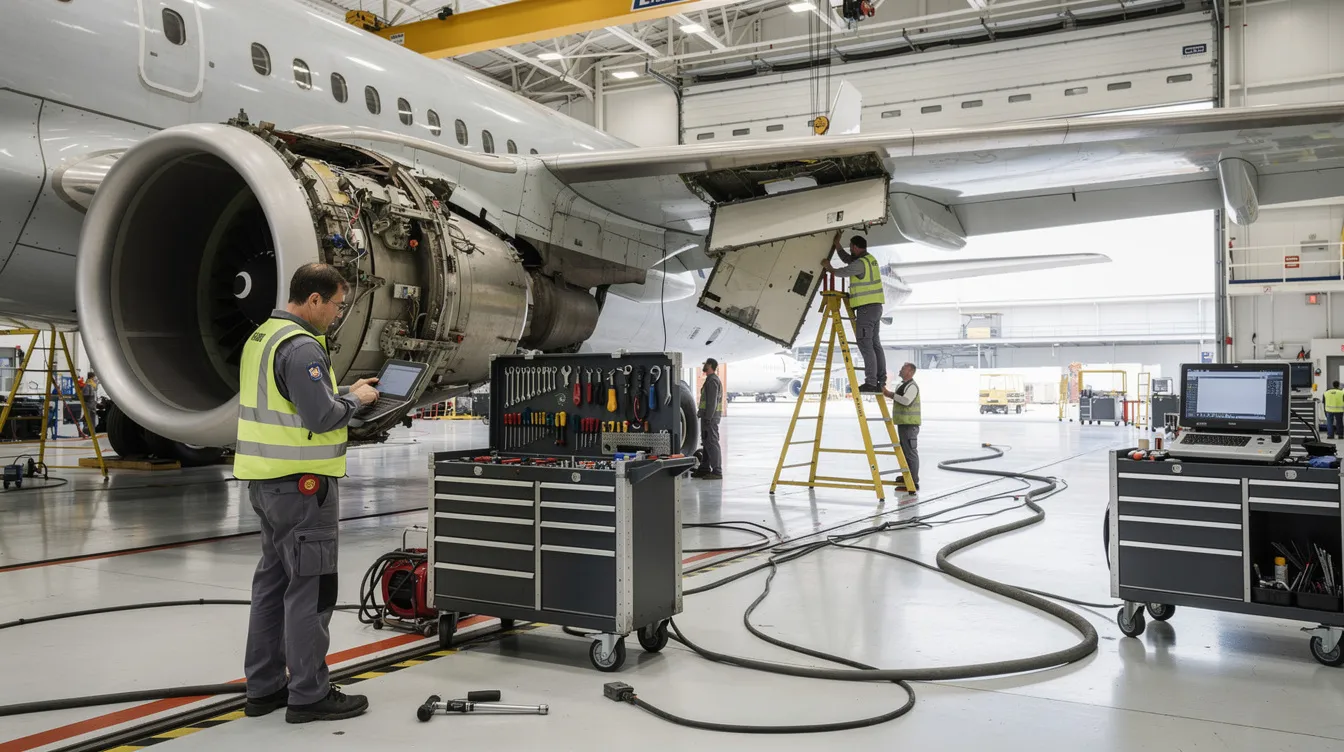
AI-based predictive maintenance can assist in optimizing maintenance schedules and predicting the remaining useful life of parts, thereby preventing failures in aviation operations. AI also plays a crucial role in risk assessment by analyzing maintenance and operational data to identify and manage potential hazards before they escalate. However, the industry faces significant challenges in implementing these AI solutions, including high investment requirements, cybersecurity risks, and operational hurdles.
The commercial aviation sector pioneered this approach. Rolls-Royce’s TotalCare program predicted 20% fewer in-flight shutdowns. Lufthansa achieved 25% fewer unscheduled removals. AI technologies are increasingly being integrated into aviation maintenance practices, allowing for real-time monitoring and predictive analytics to enhance aircraft reliability and reduce downtime. By 2020–2024, industry-wide data showed 10–20% reductions in maintenance-related delays.
Data Sources and AI Techniques
AI systems analyze massive datasets to forecast component failures, reduce flight delays, enhance cybersecurity, and streamline air traffic management, often drawing on detailed flight and turbulence route data APIs. In practice, this means:
|
Data Source |
AI Application |
Outcome |
|---|---|---|
|
Vibration sensors |
FFT analysis for anomaly detection |
Early bearing failure warning |
|
Oil debris monitors |
Pattern recognition |
Engine health trending |
|
Strain gauges |
LSTM neural networks |
Structural fatigue prediction |
|
Maintenance logs |
Random forest models |
Failure probability scoring |
For private jets, operators translate these capabilities to smaller but higher-quality data sets. A fleet of 10 Gulfstreams generates enough type-specific data to build tailored models. PRISM for Honeywell engines can predict APU failures 48 hours in advance, slashing aircraft-on-ground time from 72 hours to 12 hours. Just-in-time parts inventory, guided by AI predictions, eliminates the need to stockpile expensive components.
Safety Management and Cybersecurity
AI-powered Safety Management Systems analyze flight data to identify precursor events—minor anomalies that could signal a future accident—allowing for early intervention. AI acts as a critical safety layer by assisting pilots and monitoring system health in real time.
Key applications of AI in aviation focus on:
-
Reducing human error
-
Optimizing complex logistics
-
Identifying mechanical issues before failures occur
AI improves cybersecurity by identifying threats to airline IT systems and automates inspections of aircraft exteriors using computer vision. AI assists in analyzing data to detect precursor events to accidents and aids in risk classification. Artificial intelligence can enhance safety risk management by processing vast amounts of data to detect patterns, develop predictions, and anticipate risks.
Regulatory Oversight and Human Decision-Making
The European Union Aviation Safety Agency (EASA) published the first “Artificial Intelligence Roadmap” in 2020 to address the safety and ethical dimensions of AI development in aviation, with updates continuing through 2023. AI technology can support safety risk management by improving the capability to identify vulnerabilities, detect emerging risks, and prioritize safety issues within aviation operations.
Human engineers remain the final decision-makers. Regulatory bodies like the FAA and EASA require that predictive maintenance operates as advisory—AI flags risk, humans approve actions under DO-178C certification pathways. This oversight ensures that innovation enhances rather than undermines safety.
The development and validation of AI models in aviation also rely on the expertise of industry experts, whose insights are crucial for validating data, trends, and best practices.
Passenger Impact and Data Challenges
For passengers, fewer technical delays mean more reliable itineraries. When flights depart on schedule and without last-minute cancellations, stress drops—especially for travelers who may already be anxious or operating on tight business schedules.
The data challenge remains: integrating disparate sources from MRO providers, OEM portals, and onboard systems often proves harder than building the AI model itself. Long-term success depends on clean, consistent data capture across the entire value chain.
Customer Experience Enhancements
AI in Customer Service
In private aviation, every interaction represents an opportunity for AI to personalize and de-stress the journey. AI is enhancing customer service in aviation by providing personalized experiences, which can significantly improve customer satisfaction and retention. By leveraging AI-driven solutions, operators can better meet the needs of their customers, leading to increased satisfaction and loyalty.
AI chatbots are being utilized in airports to provide 24/7 customer assistance, helping to reduce human contact and streamline service delivery. In private aviation, natural language processing powers virtual concierges handling trip planning, catering requests, ground transfers, and last-minute changes.
These AI chatbots integrate into WhatsApp, WeChat, and other messaging platforms used by private jet clientele—Microsoft Copilot deployments at Air India demonstrate this capability at scale.
Real-Time Feedback and Personalization
The integration of AI in customer service allows for real-time feedback analytics, which can enhance service recovery and improve overall passenger experience, especially when powered by high-accuracy flight and weather data APIs.
How AI Handles Last-Minute Requests: The passenger texts about a dietary restriction 30 minutes before departure.
-
AI routes the request instantly to catering.
-
The change is confirmed, and the cabin crew is notified—all without human intervention.
Personalization engines profile passenger preferences through collaborative filtering algorithms, enabling personalized recommendations for passengers. These preferences include:
-
Seating position
-
Meal preferences
-
Cabin temperature (e.g., a client who always wants 22°C)
-
Preferred routes
-
Noise sensitivity
AI captures these details from CRM systems and automatically configures settings before each flight. IoT integration enables circadian lighting adjustments and ambient sound management tailored to individual travelers.

Reducing Flight Anxiety
For most people who experience flight anxiety, the unknown creates fear. SkyGuru addresses this directly. Using AI that fuses ADS-B data, IMU sensors, and weather feeds, the app predicts flight stages and turbulence encounters, delivering real-time explanations to passengers during flight.
“Descent initiated; expect seatbelt sign due to wind shear at 8,000 feet.” Breathing exercises cued to anticipated bumps help passengers manage physiological responses, supporting people who experience fear of flying. Beta testing showed 70% reductions in perceived anxiety—a meaningful improvement in passenger experience.
In-Cabin AI Applications
In-cabin AI applications extend beyond SkyGuru. Content recommendation engines tailor entertainment to flight length and turbulence profile (e.g., podcasts during bumpy segments when screens become hard to watch). Context-aware notifications explain unexpected sounds or maneuvers (“That thump was the landing gear extending—perfectly normal”). Ambient lighting shifts to warmer tones during rough air, reducing perceived intensity.
Combining flight operations data with passenger profiles enables proactive communication. When routing AI predicts turbulence on a particular segment, passenger-facing systems can inform travelers calmly before it happens, explaining duration and intensity. This bridges the gap between cockpit awareness and cabin understanding.
Streamlining Airport and Security Processes
AI is being adopted for secure, paperless travel, streamlining airport checkpoints from check-in to boarding through facial recognition. Artificial intelligence is streamlining passenger check-ins, security processes, and baggage handling, making air travel more efficient and convenient.
AI can assist in the detection of foreign object debris on runways and unlawful unmanned aircraft around airports, enhancing safety in airport operations.
Privacy and Ethics
Privacy and ethics demand attention. Storing sensitive passenger data—especially about anxiety levels, health conditions, or personal routines—requires robust consent management, clear data retention policies (typically 90 days), and GDPR compliance. Operators must balance personalization power with data stewardship.
In a market where aircraft types are similar, the emotional quality of the journey differentiates operators. Customer experience powered by well-designed AI systems increasingly defines which operators passengers choose. High NPS scores and 80% repeat booking rates follow from getting this right.
The Next Decade: Human–AI Collaboration in Private Aviation
Integrated AI Platforms
The siloed AI applications examined—pricing, routing, maintenance, customer experience—will increasingly converge into integrated platforms. AI applications in air traffic management can optimize flight routes, reduce flight time, and lower fuel consumption, contributing to enhanced operational efficiency. When pricing engines communicate with routing systems, and maintenance predictions inform scheduling, operators gain 20–30% greater efficiency than any single system delivers alone.
AI advancements are transforming aviation by increasing operational efficiency, reducing delays, and personalizing passenger experiences. Yet human expertise remains central. Dispatchers, pilots, maintenance engineers, and cabin crew will continue making final decisions. AI serves as a powerful recommendation engine—flagging options, quantifying trade-offs, predicting outcomes—while humans approve actions. The FAA’s AI roadmap envisions pilots approving 95% of AI route suggestions, maintaining accountability and oversight.
Likely Future Developments
Looking toward 2030–2035, several developments appear likely:
-
Semi-autonomous flight management systems with greater AI assistance
-
Expanded AI integration in air traffic management for business aviation through SESAR initiatives
-
Anticipatory passenger experience systems that predict traveler needs before boarding
-
Bio-sensor integration enabling real-time wellness monitoring and adaptive cabin environments
As flights become more predictable and explainable through AI, the psychological barrier to air travel may shrink for anxious passengers who fear flying. This represents not just better service but market expansion—reducing delays and demystifying flight through technology could bring millions of hesitant travelers into aviation.
Designing for Trust and Safety
The challenge for operators, technologists, and regulatory bodies is designing AI in the aviation industry that is transparent, explainable, and centered on human trust and safety. Systems that support rather than supplant human judgment, that explain their reasoning rather than hiding behind algorithms, and that prioritize passenger wellbeing alongside operational efficiency—these will define the next decade of innovation.
The companies that get this balance right will shape the future of private aviation, especially as AI transformation continues to influence competitive dynamics and reshape the competitive landscape within the aviation industry.
Frequently Asked Questions (FAQs)
What is AI in the aviation industry, and how is it used in private aviation?
AI in the aviation industry refers to the use of artificial intelligence technologies to optimize various aspects of aviation operations, including flight routing, maintenance, pricing, and customer experience. In private aviation, AI enhances efficiency by enabling dynamic pricing, predictive maintenance, and personalized passenger services, ultimately improving operational performance and customer satisfaction.
How does AI contribute to environmental sustainability in aviation?
AI contributes to environmental sustainability by optimizing flight trajectories and air traffic management, which reduces fuel consumption and carbon emissions. It also assists in conducting environmental impact assessments, such as analyzing noise pollution around airports and in-flight engine emissions, supporting greener aviation practices.
Can AI help reduce flight delays in private aviation?
Yes, AI-driven scheduling tools analyze real-time and historical data on weather, airport congestion, and slot availability to predict potential flight delays. This allows operators to proactively adjust schedules and routes, minimizing disruptions and improving on-time performance.
How does predictive maintenance powered by AI improve aircraft reliability?
AI-based predictive maintenance uses sensor data and advanced analytics to forecast component failures and optimize maintenance schedules. This proactive approach prevents unexpected breakdowns, reduces downtime, lowers costs, and enhances overall aircraft reliability.
In what ways is AI enhancing the customer experience for private jet travelers?
AI enhances customer experience by providing personalized services through virtual concierges, real-time feedback analytics, and in-flight turbulence forecasting. It automates last-minute requests, customizes cabin settings, and offers real-time explanations during flights, helping to reduce passenger anxiety and increase satisfaction.
Conclusion
Artificial intelligence is revolutionizing the private aviation sector by driving unprecedented efficiency, safety, and personalization. From dynamic pricing models that maximize asset utilization to flight routing AI that reduces fuel consumption and emissions, AI is reshaping operational paradigms globally. Predictive maintenance powered by real-time data analytics enhances reliability while minimizing downtime and costs. Meanwhile, AI-driven customer experience innovations—such as personalized concierge services and real-time turbulence forecasting—are transforming passenger journeys, reducing anxiety, and elevating satisfaction.
Looking ahead, the integration of AI across ground operations, crew rosters, and flight management systems promises even greater synergies and operational gains. As AI technologies mature, the aviation industry faces the dual challenge of fostering innovation while ensuring transparency, safety, and ethical stewardship. The future of private aviation lies in a harmonious human-AI collaboration that amplifies human expertise, anticipates passenger needs, and promotes sustainable practices worldwide.
By embracing AI thoughtfully, private aviation operators can unlock new competitive advantages, enhance global connectivity, and redefine what it means to fly with confidence and comfort in the years to come.
FLEET SELECTION
JET CARDS
COST ANALYSIS


How to Auditing Your Operator's Maintenance Logs
Oct 05, 2025

How to Auditing Your Operator's Maintenance Logs
Oct 05, 2025

How to Auditing Your Operator's Maintenance Logs
Oct 05, 2025
Sky Guru Weekly
The smartest private aviation intelligence in your inbox.
.svg)

